- EN


 Log in
-
- Live Auctions
- Past auctions
- More
- Kornfeld today
- The Story of Kornfeld
- Information









Mörigen 1930 - 2022 Riggisberg


1981
Acrylic on unprimed cotton
257x391 cm
Listed in the catalogue raisonné of the Franz Gertsch Archive under the number WV00049
M. Knoedler Gallery, Zurich
Louis K. Meisel Gallery, New York, acquired there by
Collection Neil Weisman, New York
Private collection, New York
Jean-Luc Daval, La Photographie. Histoire d’un Art, Paris 1982, p. 227
Dieter Ronte, Franz Gertsch, Bern 1986, mit Werkkatalog der Gemälde ab 1969, p. 133
Louis K. Meisel, Photorealism since 1980, New York 1993, p. 222
Angelika Affentranger-Kirchrath, Franz Gertsch, Die Magie des Realen, Bern 2004, p. 113/115
Reinhard Spieler unter Mitarbeit von Samuel Vitali, Franz Gertsch Retrospektive, Ostfildern-Ruit 2005, cat. no. 49, p. 254
Rainer Michael Mason, Franz Gertsch. Werkbuch 1934-2022, Rüschegg 2023, cat. no. 89
Kathleen Bühler, Arcane Beauty, in: Pol Erik Tøjner, Kirsten Degel, Drik Luckow u.A., Franz Gertsch. Blow-Up, Ausstellungskatalog zur Ausstellung im Louisiana Humlebæk und in den Deichtorhallen Hamburg, Humlebæk 2024, p. 66ff.
New York 1981, Louis K. Meisel Gallery, Franz Gertsch - Major Works
Vienna/Basel 1986, Museum Moderner Kunst/Kunsthalle Basel, Franz Gertsch
The lower right and left corners with minimal colour rubbing. With fresh colours and in impeccable overall condition
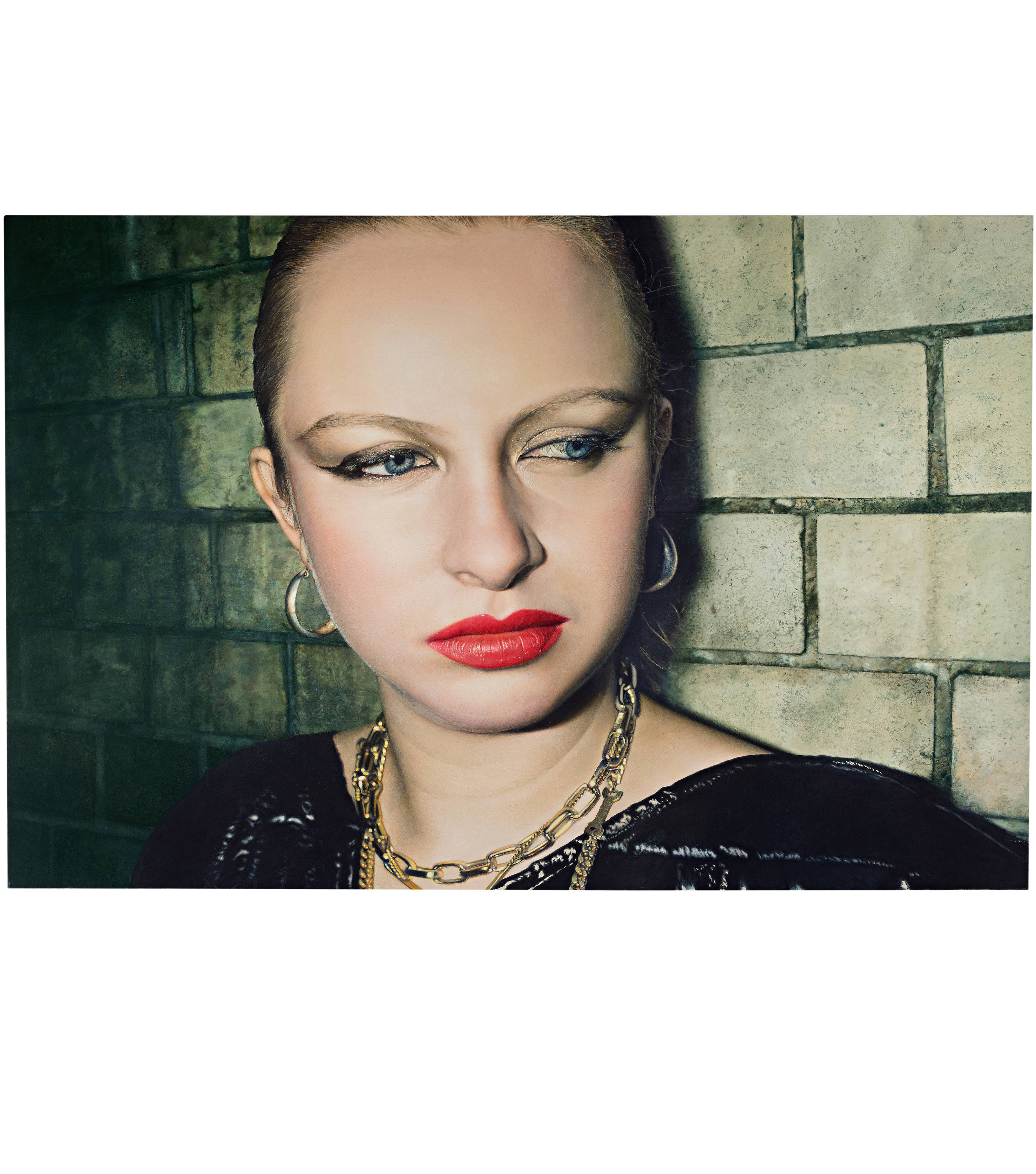
Franz Gertsch is widely regarded as one of the most important representatives of photorealism. His large-format portraits from the 1970s and 1980s reveal a radical shift towards reality, transcending mere depiction. He painstakingly transformed photographic templates into monumental acrylic paintings, transferring the original images into a new medium in a time-consuming process involving grids, layers of colour and meticulously detailed painting.
The main work of this creative phase is probably the painting 'Tabea', created in 1981. After Irène Staub (see lot 129), Tabea Blumenschein (1952-2020) was the second model for a large female portrait. The actress and artist became a central figure in Berlin's underground and queer film culture from the mid-1970s onwards. Her collaboration with filmmaker Ulrike Ottinger was particularly influential. Apparently, it was the Swiss exhibition organiser Harald Szeemann who drew Franz Gertsch's attention to Blumenschein after seeing Ottinger's film 'Bildnis einer Trinkerin' (1979) featuring the actress. The artist Luciano Castelli then took Gertsch to a restaurant in Berlin where Blumenschein was spending the evening. There, Gertsch was able to take a photograph of the actress in front of a brick wall. The photo shows a slightly irritated, distant, somewhat annoyed Blumenschein, who deliberately does not look into the camera. In contrast to the other female portraits, which feature neutral backgrounds and restrained clothing, 'Tabea' has a fully developed background, with the brick wall set in a dramatic play of light and shadow. The striking makeup and the opulent gold jewellery are unique among all of Gertsch's other large portraits. In 1981, Gertsch also created a coloured lithograph (Mason 1991, no. 2) and a gouache on paper ('Tabea III') with the same model.
At first glance, the depiction appears astonishingly photographic in its precision. Yet Gertsch's unique painting style reveals itself in subtle surface tensions, the finest colour modulations and a peculiar condensation of the moment. Time seems to stand still in the image. The photorealistic technique creates a striking presence, yet the work remains open, challenging the viewer's gaze without revealing itself.
Gertsch succeeds impressively in combining the apparent objectivity of photography with the subjectivity of painterly perception. In 'Tabea', depiction and art form, reality and imagination merge. It is this unique tension that gives his portraits a lasting, almost meditative effect. The painting was in a private collection in the USA for many years and has not been exhibited since. Its return to the market after such a long time is a sensation. The painting is regarded as one of the major works by this important Swiss artist.
We thank the Gertsch family for their valuable information regarding this work.
1981
Acryl auf ungrundierter Baumwolle
257x391 cm
Im Werkverzeichnis des Archivs Franz Gertsch unter der Nummer WV00049 eingereiht
M. Knoedler Gallery, Zürich
Louis K. Meisel Gallery, New York, dort erworben von
Slg. Neil Weisman, New York
Privatsammlung, New York
Jean-Luc Daval, La Photographie. Histoire d’un Art, Paris 1982,
Dieter Ronte, Franz Gertsch, Bern 1986, mit Werkkatalog der Gemälde ab 1969,
Louis K. Meisel, Photorealism since 1980, New York 1993,
Angelika Affentranger-Kirchrath, Franz Gertsch, Die Magie des Realen, Bern 2004,
Reinhard Spieler unter Mitarbeit von Samuel Vitali, Franz Gertsch Retrospektive, Ostfildern-Ruit 2005,
Rainer Michael Mason, Franz Gertsch. Werkbuch 1934-2022, Rüschegg 2023,
Kathleen Bühler, Arcane Beauty, in: Pol Erik Tøjner, Kirsten Degel, Drik Luckow u.a., Franz Gertsch. Blow-Up, Ausstellungskatalog zur Ausstellung im Louisiana Humlebæk und in den Deichtorhallen Hamburg, Humlebæk 2024, S. 66ff.
New York 1981, Louis K. Meisel Gallery, Franz Gertsch - Major Works
Wien/Basel 1986, Museum Moderner Kunst/Kunsthalle Basel, Franz Gertsch
Die untere rechte und linke Ecke mit minimen Farbabreibungen. Farbfrisch und in tadellosem Gesamtzustand
Franz Gertsch zählt zu den bedeutendsten Vertretern des Fotorealismus. Seine grossformatigen Porträts aus den 1970er- und 1980er-Jahren zeichnen sich durch eine radikale Hinwendung zur Wirklichkeit aus, die zugleich über das blosse Abbild hinausweist. Mit Akribie übertrug er fotografische Vorlagen in monumentale Acrylgemälde, wobei er die ursprünglichen Bilder in einem zeitintensiven Prozess durch Rasterungen, Farbschichtungen und detailgenaue Malerei in ein neues Medium transformierte.
Das Hauptwerk dieser Schaffensphase ist wohl das 1981 entstandene Gemälde "Tabea". Nach Irène Staub (vgl. Los 129) war Tabea Blumenschein (1952-2020) das zweite Modell für ein grosses Frauenporträt. Die Schauspielerin und Künstlerin wurde ab Mitte der 1970er-Jahre zu einer zentralen Figur der Berliner Underground- und queeren Filmkultur. Besonders prägend war ihre Zusammenarbeit mit der Filmemacherin Ulrike Ottinger. Es war anscheinend der Schweizer Ausstellungsmacher Harald Szeemann, der Franz Gertsch auf Blumenschein aufmerksam machte, nachdem er Ottingers Film "Bildnis einer Trinkerin" (1979) mit der Schauspielerin gesehen hatte. Der Künstler Luciano Castelli führte Gertsch dann in Berlin zu jenem Restaurant, in dem Blumenschein den Abend verbrachte. Dort konnte Gertsch eine Fotografie der Schauspielerin vor einer Backsteinwand machen. Das Foto zeigt eine leicht irritierte, distanzierte, fast ein wenig genervte Blumenschein, die bewusst nicht in die Kamera schaut. Im Gegensatz zu den anderen Frauenporträts, die vor einem neutralen Hintergrund und in zurückhaltender Kleidung geschaffen wurden, ist der Hintergrund bei "Tabea" voll ausgestaltet und die Backsteinwand liegt in einem spannenden Licht-Schatten-Spiel. Die auffällige Schminke und der opulente Goldschmuck sind einmalig für alle anderen grossen Porträts von Gertsch. Gertsch schuf 1981 noch eine farbige Lithographie (Mason 1991, Nr. 2) und eine Gouache auf Papier ("Tabea III") mit demselben Modell.
Die Darstellung wirkt auf den ersten Blick verblüffend fotografisch exakt. Doch Gertschs Malweise enthüllt sich in subtilen Oberflächenspannungen, feinsten Farbmodulationen und einer eigentümlichen Verdichtung des Moments. Die Zeit scheint im Bild förmlich stillzustehen. Die fotorealistische Technik erzeugt eine frappierende Präsenz, doch das Werk bleibt offen und fordert den Blick heraus, ohne sich preiszugeben.
Gertsch gelingt es eindrücklich, die scheinbare Objektivität der Fotografie mit der Subjektivität malerischer Wahrnehmung zu verbinden. In "Tabea" verschmelzen Abbild und Kunstform, Realität und Imagination. Es ist diese einzigartige Spannung, die seinen Porträts eine nachhaltige, fast meditative Wirkung verleiht. Das Gemälde befand sich viele Jahre lang in einer Privatsammlung in den USA und wurde nicht mehr ausgestellt. Dass es nun nach langer Zeit wieder auf den Markt kommt, ist eine Sensation. Das Gemälde gilt als eines der Hauptwerke des wichtigen Schweizer Künstlers.
Wir danken der Familie Gertsch für die wertvollen Hinweise zu diesem Werk.
| Switzerland | CHF | Individual offer |
| Europe | CHF | Individual offer |
| USA | CHF | Individual offer |
| Overseas | CHF | Individual offer |