- EN


 Log in
-
- Live Auctions
- Past auctions
- More
- Gallery
- Art Dealing
- Publishing
- Kornfeld today
- The Story of Kornfeld
- Information


Note: The image cannot be displayed for legal reasons. For more information, see the PDF of the catalogue: Link to PDF






Leitmeritz 1877 - 1959 Zwickledt



Circa 1900
Pen and India ink, partly lightly washed, on sprayed ground, on cadastral paper
30.6x18.5 cm, borderline, 39.5x21.5 cm, sheet size
Signed "A Kubin" in pencil by the artist lower right, marked "Variété" by another hand on the left
Cf. Paul Raabe, Alfred Kubin, Leben, Werk, Wirkung, Hamburg 1957, no. 40
Probably Collection Otto Wilhelm Gauss, Munich
The Eberhard W. Kornfeld Collection, with the collector's stamp on the reverse, Lugt 913b
Hermann Esswein, Alfred Kubin, Der Künstler und sein Werk, Munich 1911, ill. tf. 16
Christoph Brockhaus, Rezeptions- und Stilpluralismus, Zur Bildgestaltung in Alfred Kubins Roman "Die andere Seite", Pantheon XXXII. vol. 1974, H. III, p. 279, ill. 10
Baden-Baden/Munich/Vienna 1977, Staatliche Kunsthalle/Bayerische Akademie der Schönen Künste/Graphische Sammlung Albertina, Alfred Kubin, Das zeichnerische Frühwerk bis 1904, cat. no. 15
Winterthur 1986, Kunstmuseum, Alfred Kubin, ill. p. 59
Bern 1989, Kunstmuseum, Von Goya bis Tinguely, Aquarelle und Zeichnungen aus einer Privatsammlung [Slg. Eberhard W. Kornfeld], cat. no. 57, ill. p. 113
Bern 2013, Zentrum Paul Klee, Satire – Ironie – Groteske, Daumier, Ensor, Feininger, Klee, Kubin
Ingelheim 2015, International Days, Kunstforum - Altes Rathaus, Lyonel Feininger/Alfred Kubin. Eine Künstlerfreundschaft, ill. p. 71 (mirror-inverted)
Isolated tear nail holes to the left edge of the sheet. A small tear in the centre of the lower edge. The sheet with studio traces and slight soiling, especially in the outer margins. The image in particularly good condition
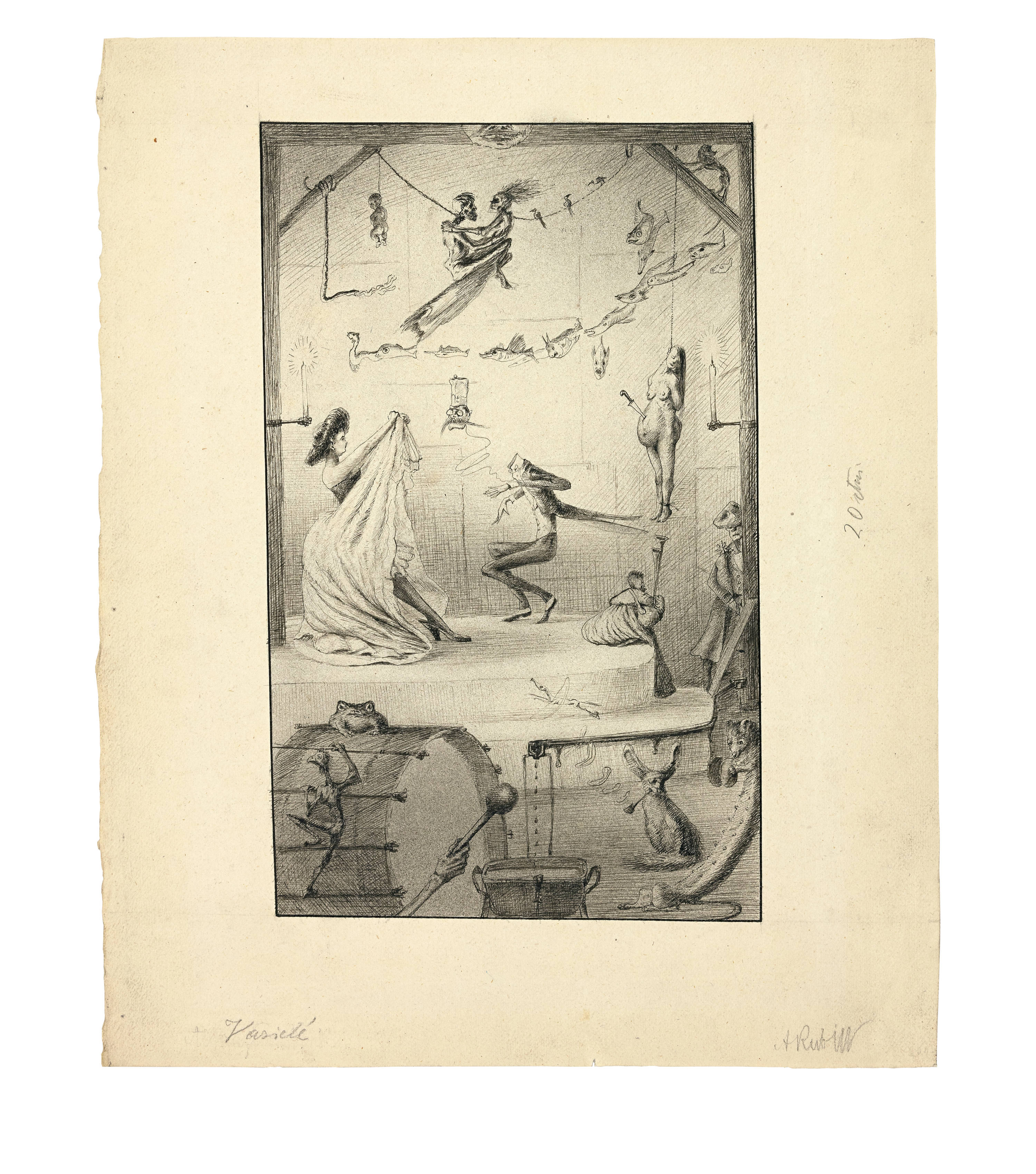
Alfred Kubin's works are characterised by the depiction of fantastic dream visions. His works from the turn of the century are dominated by dark, whimsical fantasies, which he created as ink drawings using a special technique with carefully sprayed and washed areas on the often-used cadastral paper. His dark visions show the human abyss, and in doing so, deal with power and helplessness, torture, agony, sexual fear and obsession or illness. They are blunt insights into people's instincts and fears that aroused both admiration and outrage, and soon made his works coveted objects of scandal. Kubin usually concentrated on the image of a scene in a diffuse, empty space.
The work offered here is entitled "Alltagsmusik", but what is shown is anything but everyday: a dancer reveals a glimpse under her skirts, which immediately tears the head off the conductor of the entire scene. All sorts of monstrous things happen around the stage with the protagonists. Klaus Albrecht Schröder wrote in the 2008 exhibition catalogue "Alfred Kubin: Zeichnungen 1897-1909" that Kubin knew of no dominance-free zone between the sexes, and that fear and depression were fundamental to the relationships of the figures depicted. "Alltagsmusik" is reminiscent of the writings of the Marquis de Sade (Donatien Alphonse François Comte de Sade, 1740-1814), whose violent pornographic works continued to have an impact well into the 20th century and also helped to shape certain trends in surrealism. The proto-surrealist Kubin probably also used de Sade as a source of inspiration for his literary and pictorial works. It is interesting to note that Kubin probably also modelled his iconography on the pictorial worlds of Hieronymus Bosch, as can be seen in the multi-figure drawing "Alltagsmusik". The sheet is a tremendously diverse and richly elaborated drawing.
Um 1900
Tuschfeder, teilweise leicht laviert, auf gespritztem Grund, auf Katasterpapier
30,6x18,5 cm, Einfassungslinie, 39,5x21,5 cm, Blattgrösse
Unten rechts vom Künstler in Bleistift signiert "A Kubin", von anderer Hand links bezeichnet "Variété"
Vgl. Paul Raabe, Alfred Kubin, Leben, Werk, Wirkung, Hamburg 1957,
Wohl Slg. Otto Wilhelm Gauss, München
Slg. Eberhard W. Kornfeld, Bern, rückseitig mit dem Sammlerstempel, Lugt 913b
Hermann Esswein, Alfred Kubin, Der Künstler und sein Werk, München 1911, Abb. Tf. 16
Christoph Brockhaus, Rezeptions- und Stilpluralismus, Zur Bildgestaltung in Alfred Kubins Roman "Die andere Seite", Pantheon XXXII. Jg., 1974, H. III,
Baden-Baden/München/Wien 1977, Staatliche Kunsthalle/Bayerische Akademie der Schönen Künste/Graphische Sammlung Albertina, Alfred Kubin, Das zeichnerische Frühwerk bis 1904,
Winterthur 1986, Kunstmuseum, Alfred Kubin,
Bern 1989, Kunstmuseum, Von Goya bis Tinguely, Aquarelle und Zeichnungen aus einer Privatsammlung [Slg. Eberhard W. Kornfeld],
Bern 2013, Zentrum Paul Klee, Satire – Ironie – Groteske, Daumier, Ensor, Feininger, Klee, Kubin
Ingelheim 2015, Internationale Tage, Kunstforum - Altes Rathaus, Lyonel Feininger/Alfred Kubin. Eine Künstlerfreundschaft,
Vereinzelte Reissnagellöcher an der linken Blattkante. An der Unterkante in der Mitte mit einem kleinen Einriss. Das Blatt mit Atelierspuren und leichten Verschmutzungen vor allem an den Aussenrändern. Die Darstellung in besonders schöner Erhaltung
Alfred Kubins Werke sind durch die Darstellung fantastischer Traumvisionen geprägt. In seinen um die Jahrhundertwende entstandenen Arbeiten herrschen düster-skurrile Fantasien vor, die er als Tuschezeichnungen in einer speziellen Technik mit sorgfältig gespritzten und lavierten Partien auf das oft verwendete Katasterpapier brachte. Seine düsteren Visionen zeigen die menschlichen Abgründe, es geht dabei um Macht und Ausgeliefertsein, um Folter, Qual, sexuelle Angst- und Zwangsvorstellungen oder Krankheit. Es sind unverblümte Einsichten in die Triebe und Ängste der Menschen, deren schonungslose Offenlegung Bewunderung und Empörung weckte, und die seine Werke schon bald zu begehrten Skandalobjekten werden liessen. Meist konzentrierte sich Kubin auf die Darstellung einer Szene in einem diffus-leeren Raum.
Das hier angebotene Blatt trägt den Titel "Alltagsmusik", was jedoch gezeigt wird, ist alles andere als alltäglich: Eine Tänzerin offenbart Einblick unter ihre Rockschösse, was dem Dirigenten der ganzen Szene gleich den Kopf abreisst. Rund um die Bühne mit den Protagonisten geschieht allerlei Ungeheuerliches. Klaus Albrecht Schröder schrieb im Ausstellungskatalog "Alfred Kubin: Zeichnungen 1897-1909" von 2008, dass Kubin keine dominanzfreie Zone zwischen den Geschlechtern kenne, und Angst und Depression grundlegend für die Beziehungen der dargestellten Figuren sei. "Alltagsmusik" erinnert an die Schriften des Marquis de Sade (Donatien Alphonse François Comte de Sade, 1740-1814), dessen gewaltpornographischen Werke noch weit bis in das 20. Jahrhundert wirkten und etwa gewisse Strömungen im Surrealismus mitprägen sollten. So wird wohl auch der Protosurrealist Kubin de Sade als Inspirationsquelle seiner literarischen und bildnerischen Werke genutzt haben. Spannend ist, dass sich Kubin ikonographisch wohl auch an die Bildwelten von Hieronymus Bosch angelehnt hat, wie man in der mehrfigurigen Zeichnung "Alltagsmusik" schön sehen kann. Das Blatt ist eine im wahrsten Sinne des Wortes "ungeheuer" vielfältige und reich ausgearbeitete Zeichnung im Œuvre des Meisters.
| Switzerland | CHF | 130 |
| Europe | CHF | 200 |
| USA | CHF | 250 |
| Overseas | CHF | 255 |
Note: The image cannot be displayed for legal reasons. For more information, see the PDF of the catalogue: Link to PDF