- EN

 Log in
-
- Live Auctions
- Past auctions
- More
- Kornfeld today
- The Story of Kornfeld
- Information
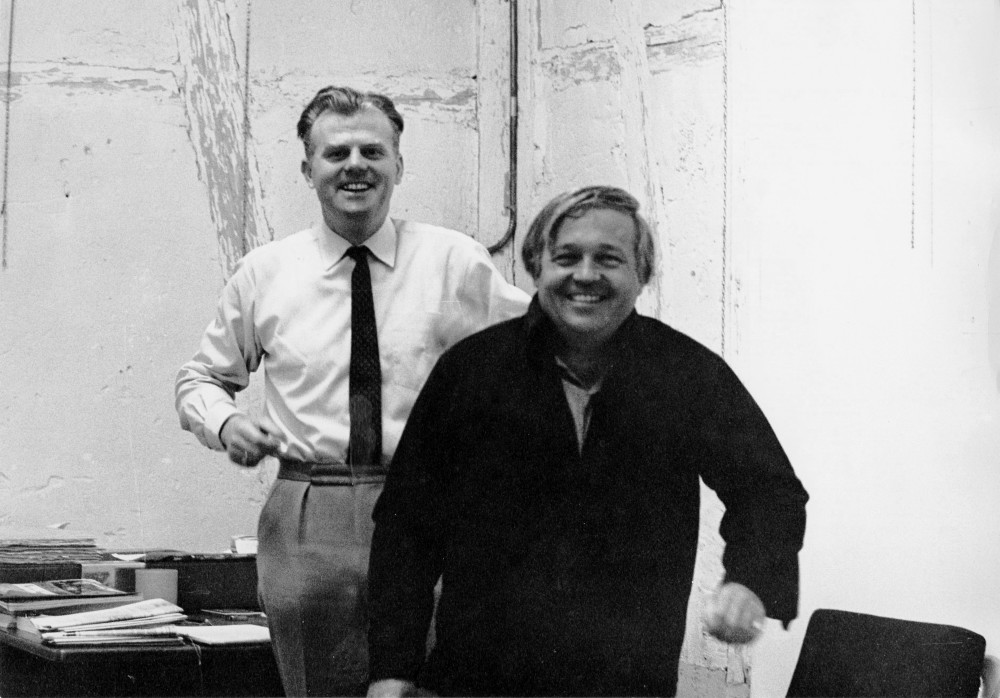
In 1945, after several years of military service during the Second World War, Eberhard W. Kornfeld began his career as a trainee with art dealer August Klipstein. Later, he became a sort of ‘mini partner’, as he would jokingly call it. Initially, Kornfeld focused on Old Master prints and classic modernism, but broadened his approach when the art historian Arnold Rüdlinger became director of the Kunsthalle Bern in 1946. Rüdlinger established an ambitious programme featuring contemporary art from Paris and the USA, which awakened Kornfeld’s interest in the field. Rüdlinger was born in 1919 and was therefore only slightly older than Kornfeld. He became a constant companion and mediator, introducing Kornfeld to contemporary artists with whom he had not previously been acquainted. Kornfeld immersed himself in the scene shaped by Rüdlinger, and he soon began to organise exhibitions with contemporary artists in his own gallery.
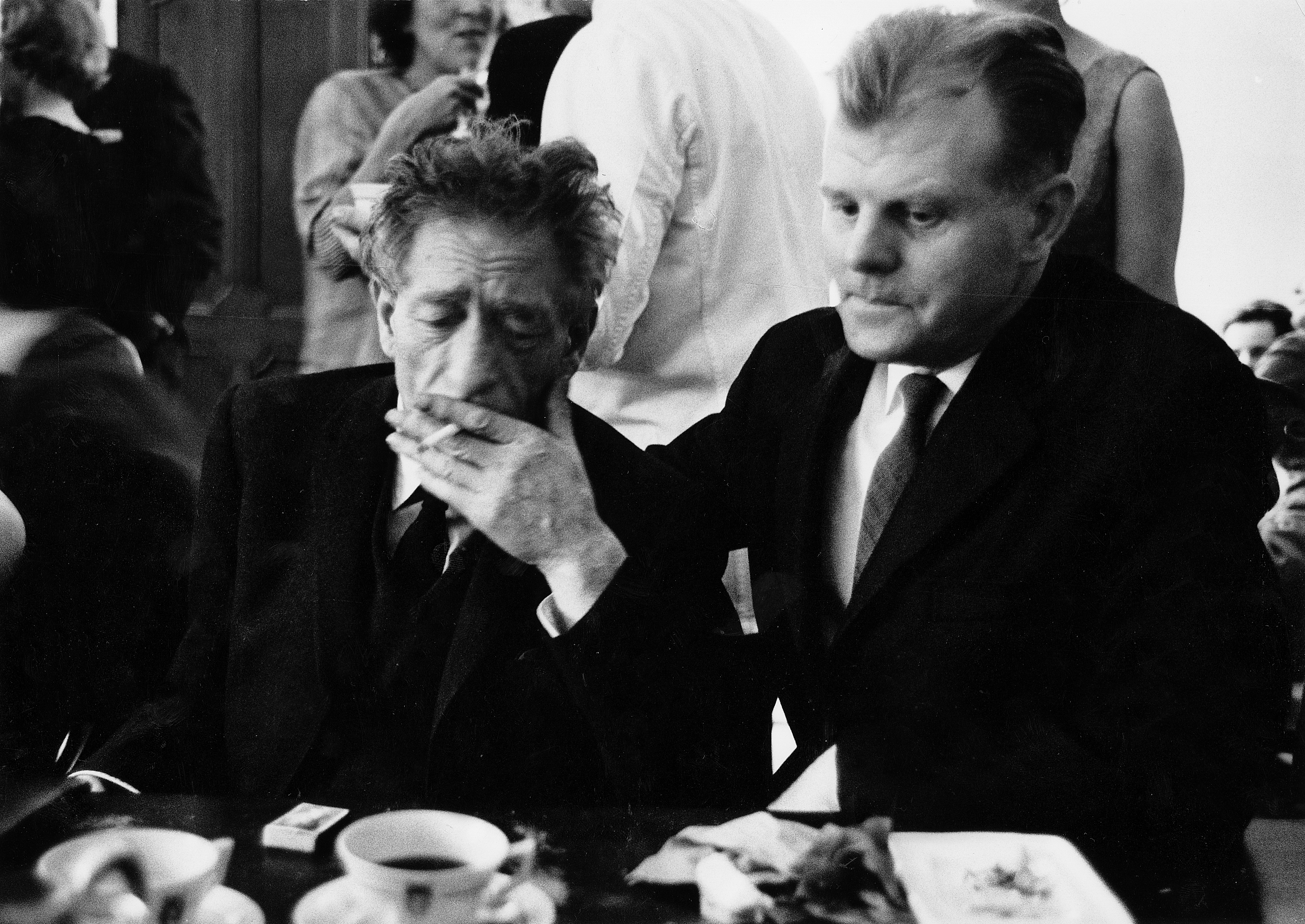
It was at the Kunsthalle Bern in 1948 that Kornfeld first met the sculptor and painter Alberto Giacometti. Born in the Bregaglia Valley, Giacometti was a good 20 years older than Kornfeld. This initial meeting developed into a close and long-standing friendship. Kornfeld regularly visited Giacometti in Paris, as well as during the artist’s stays in Stampa or Maloja. He was given the privilege of purchasing works directly from Giacometti’s studio, albeit drawings and prints only. Five pencil drawings Giacometti made of Kornfeld in 1959 are testament to their mutual appreciation. Four of these drawings were acquired by the Kornfeld collection, while the artist kept the fifth for himself. Their friendship also led to the idea of an exhibition at Klipstein & Kornfeld, which was successfully executed in the summer of 1959. The cover of the exhibition catalogue featured the title page of the 11 April 1959 ‘Figaro Littéraire’ that Giacometti had adorned with ballpoint pen drawings while in a Paris café – one of the artist’s many spontaneous graphic interventions so typical of him (see lot 28).
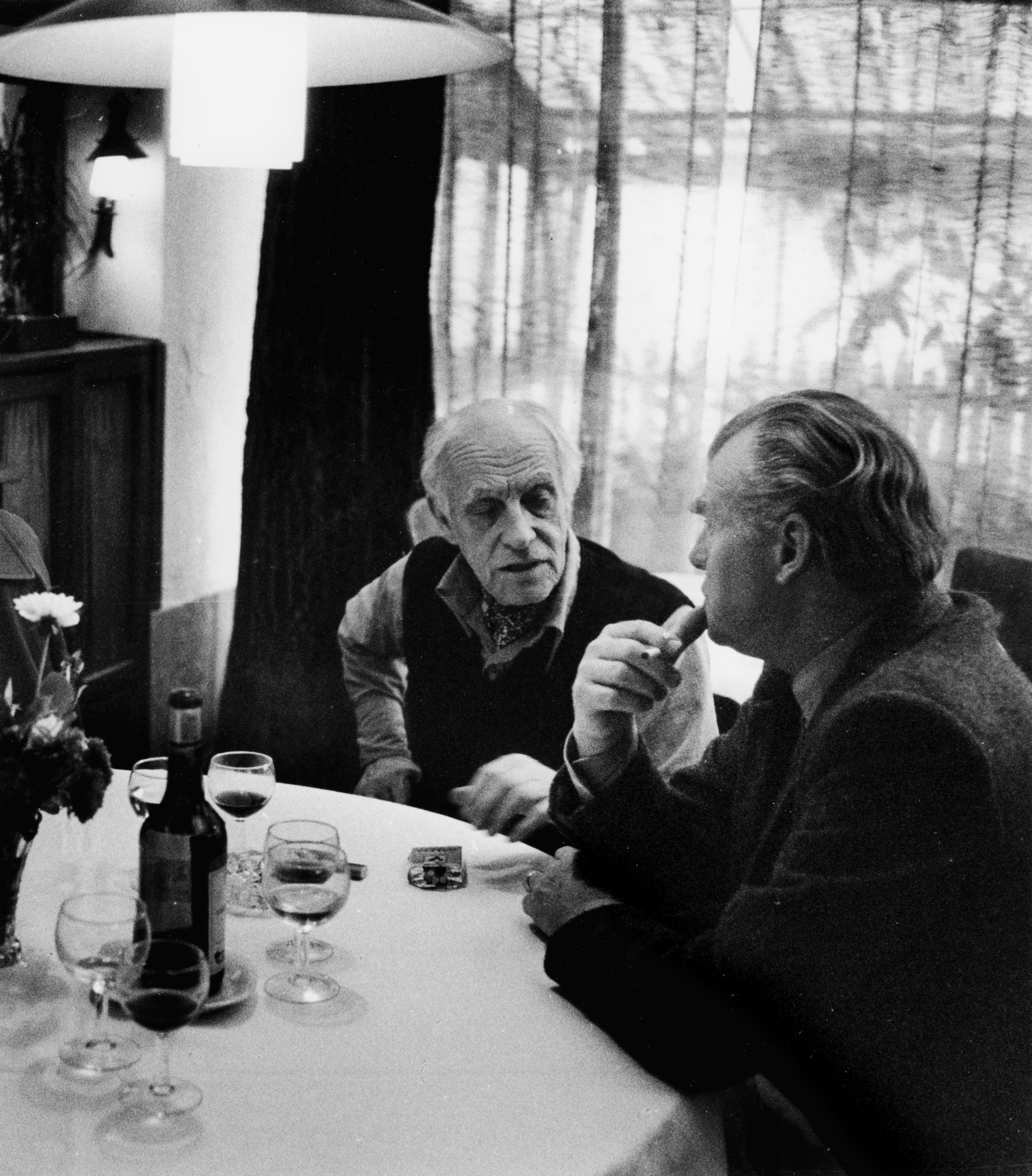
Early on, in Alberto’s studio, Kornfeld met Diego Giacometti, Alberto’s brother. Diego initially worked as a studio assistant and also served as Alberto’s most important model. It was not until his brother’s death in 1966 that Diego fully developed his own artistic style and began to realise his own furniture designs with increasing independence. Kornfeld also maintained close ties with Diego. He regularly travelled to Paris to visit him, dined with him at his favourite restaurant, ‘Clos du Moulin’, and, over many years, acquired works and objects for his own use; first for his flat in the old town of Bern, then for his holiday home in Randogne, and finally for the ‘Rothaus’ in Bolligen.
In 1955, Rüdlinger showed Sam Francis’ works for the first time at the Kunsthalle Bern as part of the exhibition ‘Tendances actuelles de l’École de Paris III’. The previous year, in Paris, he had introduced Francis to Kornfeld. This encounter soon developed into a close friendship, and in 1957, Kornfeld organised Francis’ first solo show, followed by many more. Kornfeld became the American artist’s most important gallerist in Europe and played a crucial role in his international career. At the same time, Francis was one of Kornfeld’s closest friends within the art scene. Not only did Francis become the godfather to Kornfeld’s daughter, Patricia, but the two friends also regularly travelled to the USA or Japan together. At Kornfeld’s suggestion, Francis learnt the technique of colour lithography from Emil Matthieu in Zurich. This resulted in many significant prints, such as ‘White Line’ (see catalogue 292).
Further relationships were established with artists from the Parisian avant-garde and Sam Francis’ circle of friends, including Shirley Goldfarb, Al Jensen (see lots 34,35), Joan Mitchell, Jean-Paul Riopelle (see lot 44), Kimber Smith and Walasse Ting (see catalogue 292). These connections manifested themselves in personal friendships, as well as exhibitions, editions and the publication of prints.
The first personal encounters with Marc Chagall came about through the mediation of Franz Meyer, who was married to Chagall’s daughter, Ida. When Meyer succeeded Rüdlinger as director of the Kunsthalle Bern in 1955, he introduced the artist to Kornfeld. The two men established a friendly relationship during Chagall’s visits to Bern, and the artist soon invited Kornfeld to Vence. Chagall eventually entrusted Kornfeld with creating the catalogue raisonné of his etchings and woodcuts; a sign of great esteem and mutual trust.
Kornfeld only got to know Picasso in the late 1960s, at the Madoura workshop in Vallauris. Picasso, a great admirer of Rembrandt, was already familiar with Kornfeld through his publications on printmaking and thus spontaneously invited him to visit. ‘Kornfeld, c’est pour la gravure’, Picasso is quoted as saying. It is therefore no surprise that this encounter gave rise to the idea of systematically cataloguing Picasso’s body of graphic works. The culmination of this significant project was the seven-volume publication ‘Picasso Peintre-Graveur’, which was published by the Kornfeld publishing house between 1986 and 1996. It remains the definitive publication on Picasso’s prints to this day.
As early as the final weeks of his active military service, Kornfeld met one of his oldest friends: the machine-gunner Jean Tinguely. This military camaraderie turned into a lifelong friendship. Kornfeld even became a member of the legendary ‘Kuttlebutzer’ Basel carnival troupe, for which Tinguely repeatedly created spectacular costumes and props (see catalogue 292, Stadtindianer). Tinguely also introduced Kornfeld to artists from the Nouveaux Réalistes movement, so that Tinguely’s wife, Niki de Saint Phalle, and Bernhard Luginbühl also belonged to Kornfeld’s inner circle. They both regularly exhibited at his gallery. A notable event in their friendship was the happening ‘St. Barbara Schiessen’ that Tinguely organised in collaboration with the Luginbühl family on the gallery premises on 4 December 1972. During this event, 27 homemade cannons were fired into the Bernese sky. The close bond with Tinguely and Niki de Saint Phalle continued beyond their deaths: Kornfeld was assigned the task of cataloguing their estates.
However, Kornfeld not only maintained contacts with international artists. He was also deeply rooted in the local art scene and was close friends with many regional artists, regularly exhibiting works by Kurt Blum, Hansjürg Brunner, Franz Fedier, Hans Fischer, Moehsnang, André Thomkins and Otto Tschumi at his gallery. Later, artists including Franz Gertsch, Alois Lichtsteiner, Rolf Iseli, Daniel de Quervain and Teruko Yokoi joined his roster. In addition to his work as a gallerist, during which he realised more than 200 exhibitions, Kornfeld was also a prolific publisher of prints and editions.
Eberhard W. Kornfeld was a passionate patron of the arts and a great humanitarian. During his long tenure as President of the Swiss Art Trading Association from 1959 to 1996, he staunchly advocated for the interests of artists and the art trade. He always treated artists with great respect, supporting many of them by purchasing works directly from their studios or exhibitions. Kornfeld was always fully aware that the art trade was ultimately only possible thanks to the creativity and effort of these extraordinary individuals. This special catalogue is dedicated to the numerous friendships Eberhard W. Kornfeld cultivated with artists throughout his life, ranging from close and casual, and spanning both local and international circles. The works brought together here were displayed in his private rooms and bear witness to his personal interests, his passion for collecting and his deep connection with artists of his time. Most of the works were acquired directly from the studios or during exhibitions.
Once again, we would like to extend our heartfelt thanks to the Kornfeld family for the trust they have placed in our company – a company Ebi played a decisive role in shaping during his stewardship of more than seventy years.
Online Kataloge