- EN


 Log in
-
- Live Auctions
- Past auctions
- More
- Kornfeld today
- The Story of Kornfeld
- Information




Witebsk 1887 - 1985 Saint-Paul-de-Vence


1953
Oil, tempera, sand and sawdust on canvas
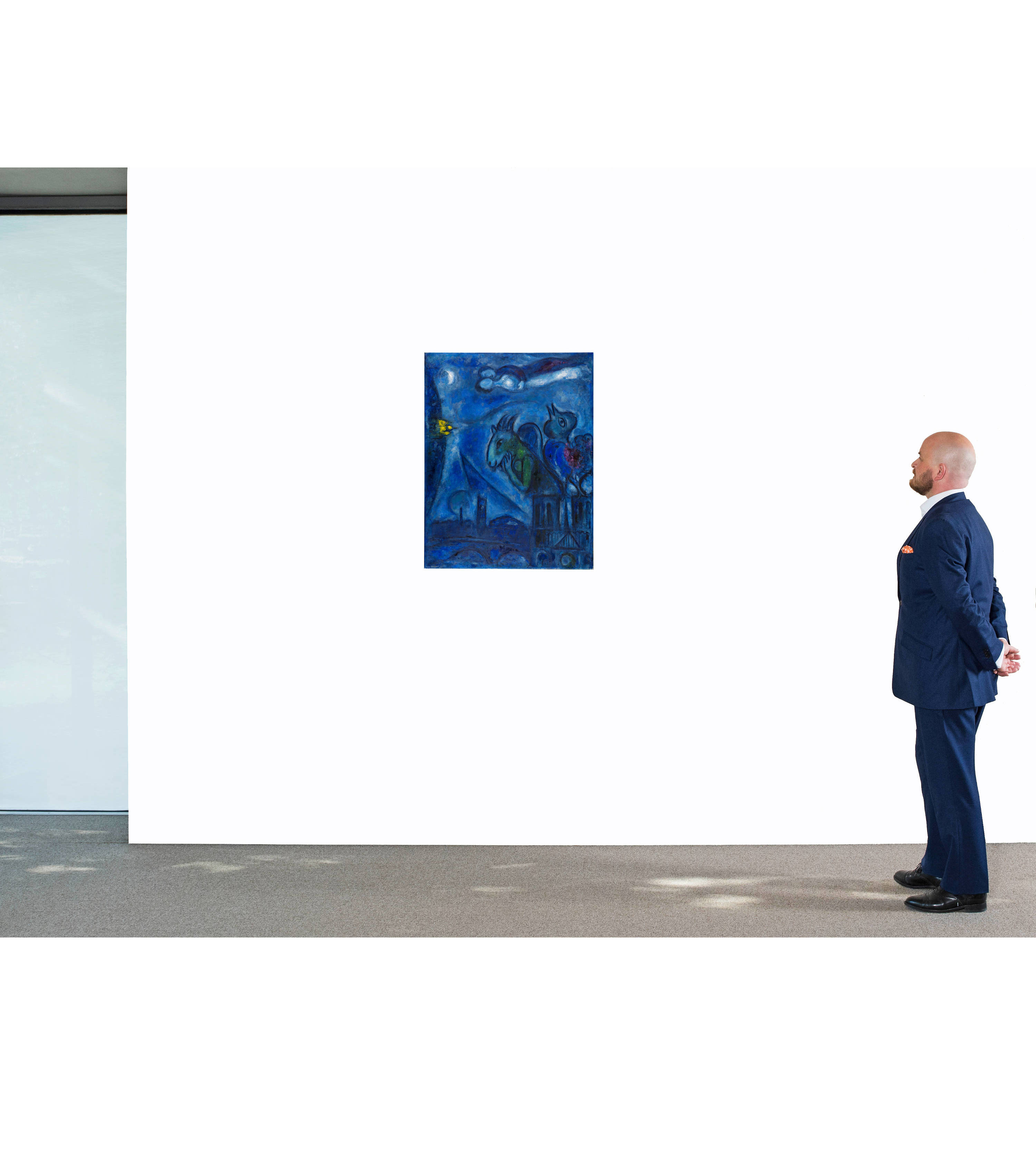
106.4x83.7 cm
Lower left signed and dated by the artist "Marc Chagall 953"
With confirmation of authenticity (no. 2026082) from the Comité Marc Chagall, Paris, dated 27 April 2026
Estate of Marc Chagall, from there to
International private collection
Franz Meyer, Marc Chagall, Paris 1964, p. 891
Itzhak Goldberg, Chagall, Paris 2019, p. 289, 268
Paris 1954, Galerie Maeght, Marc Chagall, cat. no. 3
Basel 1956, Kunsthalle, Marc Chagall, Werke aus den letzten 25 Jahren, cat. no. 67
Bern 1956, Kunsthalle, Marc Chagall, 1950-1956, cat. no. 27
Saragossa 1998, Centro de exposiciones y congresos, Marc Chagall, Pinturas alrededor de la serie de París, gouaches y aguadas, esculturas y litografías, cat. no. 57
Johannesburg 2000, Standard Bank Gallery, Marc Chagall, The Light of Origins, La lumière des origines, cat. no. 43
Nice 2001, Musée national Message Biblique Marc Chagall, Marc Chagall, Paysages, without cat.
Paris 2003, Grand Palais/Museum of Modern Art, Chagall, connu et inconnu, cat. no. 140
San Francisco 2003, Museum of Modern Art, Chagall, cat. 105
Turin 2004, Marc Chagall, Galleria d'Arte Moderna, Marc Chagall, Un maestro del '900, cat. no. 100
Seoul/Busan 2004, Museum of Art/Metropolitan Art Museum, Chagall, Magician of Color, p. 93
Ishøj 2006, Arken Museum of Modern Art, Chagall's World of Love, without cat.
Baden-Baden 2006, Museum Frieder Burda, Chagall in neuem Licht, cat. no. 175
Rome 2007, Complesso del Vittoriano, Chagall delle meraviglie, p. 233
Martigny 2007, Fondation Pierre Gianadda, Chagall, Entre ciel et terre, cat. no. 157
Zagreb 2007/2008, Galerija Klovićevi dvori, Marc Chagall, Priča nad pričama, without cat.
Nice/Rome/Verona/San Sebastian 2010/2011, Musée national Marc Chagall/Museo dell'Ara Pacis/Galleria d'arte moderna Palazzo Forti/Sala Kubo-Kutxa, Sens dessus dessous, le monde renversé de Marc Chagall, cat. no. 53
Madrid 2012, Thyssen-Bornemisza Museo Nacional, Chagall, cat. no. 77
Paris/Budapest 2013/2014 Musée du Luxembourg/Magyar Nemzeti Galeria, Chagall, Entre guerre et paix, cat. no. 84
Rouen 2014, Musée des Beaux-Arts, Cathédrales, 1789-1914, un mythe moderne, cat. no. 101
Milan/Brussels 2015, Palazzo Reale/Musées Royaux des Beaux-Arts de Belgique, Marc Chagall, Rétrospective 1908-1985, p. 227
Rovigo 2020, Palazzo Roverella, Anche la mia Russia mi amerà, cat. no. 80
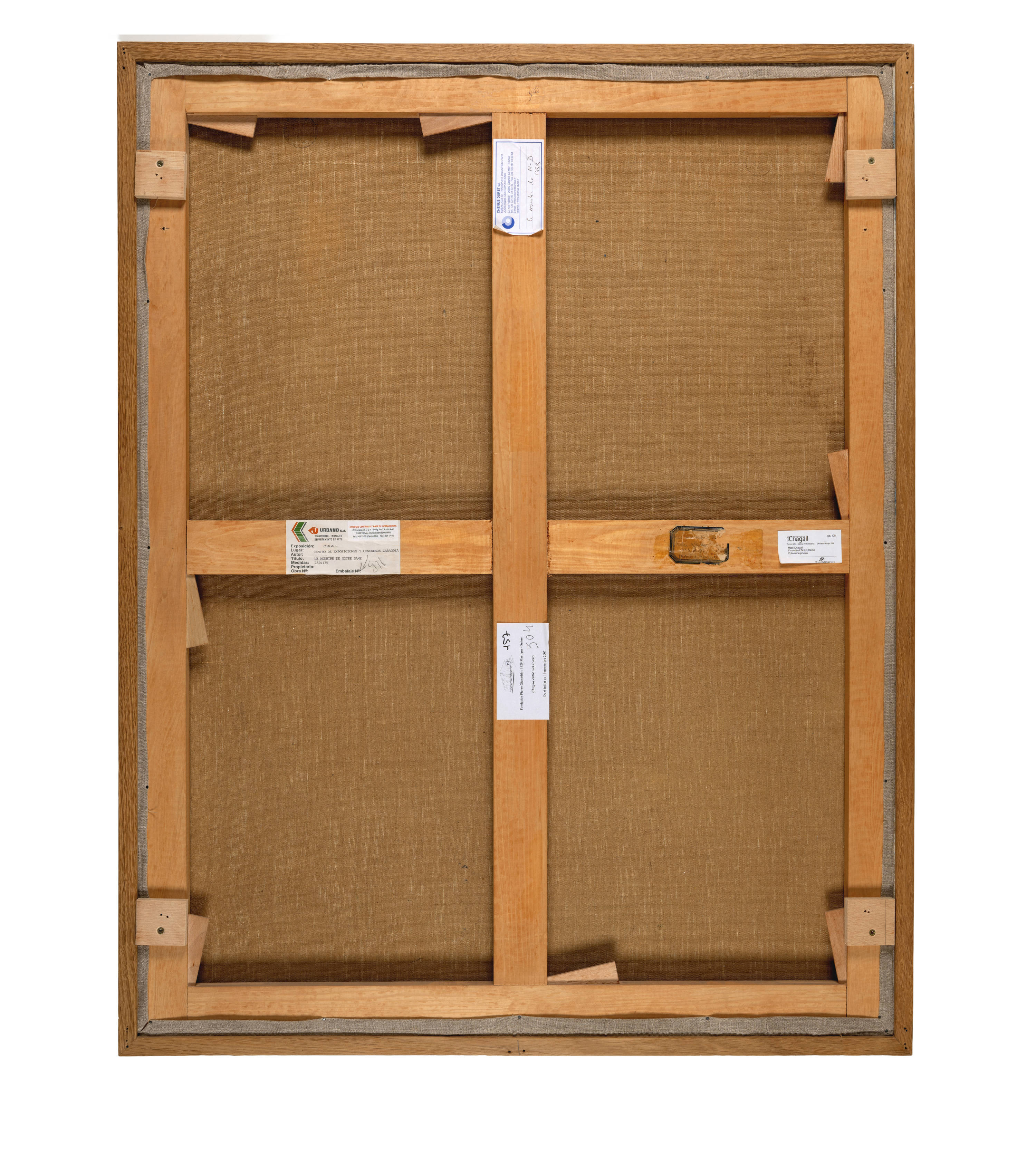
Mounted on a new stretcher with canvas reinforcements on the reverse. In excellent condition
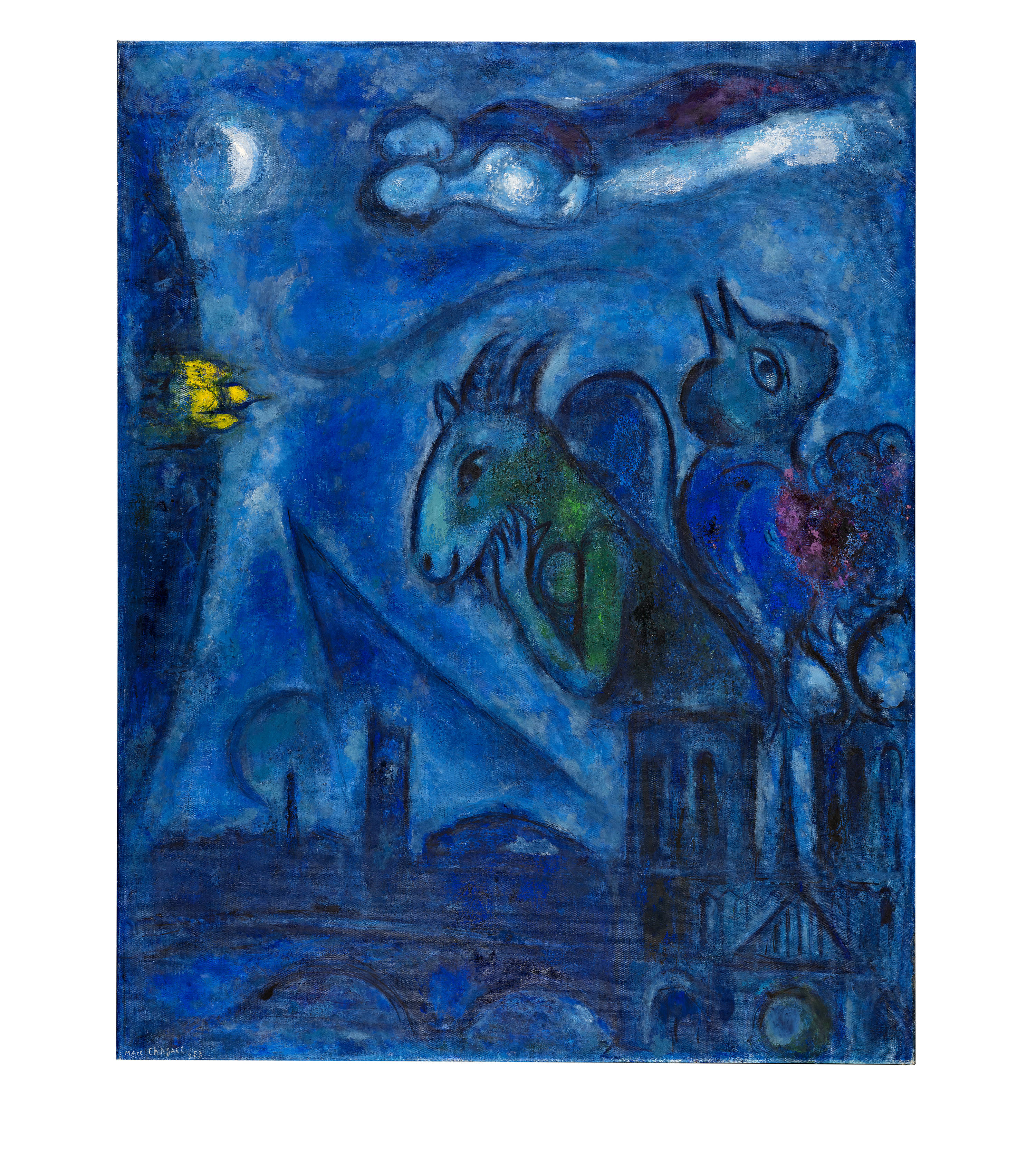
After the experiences of exile and war, Marc Chagall settled once again in France and, in his "Série de Paris", increasingly devoted himself to motifs that reflected his personal relationship to Paris and, above all, his vision of the city. The city does not appear as a realistic view, but as a concentrated symbol of memory.
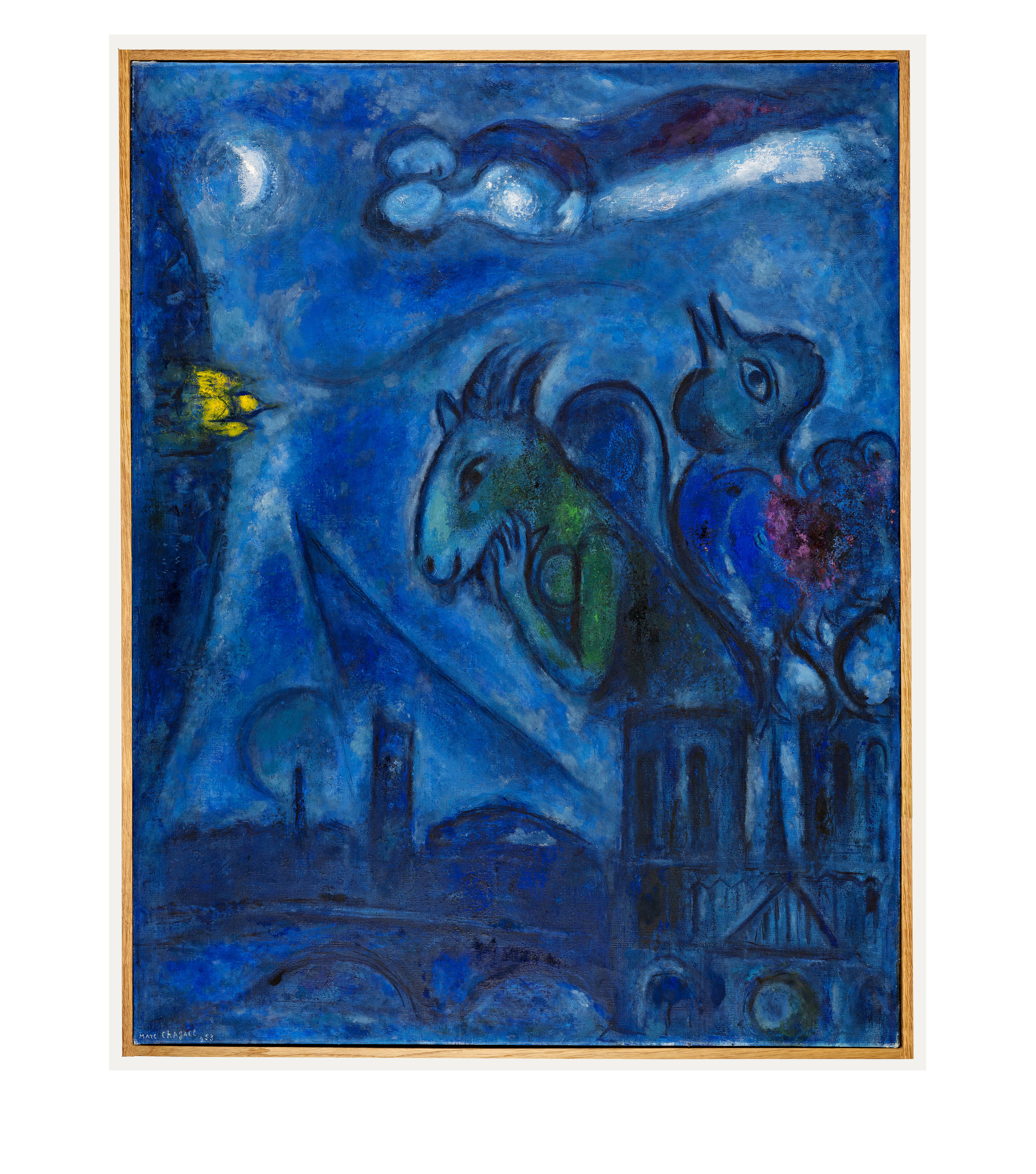
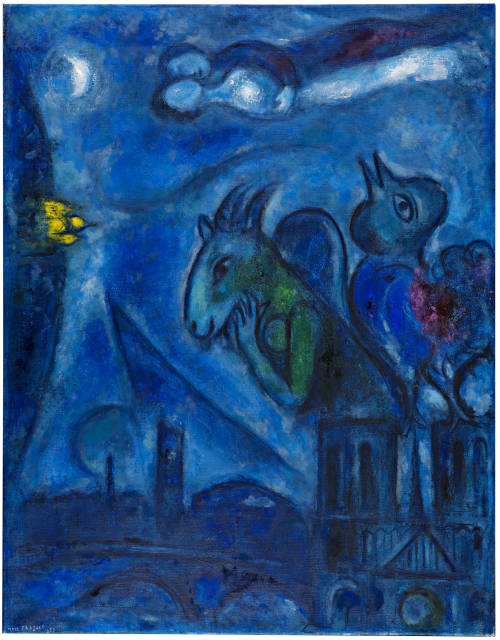
The title of the painting refers to the famous gargoyles in the form of chimeras on the Cathedral of Notre-Dame. Chagall creates from one of these figures a fantastic hybrid creature that oscillates between human and animal and gazes over the rooftops of Paris. It also bears the features of the "mystical" animal, which appears as a metaphor for creativity in many of his works. The nocturnal cityscape is rendered in luminous shades of blue, conveying a mysterious atmosphere. Alongside the monster, further motifs typical of Chagall appear: a rooster and a floating couple in love. The rooster, a frequent motif in Chagall's work, can be understood as a symbol of renewal, joy of life, and creative energy. The floating lovers are among the artist's central pictorial themes and allude to the power of love, which, in search of a home, transcends space and time.
Stylistically, the work displays the characteristic features of Chagall's mature painting. Perspective is suspended, reality and dream merge. The intense use of color does not serve faithful reproduction, but rather the expression of mood and feeling. In particular, the dominant blue creates an atmosphere between night, memory, and vision; color becomes the theme of the composition.
"Le Monstre de Notre-Dame" is thus far more than a city view. The painting transforms Paris into an imaginary cosmos in which personal memories and cultural symbols come together. It illustrates Chagall's conviction that art should not depict visible reality, but should make an inner truth visible. For this reason, the work is among the most impressive examples of his pictorial world.
1953
Öl, Tempera, Sand und Sägemehl auf Leinwand
106,4x83,7 cm
Unten links vom Künstler signiert und datiert "Marc Chagall 953"
Echtheitsbestätigung (Nr. 2026082) des Comité Marc Chagall, Paris, datiert vom 27. April 2026, liegt vor
Nachlass Marc Chagall, von dort an
Internationale Privatsammlung
Franz Meyer, Marc Chagall, Paris 1964,
Itzhak Goldberg, Chagall, Paris 2019,
Paris 1954, Galerie Maeght, Marc Chagall,
Basel 1956, Kunsthalle, Marc Chagall, Werke aus den letzten 25 Jahren,
Bern 1956, Kunsthalle, Marc Chagall, 1950-1956,
Saragossa 1998, Centro de exposiciones y congresos, Marc Chagall, Pinturas alrededor de la serie de París, gouaches y aguadas, esculturas y litografías,
Johannesburg 2000, Standard Bank Gallery, Marc Chagall, The Light of Origins, La lumière des origines,
Nizza 2001, Musée national Message Biblique Marc Chagall, Marc Chagall, Paysages, ohne Kat.
Paris 2003, Grand Palais/Museum of Modern Art, Chagall, connu et inconnu,
San Francisco 2003, Museum of Modern Art, Chagall, Kat. 105
Turin 2004, Marc Chagall, Galleria d'Arte Moderna, Marc Chagall, Un maestro del '900,
Seoul/Busan 2004, Museum of Art/Metropolitan Art Museum, Chagall, Magician of Color,
Ishøj 2006, Arken Museum of Modern Art, Chagall's World of Love, ohne Kat.
Baden-Baden 2006, Museum Frieder Burda, Chagall in neuem Licht,
Rom 2007, Complesso del Vittoriano, Chagall delle meraviglie,
Martigny 2007, Fondation Pierre Gianadda, Chagall, Entre ciel et terre,
Zagreb 2007/2008, Galerija Klovićevi dvori, Marc Chagall, Priča nad pričama, ohne Kat.
Nizza/Rom/Verona/San Sebastian 2010/2011, Musée national Marc Chagall/Museo dell'Ara Pacis/Galleria d'arte moderna Palazzo Forti/Sala Kubo-Kutxa, Sens dessus dessous, le monde renversé de Marc Chagall,
Madrid 2012, Thyssen-Bornemisza Museo Nacional, Chagall,
Paris/Budapest 2013/2014 Musée du Luxembourg/Magyar Nemzeti Galeria, Chagall, Entre guerre et paix,
Rouen 2014, Musée des Beaux-Arts, Cathédrales, 1789-1914, un mythe moderne,
Mailand/Brüssel 2015, Palazzo Reale/Musées Royaux des Beaux-Arts de Belgique, Marc Chagall, Rétrospective 1908-1985,
Rovigo 2020, Palazzo Roverella, Anche la mia Russia mi amerà,
Auf einem neuen Chassis mit umseitigen Leinwandverstärkungen aufgezogen. In ausgezeichneter Erhaltung
Nach den Erfahrungen von Exil und Krieg hatte sich Marc Chagall wieder in Frankreich niedergelassen und widmete sich in seiner "Série de Paris" verstärkt Motiven, die seine persönliche Beziehung zu Paris und vor allem seine Vision von der Stadt widerspiegeln. Die Stadt erscheint dabei nicht als realistische Ansicht, sondern als konzentriertes Sinnbild der Erinnerung.
Der Titel des Gemäldes bezieht sich auf die berühmten Wasserspeier in Form von Chimären der Kathedrale Notre-Dame. Chagall kreiert aus einer dieser Figuren ein fantastisches Mischwesen, das zwischen Mensch und Tier oszilliert und über die Dächer von Paris blickt. Es trägt auch die Züge vom "mystischem" Tier, das sich als Metapher für die Kreativität in zahlreichen seiner Werke findet. Die nächtliche Stadtlandschaft ist in leuchtenden Blautönen gehalten und vermittelt eine geheimnisvolle Atmosphäre. Neben dem Monster erscheinen weitere für Chagall typische Motive: ein Hahn und ein schwebendes Liebespaar. Der Hahn, ein häufiges Motiv bei Chagall, kann als Symbol für Erneuerung, Lebensfreude und schöpferische Energie verstanden werden. Die schwebenden Liebenden gehören zu den zentralen Bildthemen des Künstlers und verweisen auf die Kraft der Liebe, die auf der Suche nach einer Bleibe Raum und Zeit überwindet.
Stilistisch zeigt das Werk die charakteristischen Merkmale von Chagalls reifer Malerei. Die Perspektive ist aufgehoben, Realität und Traum verschmelzen miteinander. Die intensive Farbigkeit dient nicht der naturgetreuen Wiedergabe, sondern dem Ausdruck von Stimmung und Gefühl. Besonders das dominante Blau erzeugt eine Atmosphäre zwischen Nacht, Erinnerung und Vision, die Farbe wird zum Thema der Komposition.
"Le Monstre de Notre-Dame" ist damit weit mehr als eine Stadtansicht. Das Gemälde verwandelt Paris in einen imaginären Kosmos, in dem persönliche Erinnerungen und kulturelle Symbole zusammenfinden. Es veranschaulicht Chagalls Überzeugung, dass die Kunst nicht die sichtbare Wirklichkeit abbilden sollte, sondern eine innere Wahrheit sichtbar machen sollte. Dadurch zählt das Werk zu den eindrucksvollsten Beispielen seiner Bildwelt.
| Switzerland | CHF | Individual offer |
| Europe | CHF | Individual offer |
| USA | CHF | Individual offer |
| Overseas | CHF | Individual offer |