- EN


 Log in
-
- Live Auctions
- Past auctions
- More
- Kornfeld today
- The Story of Kornfeld
- Information


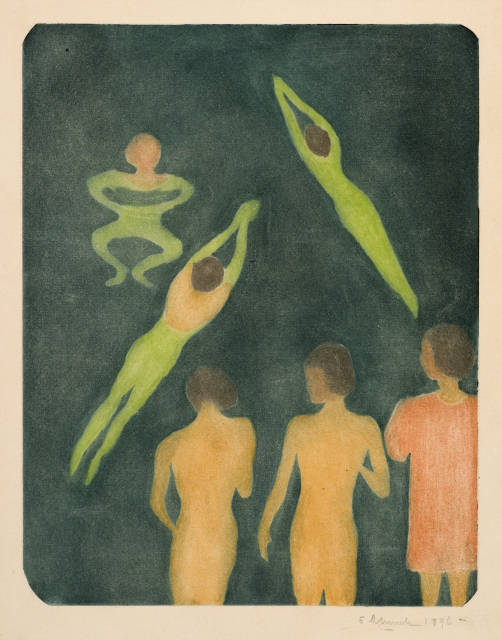







Løten 1863 - 1944 Oslo


1896
Mezzotint on Arches laid paper with watermark
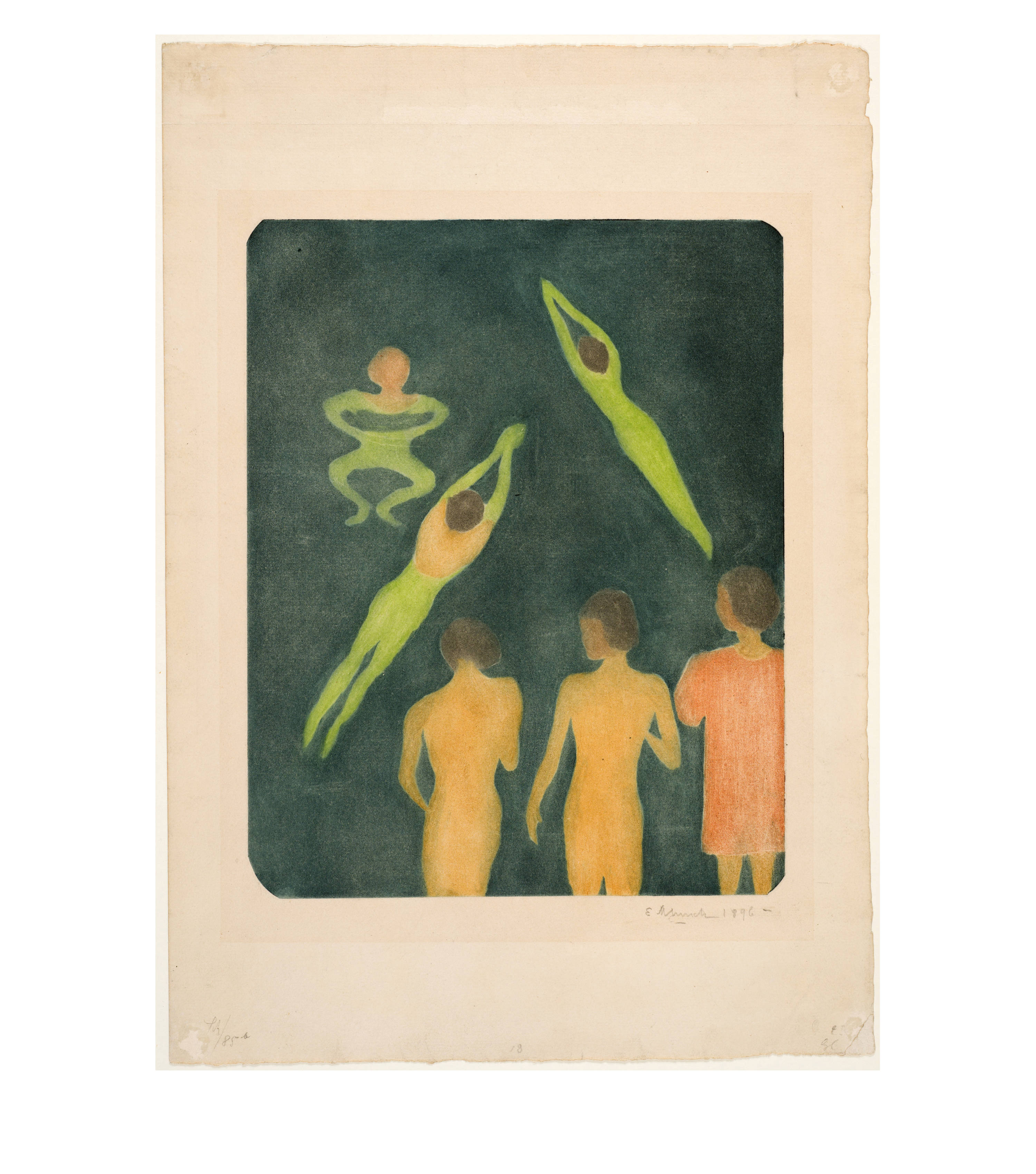
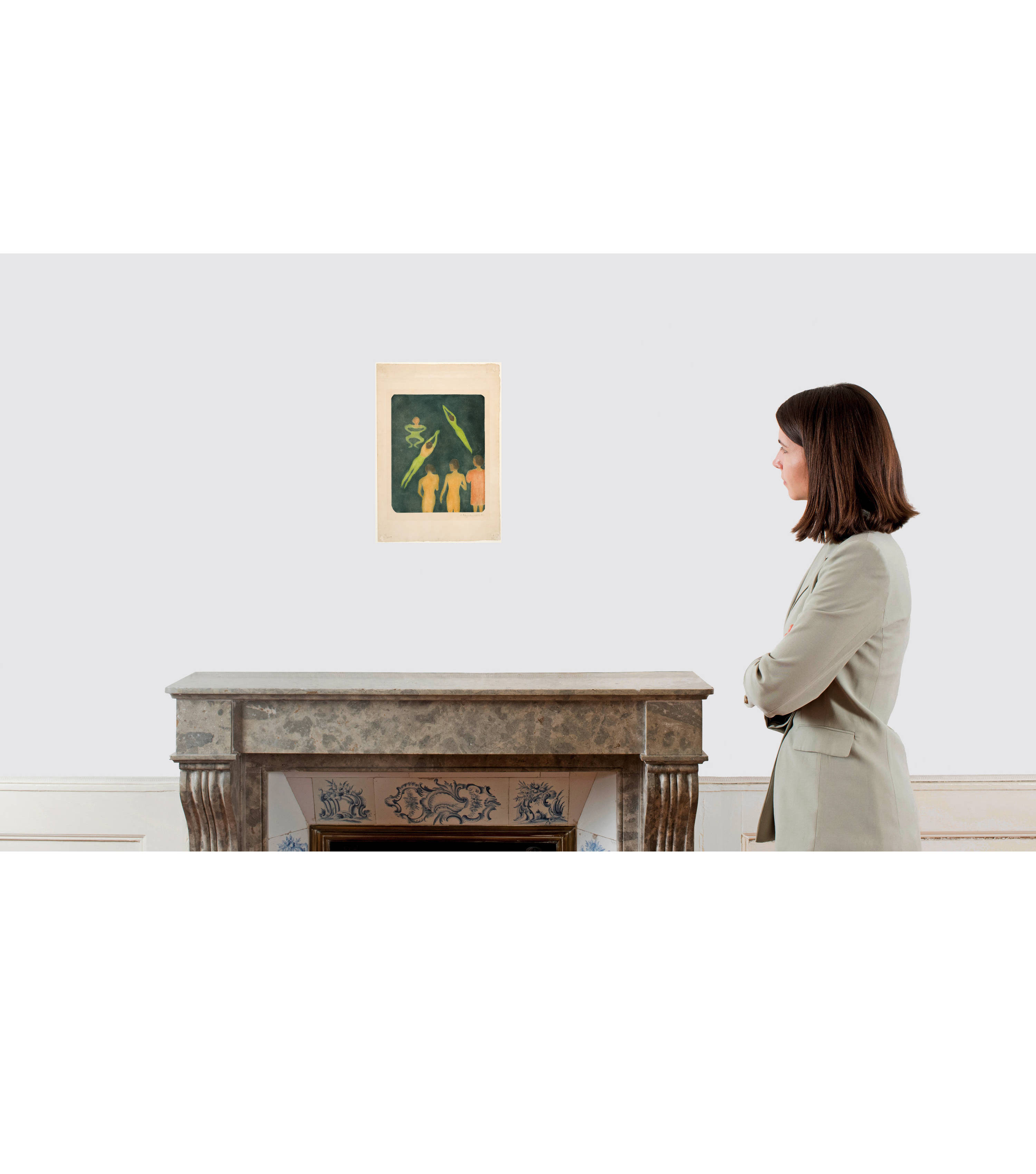
29.7x23.5 cm, platemark; 44.5x30.8 cm, sheet size
Lower right signed and dated by the artist in pencil 'E Munch 1896'
Gerd Woll, Edvard Munch, The Complete Graphic Works, Oslo 2012, no. 61/B (v. C), one of the copies mentioned there
Collection Prof. Dr. Curt Glaser (1879-1943), Berlin, auctioned at
Auction Max Perl, Berlin, 19 May 1933, lot 1123, acquired there by
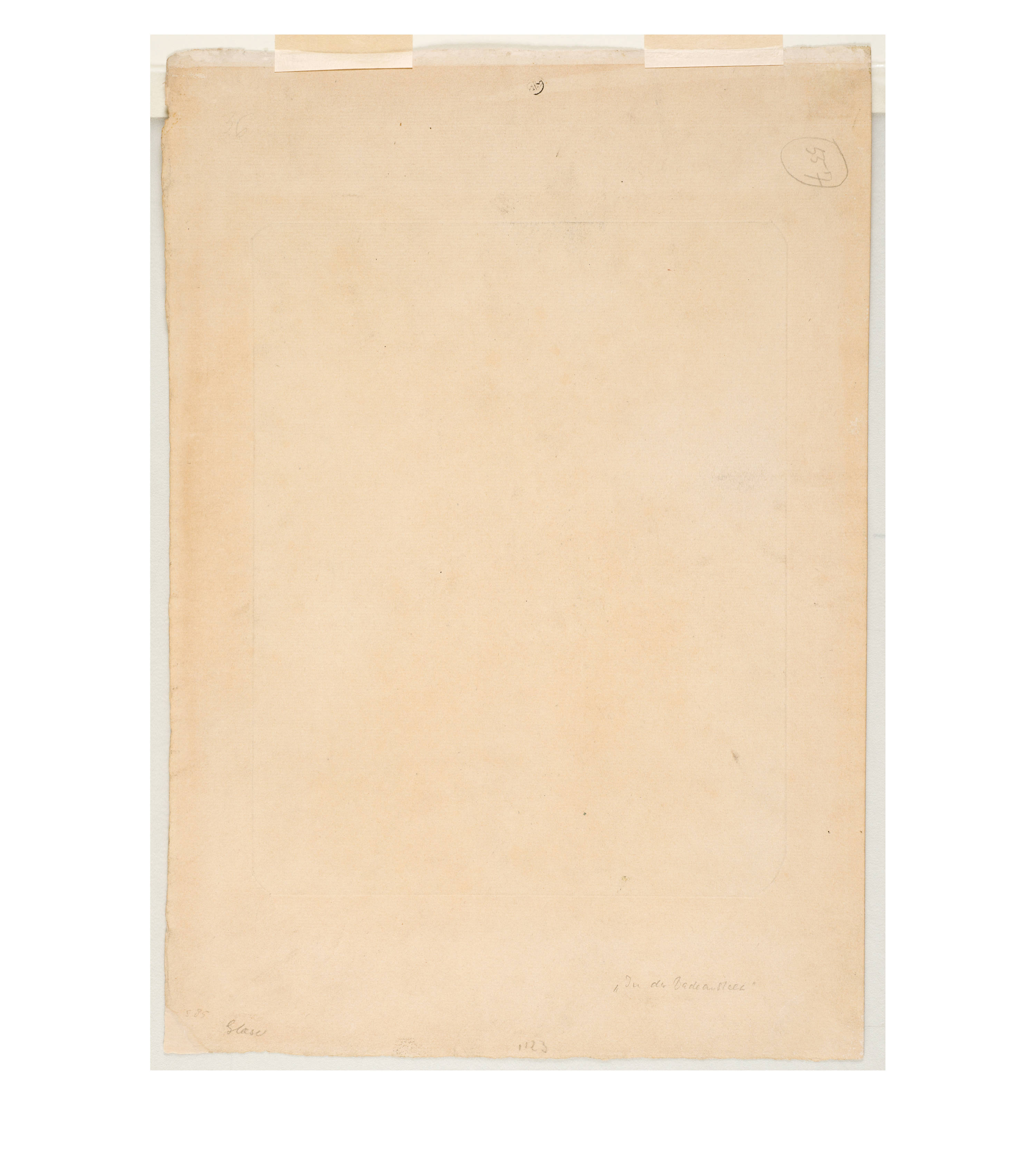
Collection Arnold Budczies, Berlin, with the collector's stamp on the back
Bremen 1970, Kunsthalle, Edvard Munch, Druckgraphik, Auswahl aus einer bremischen Privatsammlung, cat. no. 50
All sheet corners with traces of old mounting. The lower right corner supplemented. At the top a horizontal fold in the paper. At the upper edge a small backed tear. Minimal light-struck area and signs of use. The reverse slightly browned in the paper. Particularly beautiful impression in very fine overall condition
Edvard Munch's stay in Paris in 1896 coincided with a period of intense experimentation in printmaking. In the French capital, Munch encountered an avant-garde art scene that had a lasting influence on his visual language. At the same time, he had access to the most modern print studios. Printers such as Auguste Clot and Alfred Porcabœuf introduced him to new possibilities in printmaking.
Thus, in the studio of Alfred Salmon, which was then run by Alfred Porcabœuf, eight mezzotint plates were created. This printing technique is considered one of the most elaborate of all: first, the zinc plates are prepared with aquatint and then worked with the rocker until a dense, even mesh is formed. This produces a velvety, even surface in the print with soft transitions. Mezzotint was already developed in the 17th century, primarily to reproduce a painterly effect.
It was precisely this painterly aspect of printmaking that must have fascinated Munch. He deliberately used the qualities of the print to create atmosphere and emotional intensity. In doing so, he produced only a few examples, each with different colouring from print to print. The impressions were in all likelihood printed by the artist himself or from plates he inked himself. Mezzotint prints are among Munch's rarest and most sought-after graphic works.
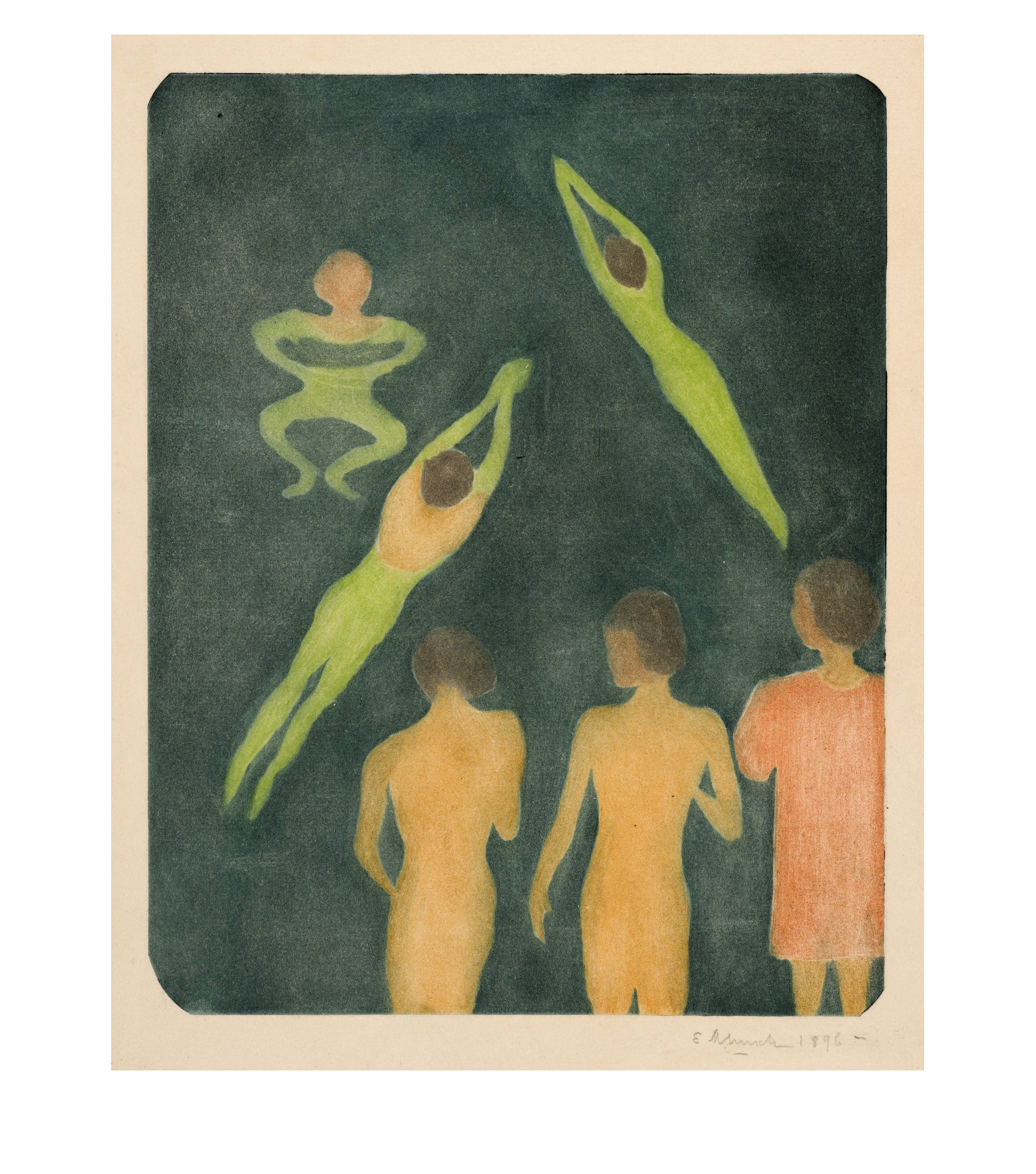
The rare mezzotint 'Badende Knaben' ('Bathing Boys') takes up a scene that was already present in Munch's paintings and drawings of the 1880s. It depicts youths by the water, in motion, some standing, some about to enter the water. The scene is set in nature, probably at a Norwegian fjord. With Munch, the view is never purely documentary or idyllic: the figures remain ghostly, fleeting and almost dreamlike.
Typical of mezzotint are the velvety depth of the dark black-green and the soft transition between light and dark. Munch masterfully uses these qualities to dissolve the pictorial space. 'Badende Knaben' is an image of the transition between childhood and youth, nature and culture, body and mind. Although the sheet was created in Paris, its content strongly refers to Munch's Norwegian origins and his early engagement with questions of identity, masculinity and transience.
Probably only eight multi-coloured impressions were made. The present sheet is distinguished by its rich colouring and is particularly beautiful.
An amicable agreement was reached with the heirs of Curt Glaser, represented by the Berlin law firm 'S+N Rechtsanwälte'. The current sale takes place with the consent of the heirs of Curt Glaser and is therefore free of any claims. The amicable agreement has been recorded in the Lost Art Database of the German Lost Art Foundation.
1896
Mezzotinto auf Arches-Bütten mit Wasserzeichen
29,7x23,5 cm, Plattenkante; 44,5x30,8 cm, Blattgrösse
Unten rechts vom Künstler in Bleistift signiert und datiert "E Munch 1896"
Gerd Woll, Edvard Munch, The Complete Graphic Works, Oslo 2012,
Slg. Prof. Dr. Curt Glaser (1879-1943), Berlin, versteigert bei
Auktion Max Perl, Berlin, 19. Mai 1933, Los 1123, dort erworben von
Slg. Arnold Budczies, Berlin, rückseitig mit dem Sammlerstempel
Bremen 1970, Kunsthalle, Edvard Munch, Druckgraphik, Auswahl aus einer bremischen Privatsammlung,
Alle Blattecken mit Spuren alter Montierungen. Die untere rechte Ecke ergänzt. Oben ein Querfalz im Papier. Am oberen Rand kleiner hinterlegter Einriss. Minimer Lichtrand und Gebrauchsspuren. Die Rückseite leicht im Papier gebräunt. Besonders schöner Druck in sehr schöner Gesamterhaltung
Edvard Munchs Aufenthalt in Paris im Jahr 1896 fiel in eine Phase intensiver druckgraphischer Experimente. In der französischen Hauptstadt begegnete Munch einer avantgardistischen Kunstszene, die seine Bildsprache nachhaltig beeinflusste. Gleichzeitig hatte er dort Zugang zu modernsten Druckwerkstätten. Drucker wie Auguste Clot oder Alfred Porcabœuf vermittelten ihm neue druckgraphische Möglichkeiten.
So entstanden etwa im Atelier Alfred Salmon, das damals von Alfred Porcabœuf geleitet wurde, acht Schabkunstblätter (Mezzotinten). Dieses Druckverfahren gilt als eines der aufwändigsten überhaupt: Zunächst werden die Zinkplatten mit Aquatinta vorbereitet und anschliessend mit dem Wiegemesser so lange bearbeitet, bis sich ein dichtes, gleichmässiges Raster bildet. Dieses erzeugt im Druck eine flächig-samtene Struktur mit weichen Übergängen. Die Schabkunst wurde bereits im 17. Jahrhundert entwickelt, vor allem zur Wiedergabe einer malerischen Wirkung.
Genau dieser malerische Aspekt der Druckgraphik wird Munch fasziniert haben. Er nutzte die Qualitäten des Druckes gezielt, um Atmosphäre und emotionale Dichte zu erzeugen. Dabei schuf er jeweils nur wenige Exemplare mit von Druck zu Druck abweichender Farbgebung. Die Abzüge waren aller Wahrscheinlichkeit nach Eigendrucke bzw. von ihm selbst eingefärbte Platten. Blätter in Mezzotinto gehören zu Munchs seltensten und begehrtesten Graphiken überhaupt.
Das seltene Mezzotinto "Badende Knaben" greift eine Szene auf, die bereits in Munchs Gemälden und Zeichnungen der 1880er-Jahre angelegt war. Zu sehen sind Jünglinge am Wasser, in Bewegung, teils stehend, teils im Begriff ins Wasser zu gehen. Die Szene spielt in der Natur, vermutlich an einem norwegischen Fjord. Bei Munch ist der Blick nie rein dokumentarisch oder idyllisch: Die Körper bleiben schemenhaft, flüchtig und wirken fast traumartig.
Typisch für die Schabkunst sind die samtige Tiefe des dunklen Schwarz-Grüns und der weiche Übergang zwischen Hell und Dunkel. Munch nutzt diese Qualitäten meisterhaft, um den Bildraum aufzulösen. "Badende Knaben" ist ein Bild des Übergangs zwischen Kindheit und Jugend, Natur und Kultur, Körper und Geist. Obwohl das Blatt in Paris entstand, verweist es inhaltlich stark auf Munchs norwegische Herkunft und auf seine frühe Auseinandersetzung mit Fragen der Identität, Männlichkeit und Vergänglichkeit.
Es entstanden wohl nur acht mehrfarbige Exemplare. Das vorliegende Blatt zeichnet sich durch seine satte Farbigkeit aus und ist besonders schön.
Es wurde eine gütliche Einigung mit den Erben nach Curt Glaser, vertreten durch die Berliner Kanzlei "S+N Rechtsanwälte", getroffen. Der aktuelle Verkauf erfolgt mit dem Einverständnis der Erben nach Curt Glaser und ist daher frei von jeglichen Ansprüchen. Die gütliche Einigung wurde in der Lost Art-Datenbank des Deutschen Zentrums Kulturgutverluste vermerkt.
| Switzerland | CHF | 130 |
| Europe | CHF | 200 |
| USA | CHF | 250 |
| Overseas | CHF | 255 |