- EN


 Log in
-
- Live Auctions
- Past auctions
- More
- Kornfeld today
- The Story of Kornfeld
- Information









Málaga 1881 - 1973 Mougins


5 June 1967
Pen and brush in Indian ink on Canson watercolour paper with embossing
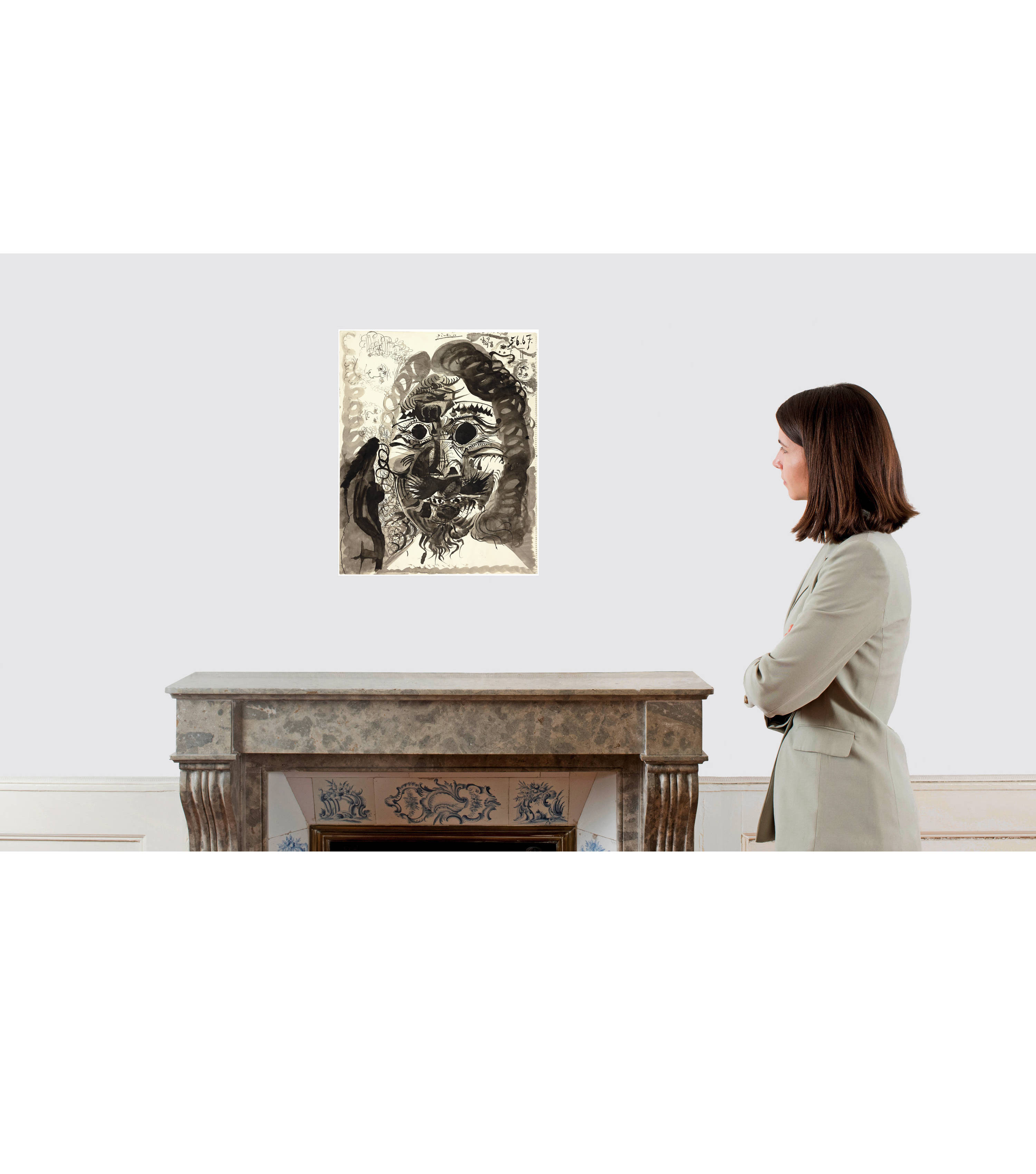
60.5x49.7 cm
Upper centre signed by the artist 'Picasso', right dated '5.6.67' and upside down '8.6.67', below inscribed '7 II'. On the reverse again dated by the artist in brush '5.6.67', inscribed 'III' and signed 'Picasso'.
Christian Zervos, Pablo Picasso, Œuvres de 1967 et 1968, vol. 27, Paris 1973, no. 9 and 10
Galerie Louise Leiris, Paris, verso with label on the backing board with inventory number 12245 and photo number 62029
Private collection France
Right margin with perforation. Verso with traces of old mounting. Impeccable condition
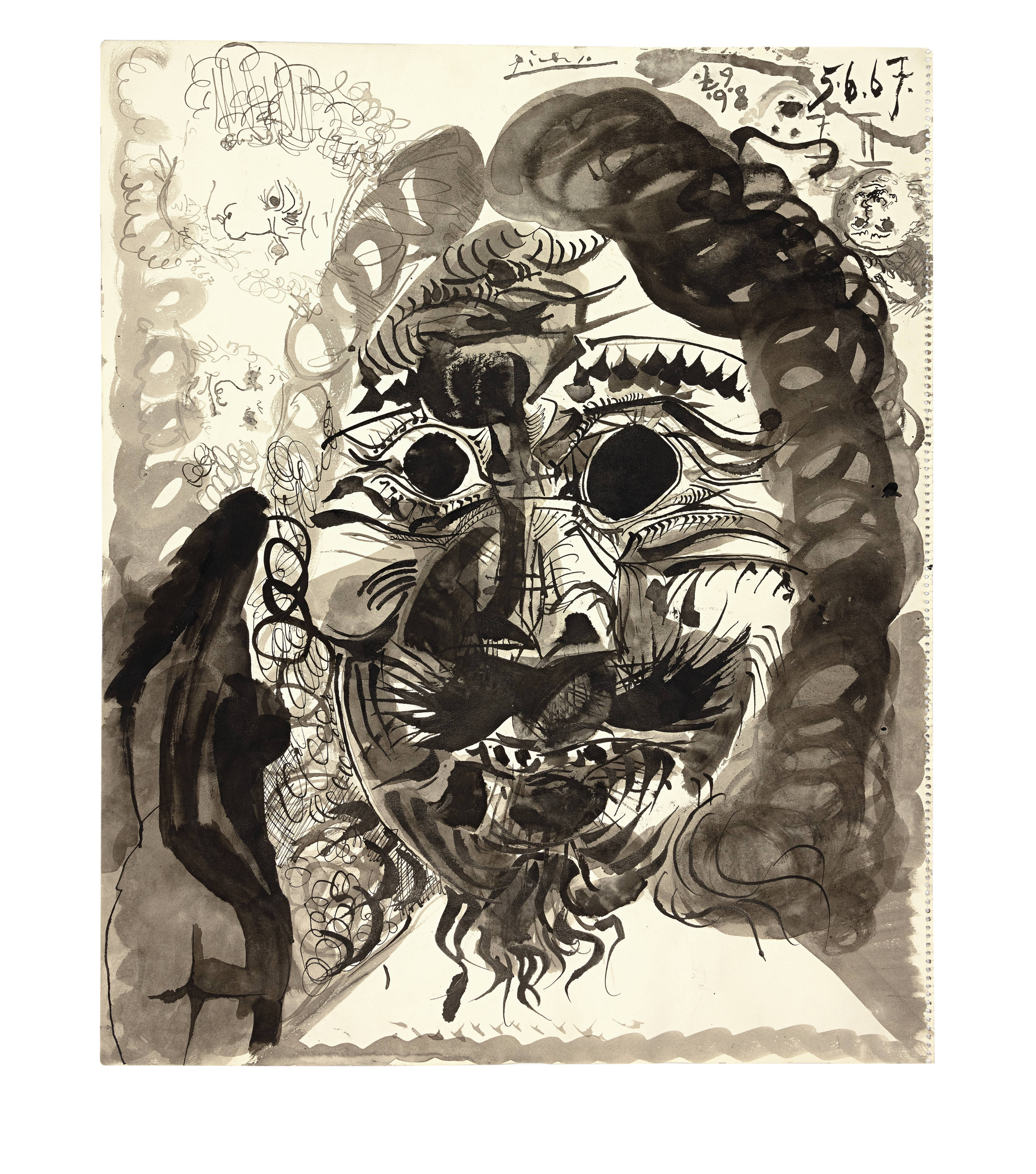
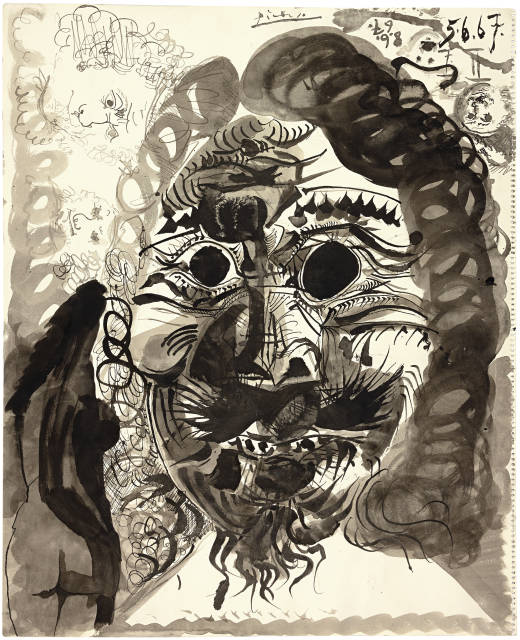
The double-sided drawing belongs to a group of works in which Pablo Picasso experimented with expressive techniques, historical masks, and erotic motifs. The depiction of a musketeer - a figure that Picasso obsessively varied in the 1960s - is rendered with wild, almost baroque expressiveness. Using brush and pen in ink, he covers the face with sweeping lines, bold brushstrokes, dark areas and ornamental flourishes. Here, the musketeer does not serve as a historical portrait, but as a projection surface for role-play, male identity and artistic masquerade. Rembrandt and Velázquez, two painters whom Picasso studied intensively in his later years, also seem to resonate in this radical reinterpretation. The black ink is used not only as a drawing medium, but also to create dramatic intensity.
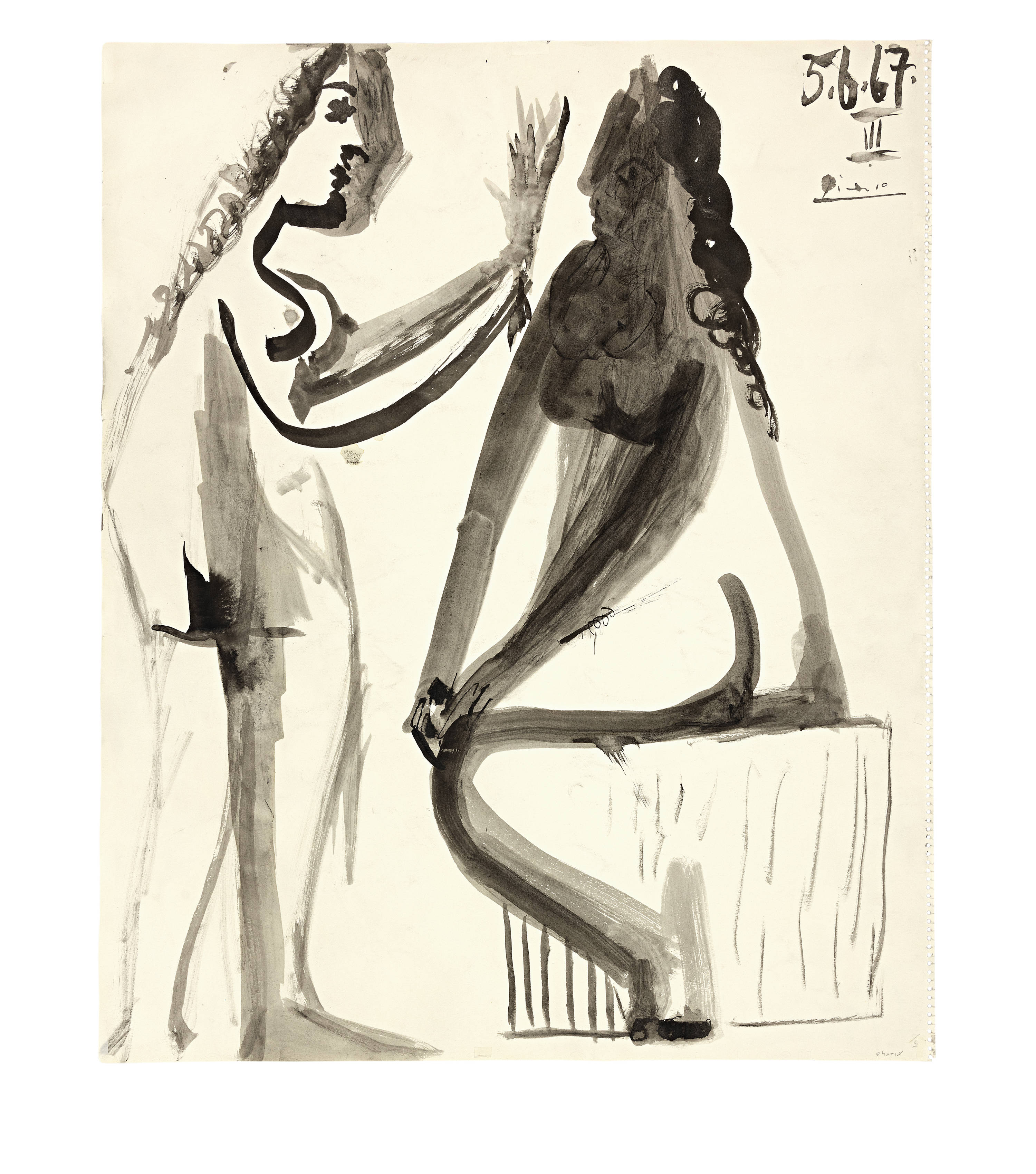
On the reverse of the sheet, two female figures are depicted in an intimate, tension-filled moment. The standing figure touches or speaks to the seated woman. The ink drawing here is more reduced, but no less expressive. With just a few gestural brushstrokes, a physical closeness is created that suggests both tenderness and power dynamics. Picasso plays with the classic themes of artist and model, of observer and observed. The confrontation between the two figures remains deliberately ambiguous: are they lovers, rivals, or actresses performing a scene?
5. Juni 1967
Tuschfeder und Tuschpinsel auf Aquarellpapier Canson mit Prägedruck
60,5x49,7 cm
Oben in der Mitte vom Künstler signiert "Picasso", rechts datiert "5.6.67" und verkehrt herum "8.6.67" darunter bezeichnet "7 II". Rückseitig nochmals vom Künstler in Pinsel datiert "5.6.67", bezeichnet "III" und signiert "Picasso".
Christian Zervos, Pablo Picasso, Œuvres de 1967 et 1968, Bd. 27, Paris 1973,
Galerie Louise Leiris, Paris, rückseitig mit Etikette auf dem Rückenkarton mit der Inventarnummer 12245 und der Photonummer 62029
Privatsammlung Frankreich
Rechter Rand mit Perforierung. Rückseitig mit Montierungsresten. Tadellos in der Erhaltung
Die beidseitig ausgeführte Zeichnung gehört zu einer Werkgruppe, in der Pablo Picasso mit expressiven Techniken, historischen Masken und erotischen Motiven experimentierte. Die Darstellung eines Musketiers - eine Figur, die Picasso in den 1960er-Jahren obsessiv variierte - ist in wilder, fast barocker Expressivität ausgeführt. Mit Tuschpinsel und -feder überzieht er das Gesicht mit schwungvollen Linien, kräftigen Pinselzügen, dunklen Flächen und ornamentalen Schnörkeln. Der Musketier dient hier nicht als historisches Porträt, sondern als Projektionsfläche für Rollenspiele, männliche Identität und künstlerische Maskerade. Auch Rembrandt und Velázquez - zwei Maler, die Picasso in seinen späten Jahren intensiv studierte - scheinen in dieser radikalen Neuinterpretation mitzuschwingen. Die schwarze Tusche wird dabei nicht nur als zeichnerisches Medium, sondern als Material dramatischer Intensität eingesetzt.
Auf der Rückseite des Blattes begegnen wir zwei Frauenfiguren in einem intimen, spannungsgeladenen Moment. Die stehende Figur berührt oder spricht mit der sitzenden Frau. Die Tuschezeichnung ist hier reduzierter, aber nicht weniger expressiv. Mit wenigen gestischen Pinselzügen wird eine körperliche Nähe geschaffen, die sowohl Zärtlichkeit als auch Machtverhältnisse andeutet. Picasso spielt mit den klassischen Themen von Künstler und Modell, von Betrachter und Betrachtetem. Die Konfrontation der beiden Figuren bleibt bewusst uneindeutig: Sind sie Liebende, Rivalinnen oder Schauspielerinnen einer Szene?
| Switzerland | CHF | 170 |
| Europe | CHF | 270 |
| USA | CHF | 360 |
| Overseas | CHF | 380 |