- EN


 Log in
-
- Live Auctions
- Past auctions
- More
- Kornfeld today
- The Story of Kornfeld
- Information


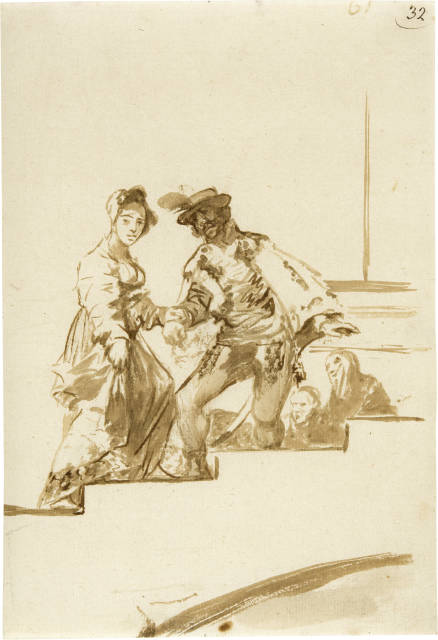







Fuendetodos 1746 - 1828 Bordeaux



Circa 1815-1820
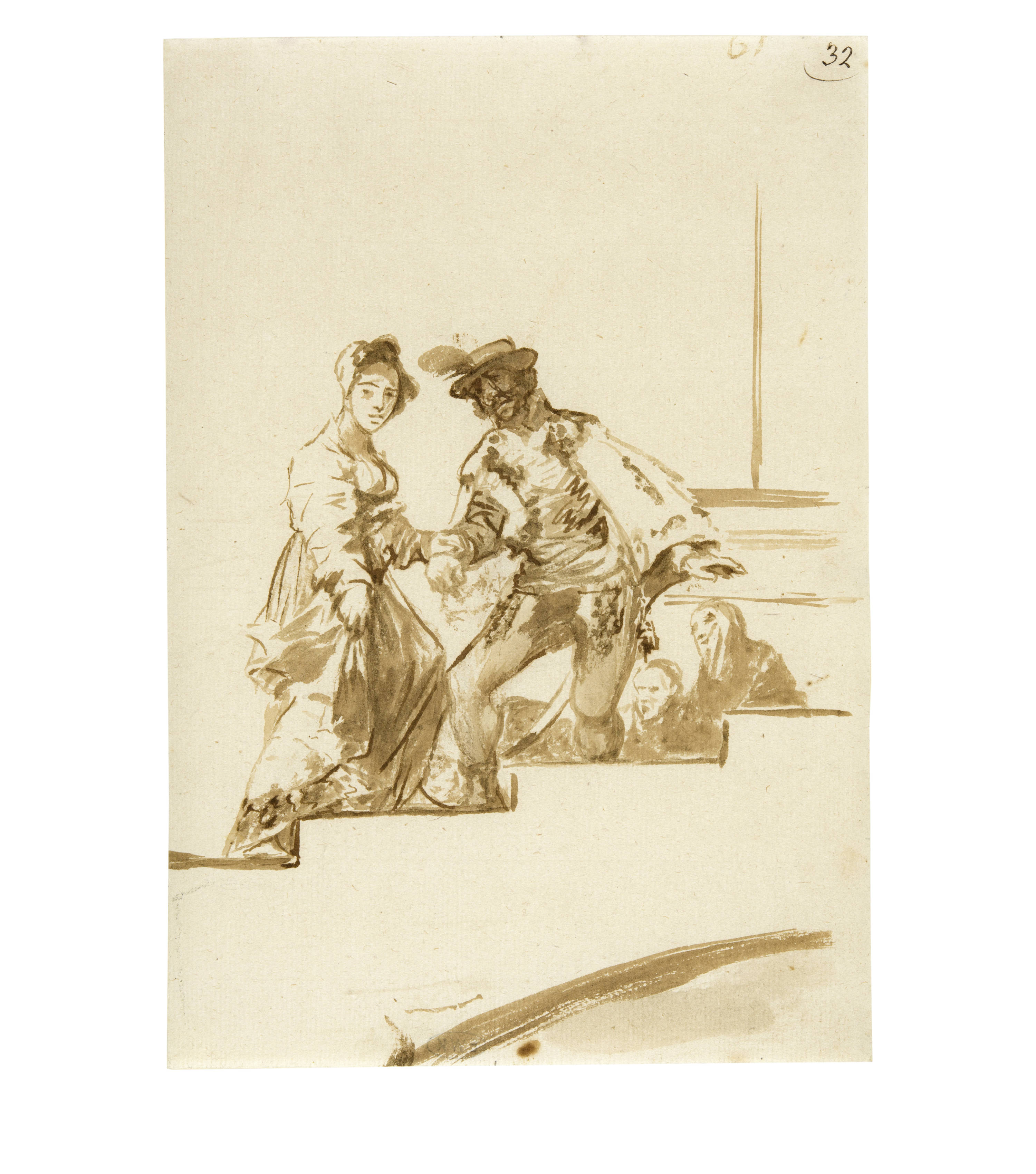
Brush drawing in sepia and dark brown in two tones on thin wove paper with watermark "M" in cartouche
20.8x14.2 cm, sheet size
With the number "61" in his own hand at the top right, the number "32" probably by the hand of Javier Goya, the artist's son
Pierre Gassier, The Drawings of Goya, The Complete Albums, London 1973, no. 327 (album F. 61)
Pierre Gassier/Juliet Wilson, Vie et œuvre de Francisco Goya, L'œuvre complet illustré, Fribourg 1970, no. 1482
Collection Javier Goya y Bayeu (1784--1854), from 1828
Collection Mariano Goya y Goicoechea (1806--1874), from 1854
Federico de Madrazo y Kuntz (1815--1894) and/or Román Garreta y Huerta (c. 1855--1860)
Collection Paul Lebas, Paris, before 1877
Auction Hôtel Drouot, Paris, Vente anonyme P. L., 3 April 1877, lot 48, to
Féral, Paris
Collection Alfred Stroelin (1871--1954), Paris and Lausanne
Auction Galerie Kornfeld und Klipstein, Bern, 7-8 June 1978, lot 371
The Eberhard W. Kornfeld Collection, Bern, Lugt 913b
Pierre Gassier, Une source inédite de dessins de Goya en France au XIXe siècle, Gazette des beaux-arts, 80, 1972, p. 113
Juliet Wilson-Bareau, Goya in Bern, in: Christine E. Stauffer (ed.), Festschrift für Eberhard W. Kornfeld zum 80. Geburtstag, Bern 2003, ill. p. 95
Martigny 1982, Fondation Pierre Gianadda, Goya dans les collections suisses, cat. no. 18, with illustration
Bern 1989, Kunstmuseum, Von Goya bis Tinguely, Aquarelle und Zeichnungnen aus einer Privatsammlung [Collection Eberhard W. Kornfeld], cat. no. 1, with illustration
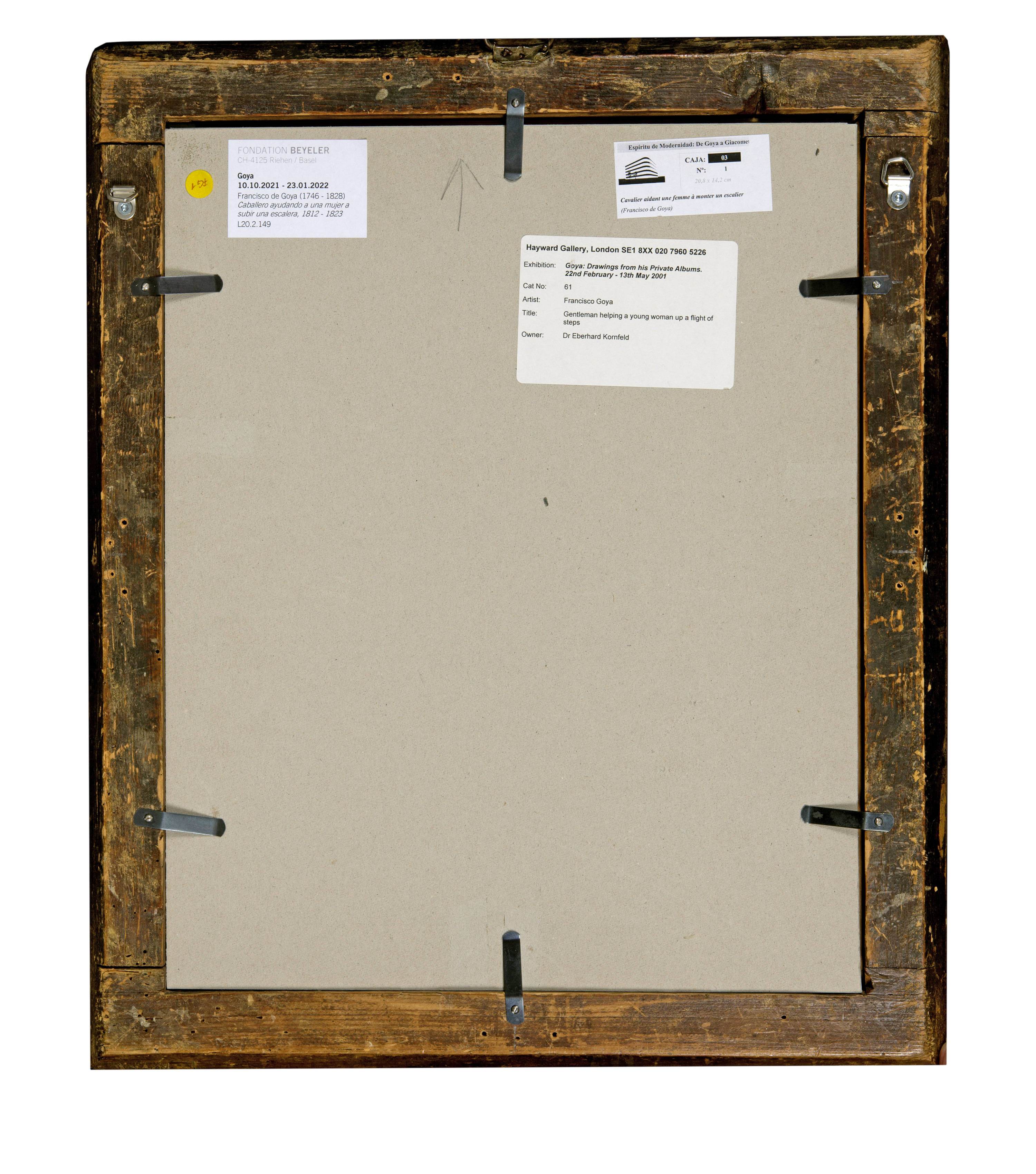
London 2001, Hayward Gallery, Goya: Drawings from His Private Albums, cat. no. 61, p. 185, with illustration
Madrid 2003, Fundación Juan March, Espíritu de modernidad: de Goya a Giacometti, Obra sobre papel de la colección Kornfeld, cat. no. 7, p. 130, with illustration p. 17
Zurich 2011, Graphische Sammlung der ETH, Francisco Goya, Augenzeuge und Visionär
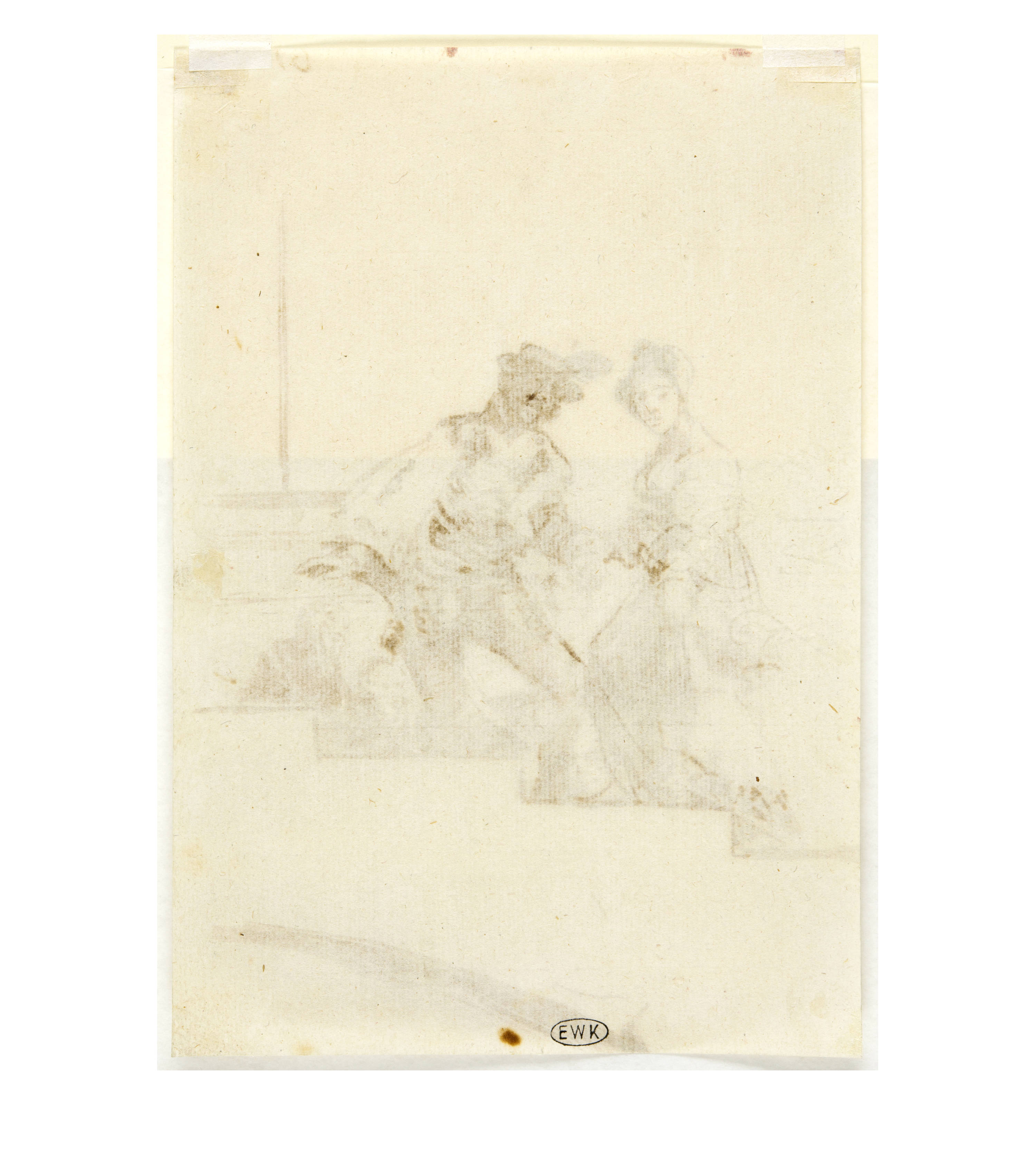
The dark ink accents as well as the small ink stain in the centre of the lower margin on the reverse somewhat showing through. Apart from this, the sheet (like the previous one from the same album) is in an overall excellent state of preservation and appears fresh and completely untreated
It was not until 1796, at the age of 50, that Goya began to draw in small bound books. By the time of his death in Bordeaux in 1828, he had filled eight such albums with around 550 drawings. These were not sketchbooks in the conventional sense. Although he occasionally drew on his drawings in prints, most of the sheets are entirely his own - private pictures, so to speak, which were reserved for Goya himself, his family and, at most, a small circle of friends. After his death, the albums were dissolved and the drawings scattered to the four winds.
The two drawings in the Kornfeld Collection are from Album F, a bound Spanish notebook containing 106 numbered pages. Goya began it during or immediately after the Spanish struggle for independence against the French occupation in 1808-1814. The album contains some of "the most radiant and captivating images Goya ever drew" (Juliet Wilson-Bareau, p. 17), to which the two sheets on offer can undoubtedly be counted.
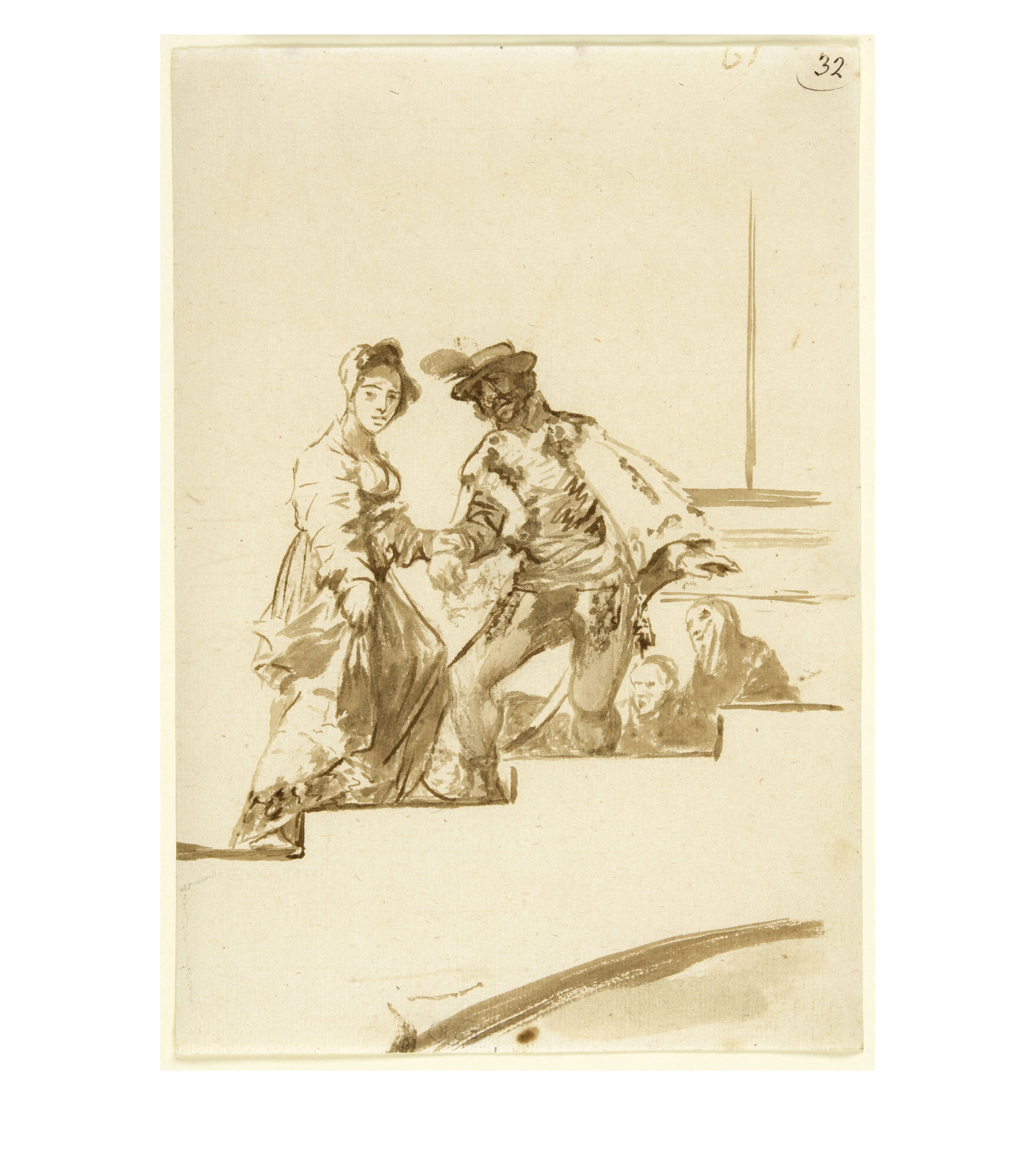
Drawing no. 61 of album F shows a gentleman helping a lady up the stairs. The horizontal and vertical lines of the steps and the background, which cannot be precisely named, contrast with the implied arch at the bottom of the page. On the staircase, which spans the room like a bridge, a young lady strides up the steps. The staircase has no banisters, so that the lady must be supported by an elderly nobleman in old-fashioned clothing. The precariousness of the situation is expressed in the sometimes shimmering style of the drawing, for example in the dabbed spots on the clothes. Goya demonstrates his mastery of the medium by skilfully incorporating the white of the paper into his composition.
Um 1815-1820
Pinselzeichnung in Sepia und dunklem Braun in zwei Tönen auf dünnem Velin mit Wasserzeichen "M" in Kartusche
20,8x14,2 cm, Blattgrösse
Oben rechts mit der eigenhändigen Nummer "61", die Nummer "32" wohl von der Hand Javier Goyas, des Sohnes des Künstlers
Pierre Gassier, The Drawings of Goya, The Complete Albums, London 1973,
Pierre Gassier/Juliet Wilson, Vie et œuvre de Francisco Goya, L'œuvre complet illustré, Fribourg 1970,
Slg. Javier Goya y Bayeu (1784–-1854), ab 1828
Slg. Mariano Goya y Goicoechea (1806–-1874), ab 1854
Federico de Madrazo y Kuntz (1815–-1894) und/oder Román Garreta y Huerta (um 1855–-1860)
Slg. Paul Lebas, Paris, vor 1877
Auktion Hôtel Drouot, Paris, Vente anonyme P. L., 3. April 1877, Los 48, an
Féral, Paris
Slg. Alfred Stroelin (1871–-1954), Paris und Lausanne
Auktion Galerie Kornfeld und& Klipstein, Bern, 7.–8. Juni 1978, Los 371
Slg. Eberhard W. Kornfeld, Bern, Lugt 913b
Pierre Gassier, Une source inédite de dessins de Goya en France au XIXe siècle, Gazette des beaux-arts, 80, 1972, pag. 113
Juliet Wilson-Bareau, Goya in Bern, in: Christine E. Stauffer (Hg.), Festschrift für Eberhard W. Kornfeld zum 80. Geburtstag, Bern 2003, reprod. pag. 95
Martigny 1982, Fondation Pierre Gianadda, Goya dans les collections suisses,
Bern 1989, Kunstmuseum, Von Goya bis Tinguely, Aquarelle und Zeichnungen aus einer Privatsammlung [Slg. Eberhard W. Kornfeld],
London 2001, Hayward Gallery, Goya: Drawings from His Private Albums,
Madrid 2003, Fundación Juan March, Espíritu de modernidad: de Goya a Giacometti, Obra sobre papel de la colección Kornfeld,
Zürich 2011, Graphische Sammlung der ETH, Francisco Goya, Augenzeuge und Visionär
Die dunklen Tintenakzente sowie der kleine mittige Tintenfleck am unteren Rand rückseitig etwas durchschlagend. Davon abgesehen ist das Blatt (wie auch das vorhergegangene, aus dem gleichen Album stammende) in einem insgesamt ganz hervorragenden Erhaltungszustand und wirkt frisch und gänzlich unbehandelt
Erst 1796, im Alter von 50 Jahren, begann Goya, in kleine gebundene Bücher zu zeichnen. Bis zu seinem Tod 1828 in Bordeaux füllte er acht solche Alben mit ca. 550 Zeichnungen. Dabei handelt es sich nicht um Skizzenbücher im herkömmlichen Sinne. Zwar griff er in Graphiken vereinzelt auf seine Zeichnungen zurück, die meisten der Blätter sind jedoch gänzlich eigenständig – gleichsam private Bilder, die Goya selbst, seiner Familie und allenfalls einem kleinen Freundeskreis vorbehalten waren. Nach seinem Tod wurden die Alben aufgelöst und die Zeichnungen in alle Winde zerstreut.
Die beiden Zeichnungen aus der Sammlung Kornfeld stammen aus dem Album F, einem gebundenen spanischen Notizbuch, das 106 nummerierte Seiten umfasste. Goya begann es während oder unmittelbar nach dem Unabhängigkeitskampf der Spanier gegen die französische Okkupation 1808–1814. Das Album enthält einige "der strahlendsten und fesselndsten Bilder, die Goya jemals zeichnete" (Juliet Wilson-Bareau, pag. 17), wozu die beiden angebotenen Blätter zweifellos gezählt werden dürfen.
Die Zeichnung
| Switzerland | CHF | 130 |
| Europe | CHF | 200 |
| USA | CHF | 250 |
| Overseas | CHF | 255 |