- EN


 Log in
-
- Live Auctions
- Past auctions
- More
- Kornfeld today
- The Story of Kornfeld
- Information


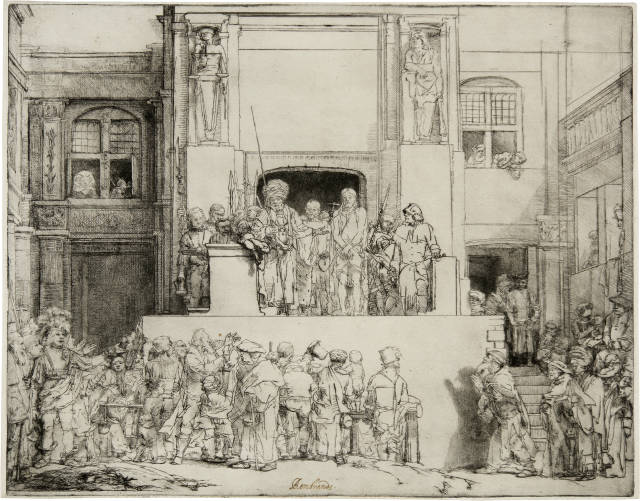







Leiden 1606 - 1669 Amsterdam



1655
Drypoint on laid paper
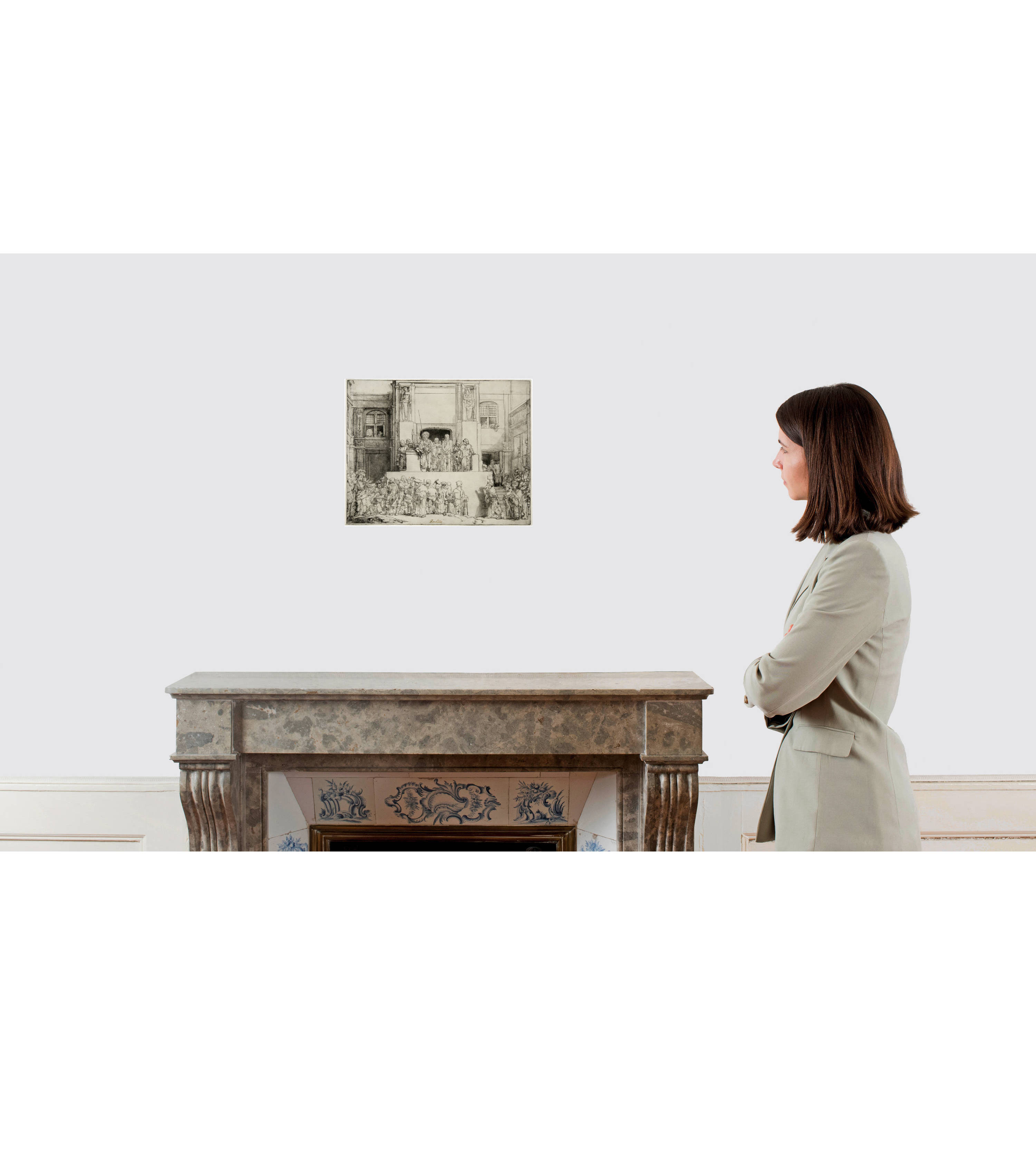
36.2x46.4 cm, sheet size
The New Hollstein (Hinterding/Rutgers) 290/V (of VIII) (this sheet mentioned)
White/Boon 76/V (of VIII)
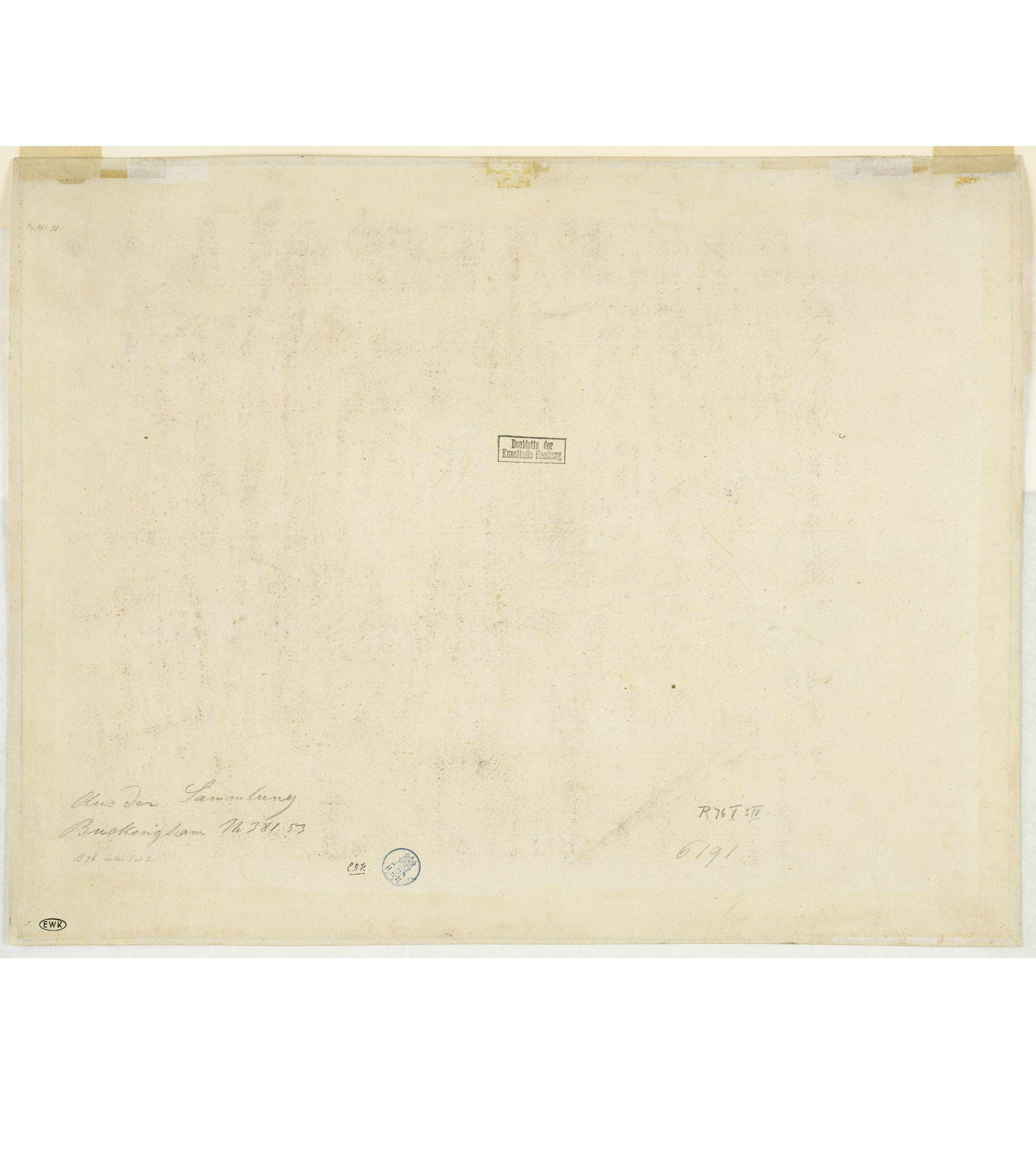
Collection Richard Temple-Nugent-Brydges-Chandos-Grenville, 1st Duke of Buckingham and Chandos, (1776-1839), Stowe (verso with pencil note: From the Buckingham Collection no. 381.53, his collection auctioned at
Phillips auction, London, 12 June 1834, part 2, lot 1620, for 23 guineas to
Henry Josi (probably for Joseph Harding)
Kunsthalle Hamburg, Lugt 1328 and the doublet stamp Lugt 1235
[Not part of the doublet auction at Amsler & Ruthardt, Berlin, 17 April and following days 1905; according to Lugt, the doublet stamp was only used after 1914]
Collection Dr Carl Gaa, Mannheim (not stamped, cf. Lugt 538a), his collection auctioned at
Auction C. G. Boerner, Leipzig, 5-6 May 1926, lot 758; for 11000 Reichsmark to
Gilhofer and Ranschburg (against Colnaghi) for
Collection Carl and Rose Hirschler, née Dreyfus, Haarlem (Lugt 633a)
C. G. Boerner, Düsseldorf and New York
The Eberhard W. Kornfeld Collection, Bern, Lugt 913b
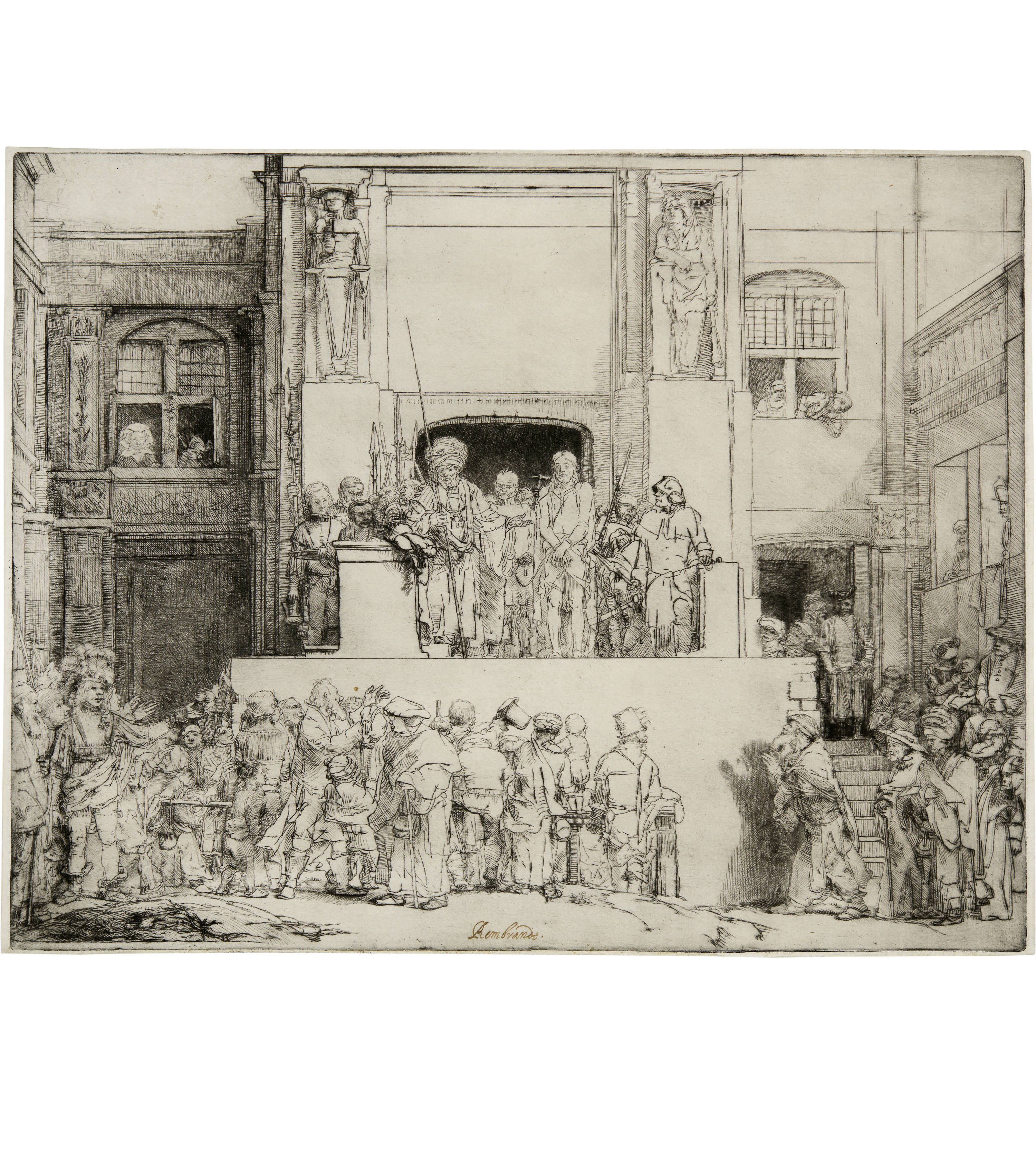
In immaculate condition, with small margins. The sheet has survived completely untouched, if one disregards the English collector (or his librarian) who, in the absence of a larger album sheet, thought he had to record Rembrandt's name directly at the bottom of the sheet
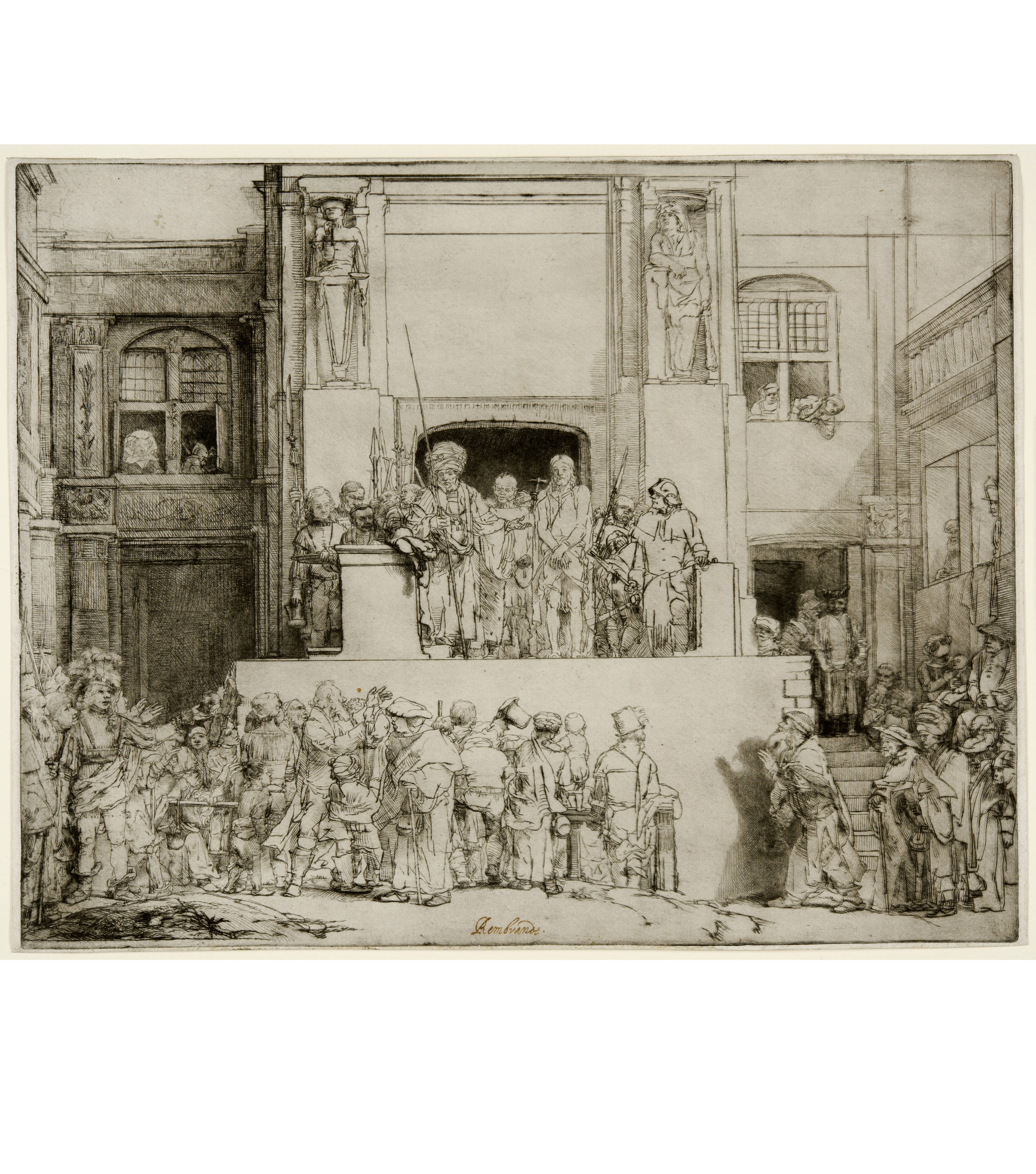
In this large Ecce Homo depiction, Rembrandt took up the same theme as Lucas van Leyden and realised it as a print. In a certain sense, Rembrandt thus entered into an artistic competition with his probably most important Dutch predecessor. Like the "Three Crosses", this sheet too, executed entirely in drypoint, is a high point in the history of printmaking. The two works of the same size were possibly even intended as counterparts and were certainly seen and collected as such by posterity.
On the balcony of the governor's palace, which is decorated with two allegorical sculptures of Justitia and Fortitudo, Pontius Pilate in oriental dress shows the bound Jesus to the people. Unusually, Rembrandt shows Barnabas in the centre behind the main figures in front of the deep black opening of the balcony entrance. The governor's wife is watching the events from the window on the left.
As early as 1926, in C. G. Boerner's auction catalogue, the following was noted about the present copy: "The magnificent main sheet in an excellent early impression [...] With plate tone, with rough plate edges [...] Of the greatest rarity and hardly to be found in the trade".
1655
Kaltnadel auf festem Bütten
36,2x46,4 cm, Blattgrösse
The New Hollstein (Hinterding/Rutgers) 290/V (v. VIII) (dieses Blatt erwähnt)
White/Boon 76/V (v. VIII)
Slg. Richard Temple-Nugent-Brydges-Chandos-Grenville, 1st Duke of Buckingham and Chandos, (1776-1839), Stowe (verso mit Bleistiftnotiz: Aus der Sammlung Buckingham Nr. 381.53, seine Sammlung versteigert bei
Auktion Phillips, London, 12. Juni 1834, Teil 2, Los 1620. Für 23 Guineas an
Henry Josi (wohl für Joseph Harding)
Kunsthalle Hamburg, Lugt 1328 und der Doublettenstempel Lugt 1235
[Nicht Teil der Doublettenauktion bei Amsler & Ruthardt, Berlin, 17. April und folgende Tage 1905; laut Lugt fand der Doublettenstempel erst nach 1914 Verwendung]
Slg. Dr. Carl Gaa, Mannheim (nicht gestempelt, vgl. Lugt 538a), seine Sammlung versteigert bei
Auktion C. G. Boerner, Leipzig, 5.–6. Mai 1926, Los 758; für 11000 Reichsmark an
Gilhofer and Ranschburg (gegen Colnaghi) für
Slg. Carl and Rose Hirschler, geb. Dreyfus, Haarlem (Lugt 633a)
C. G. Boerner, Düsseldorf und New York
Slg. Eberhard W. Kornfeld, Bern, Lugt 913b
In makellosem Zustand, mit kleinem Rand. Das Blatt hat sich gänzlich unberührt erhalten, wenn man von dem wohl englischen Sammler (oder dessen Bibliothekar) einmal absieht, der wohl in Ermangelung eines grösseren Albumbogens meinte, den Namen Rembrandts unten gleich direkt auf dem Blatt festhalten zu müssen
Rembrandt setzte sich in dieser grossen Ecce-homo-Darstellung mit der graphischen Umsetzung des gleichen Themas durch Lucas van Leyden auseinander. In gewisser Weise trat Rembrandt damit in einen Künstlerwettstreit mit seinem wohl bedeutendsten niederländischen Vorläufer. Auch dieses, wie schon die "Drei Kreuze" ausschliesslich in Kaltnadel ausgeführte Blatt ist ein Höhepunkt in der Geschichte der Druckgraphik. Die beiden gleich grossen Werke waren möglicherweise gar als Pendants gedacht und wurden von der Nachwelt sicherlich als solche gesehen und gesammelt.
Auf dem Balkon des Statthalterpalastes, der durch zwei allegorische Skulpturen von Justitia und Fortitudo geschmückt wird, zeigt Pontius Pilatus in orientalischer Kleidung den gefesselten Jesus dem Volk. Ungewöhnlich ist, dass Rembrandt in der Mitte hinter den Hauptfiguren vor der tiefschwarzen Öffnung des Balkoneingangs Barnabas zeigt. Die Frau des Statthalters betrachtet aus dem Fenster links das Geschehen.
Schon 1926, im Auktionskatalog von C. G. Boerner, wurde zum vorliegenden Exemplar vermerkt: "Das prachtvolle Hauptblatt in einem ausgezeichneten frühen Abdruck […] Mit Plattenton, mit rauhen Plattenrändern […] Von grösster Seltenheit und im Handel kaum noch anzutreffen".
| Switzerland | CHF | 150 |
| Europe | CHF | 250 |
| USA | CHF | 320 |
| Overseas | CHF | 325 |