- EN


 Log in
-
- Live Auctions
- Past auctions
- More
- Kornfeld today
- The Story of Kornfeld
- Information









Münchenbuchsee bei Bern 1879 - 1940 Muralto


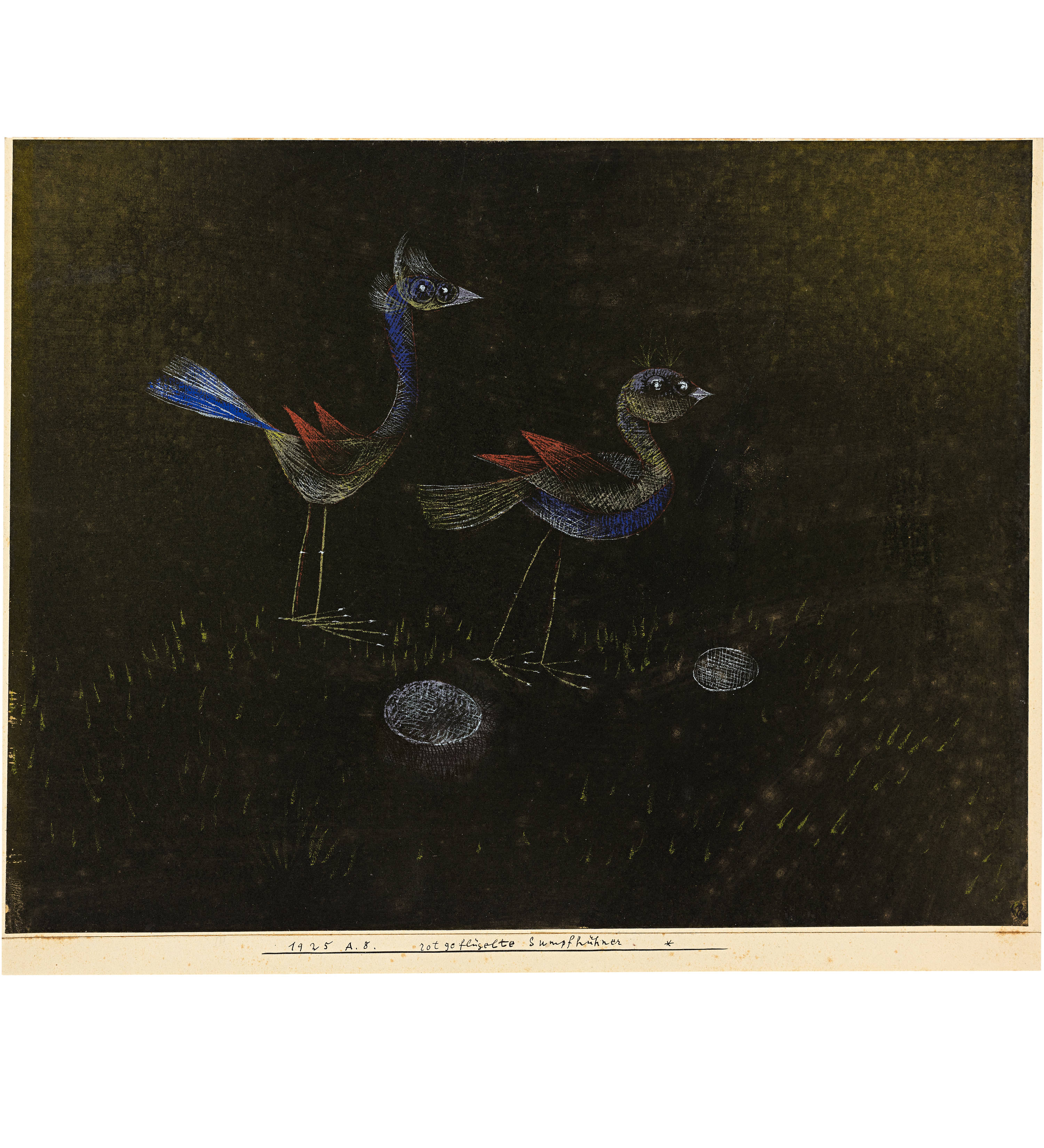
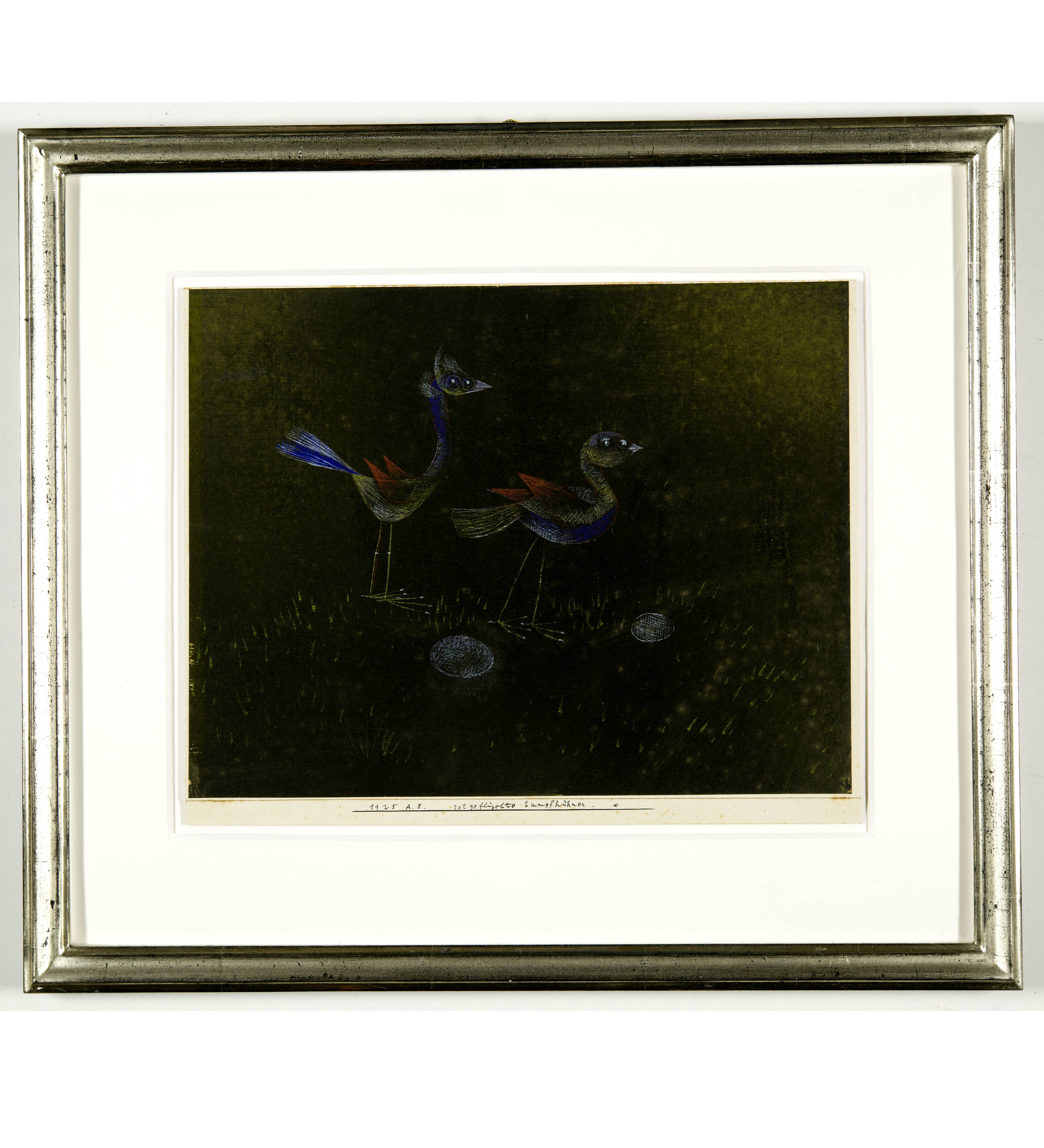
1925 - work number 1925.108 (A 8)
Fine pastels and pen and Indian ink over black wash on gouache or watercolour
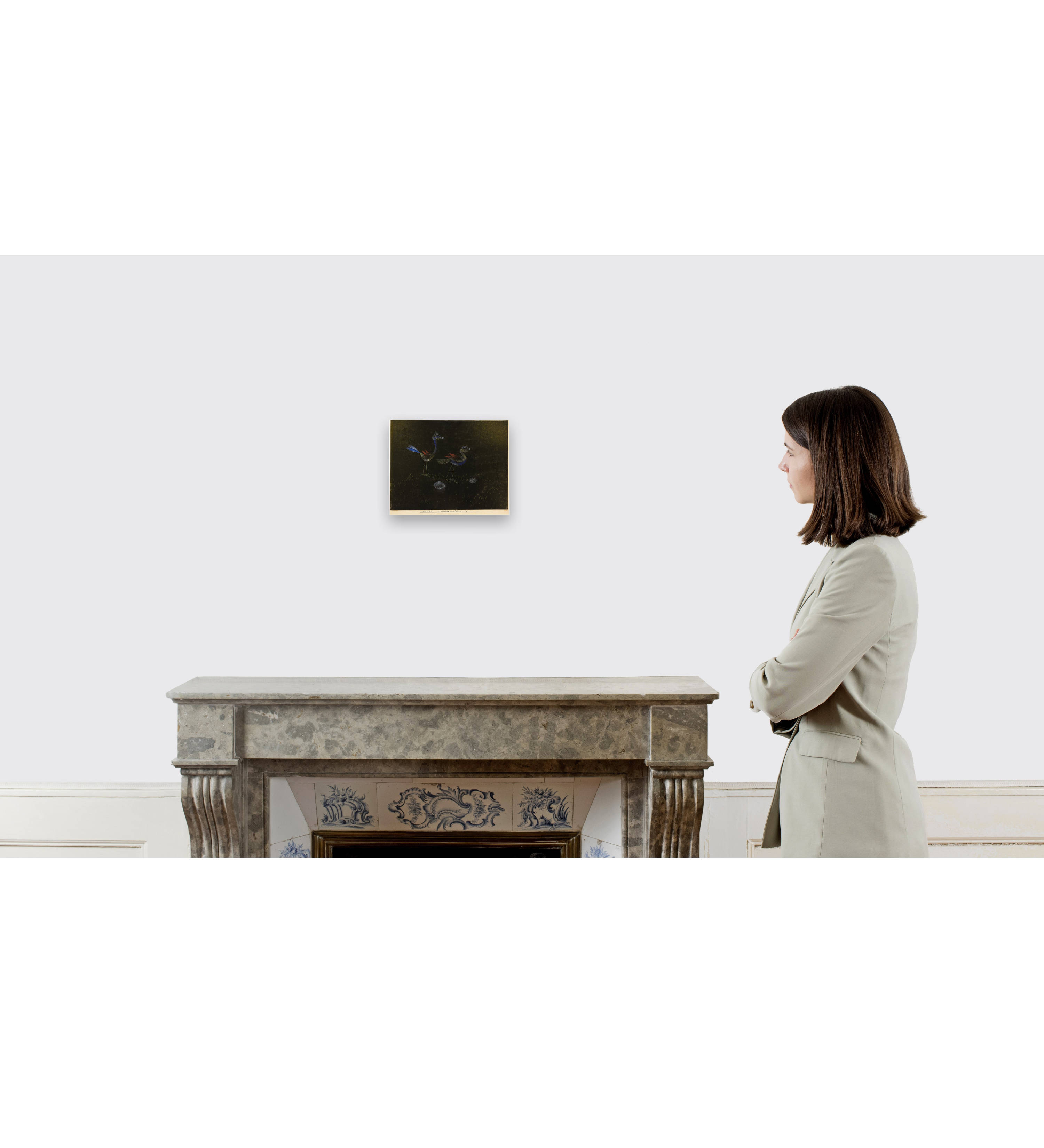
22.8x28.8 cm, image with writing and end line; 23.5x29.4 cm, cardboard
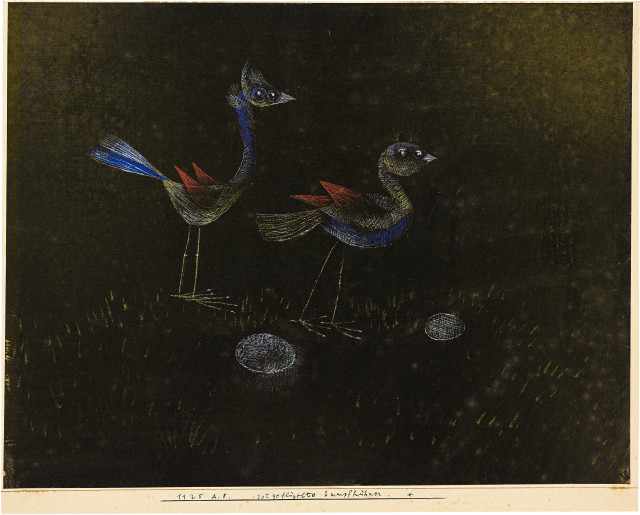
Signed by the artist in ink at lower right "Klee". Inscribed in the centre of the cardboard "1925 A. 8. rotgeflügelte Sumpfhühner *", inscribed on the left in pencil "III"
Catalogue raisonné, Paul Klee, vol. 4, Works 1923-1926, Bern 2000, no. 3789
Collection Hanni Bürgi-Bigler, Bern
Collection Rolf and Catherine E. Bürgi, Bern
Private collection Switzerland
Paul Klee. Der Künstler und die Sammlerin, in: Du, 60th year, no. 703, February 2000, reprod.
Stefan Frey, Hanni Bürgi-Bigler: Sammlerin und Mäzenin Paul Klees. Zur Geschichte ihrer Sammlung, in: Exhibition catalogue Bern/Hamburg/Edinburgh 2000, pag. 19
Bern 1931, Kunsthalle, Paul Klee, Walter Helbig, M. de Vlaminck, Phillipp Bauknecht, Arnold Huggler, cat. no. 18
Bern 1937, Art Museum, Paul Klee. On loan from Mrs. H. Bürgi and property of the Kunstmuseum, cat. no. 56
Basel 1950, Kunstmuseum, Paul Klee, 1879-1940. Ausstellung aus Schweizer Privatsammlungen. Zum 10. Todestag 29. Juni 1950, cat. no. 59
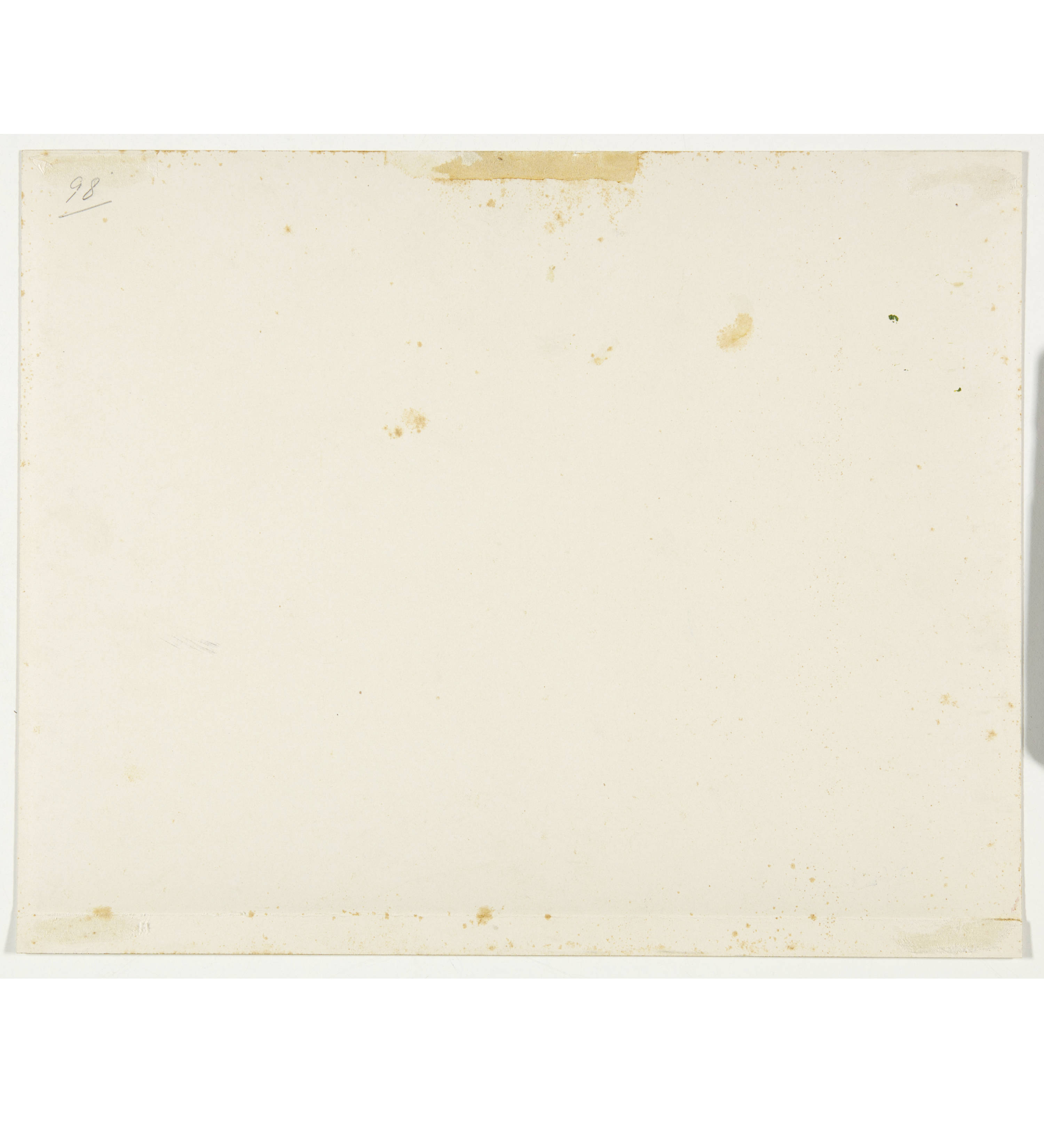
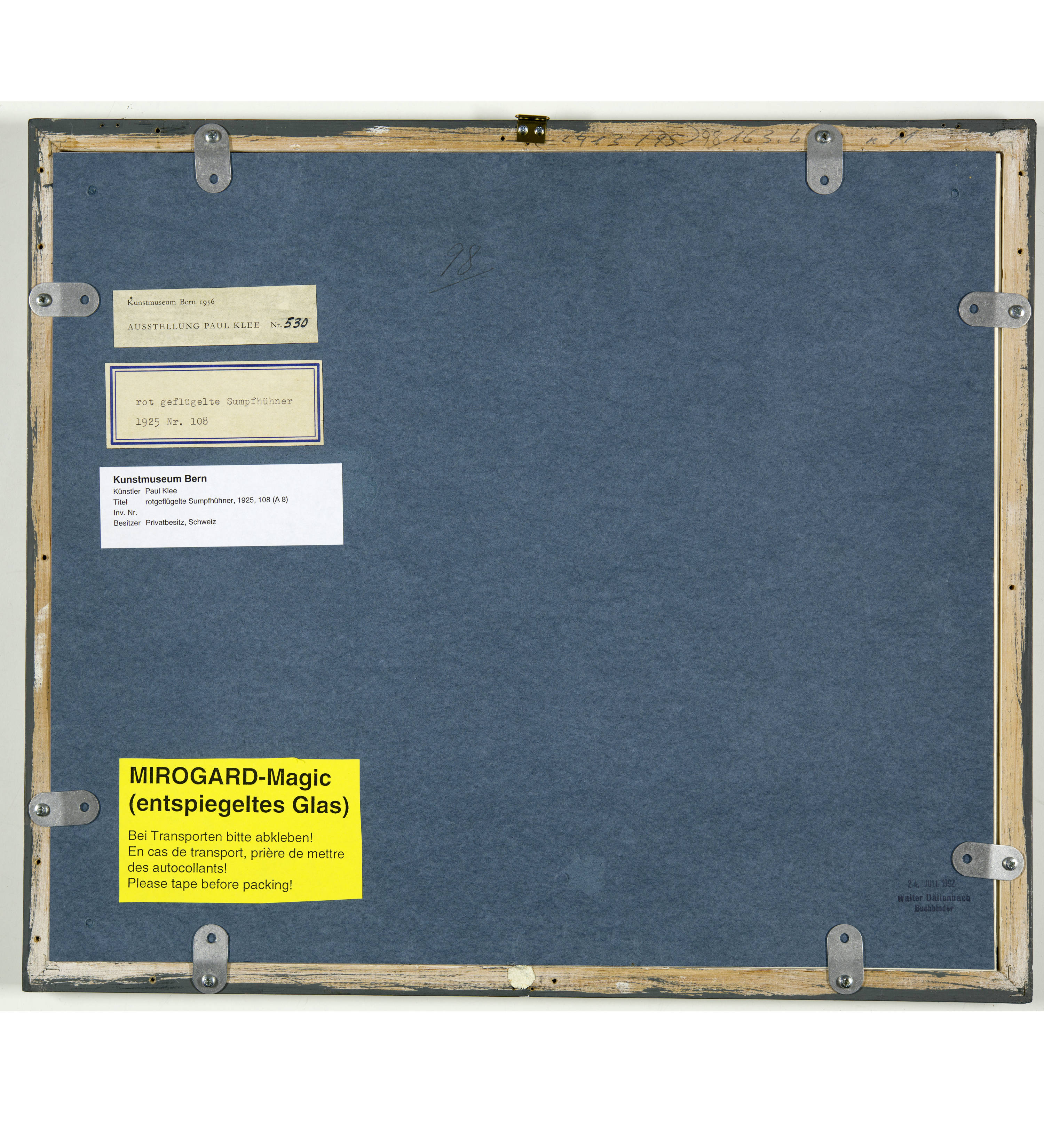
Bern 1956, Museum of Art, Paul Klee. Ausstellung in Verbindung mit der Paul-Klee-Stiftung, cat. no. 530, label on reverse
Andros 1993, Museum of Modern Art, Paul Klee, cat. no. 54, reprod.
Bern/Hamburg/Edinburgh 2000, Kunstmuseum/Kunsthalle/Scottish National Gallery of Modern Art, Paul Klee. Die Sammlung Bürgi, cat. no. 85, reprod.
Old trimmed cardboard, single spots on the cardboard. Fresh in colour and in impeccable overall condition
In October 1920, Paul Klee was appointed master (Meister) by Walter Gropius at the State Bauhaus in Weimar and began teaching there in January 1921. These were very intensive and fruitful creative years for the artist. Due to political pressure, the important teaching institution had to leave Weimar in 1925 and make a new start in Dessau.
As early as the summer of 1905, Klee began to use blackened glass plates as picture supports by working them with a needle. In this way he found a new way of pictorial expression, the "incised drawing". In his diary he described the new process as follows: "The medium is thus no longer the black line, but the white one. The bright energy on a nocturnal ground corresponds very beautifully to the word 'let there be light'. Thus I glide gently over into the new world of tonalities." From then on, scratch drawings or paintings based on them with the finest brushes or with coloured and pastel pencils with the same effect can be found again and again in his œuvre. In 1925 he produced several works with zoological themes, such as the sheet offered here. The two "Paradiesvögel" (Birds of Paradise) shine out of the dark ground. Together with "Betrachtung beim Frühstück" (Viewing at Breakfast, Cat. rais. 3794) in the Berggruen Collection, which was painted shortly afterwards, it forms a wonderful group with "feathered creatures" and eggs.
1925 - Werknummer 1925.108 (A 8)
Feine Pastellkreide und Feder in Tusche über schwarz laviertem Tuschegrund auf Gouache oder Aquarell
22,8x28,8 cm, Darstellung mit Schrift und Abschlussstrich; 23,5x29,4 cm, Karton
Unten rechts vom Künstler in Tusche signiert "Klee". Mittig auf dem Karton bezeichnet "1925 A. 8. rotgeflügelte Sumpfhühner *", links mit Bleistift bezeichnet "III"
Catalogue raisonné, Paul Klee, Band 4, Werke 1923-1926, Bern 2000,
Slg. Hanni Bürgi-Bigler, Bern
Slg. Rolf und Catherine E. Bürgi, Bern
Privatsammlung Schweiz
Paul Klee. Der Künstler und die Sammlerin, in: Du, 60. Jg.,
Stefan Frey, Hanni Bürgi-Bigler: Sammlerin und Mäzenin Paul Klees. Zur Geschichte ihrer Sammlung, in: Ausstellungskatalog Bern/Hamburg/Edinburgh 2000, pag. 19
Bern 1931, Kunsthalle, Paul Klee, Walter Helbig, M. de Vlaminck, Phillipp Bauknecht, Arnold Huggler,
Bern 1937, Kunstmuseum, Paul Klee. Leihgabe der Frau H. Bürgi und Besitz des Kunstmuseums,
Basel 1950, Kunstmuseum, Paul Klee, 1879-1940. Ausstellung aus Schweizer Privatsammlungen. Zum 10. Todestag 29. Juni 1950,
Bern 1956, Kunstmuseum, Paul Klee. Ausstellung in Verbindung mit der Paul-Klee-Stiftung,
Andros 1993, Museum of Modern Art, Paul Klee,
Bern/Hamburg/Edinburgh 2000, Kunstmuseum/Kunsthalle/Scottish National Gallery of Modern Art, Paul Klee. Die Sammlung Bürgi,
Alt beschnittener Karton, einzelne Fleckchen auf dem Karton. Farbfrisch und in tadelloser Gesamterhaltung
Im Oktober 1920 wurde Paul Klee von Walter Gropius als Meister an das Staatliche Bauhaus in Weimar berufen und begann dort seine Lehrtätigkeit im Januar 1921. Es waren sehr intensive und fruchtbare Schaffensjahre für den Künstler. Aufgrund politischen Drucks musste die wichtige Lehrinstitution 1925 Weimar verlassen und in Dessau einen Neuanfang machen
Bereits im Sommer 1905 begann Klee geschwärzte Glasplatten als Bildträger zu verwenden, indem er sie mit einer Nadel bearbeitete. Er fand so eine neue Möglichkeit des bildnerischen Ausdrucks, die "Ritzzeichnung". In seinem Tagebuch beschrieb er das neue Verfahren wie folgt: "Das Mittel ist also nicht mehr der schwarze Strich, sondern der weisse. Die helle Energie auf nächtlichem Grund entspricht sehr schön dem Wort "es werde Licht". So gleite ich sachte hinüber in die neue Welt der Tonalitäten." Fortan finden sich immer wieder Ritzzeichnungen oder daran angelehnte Malereien mit feinsten Pinseln oder mit Farb- und Pastellstiften mit demselben Effekt in seinem Œuvre. 1925 entstanden einige Arbeiten mit zoologischen Themen, so das hier angebotene Blatt. Aus dem dunkeln Grund heraus leuchten die beiden "Paradiesvögel". Zusammen mit dem sich in der Sammlung Berggruen befindlichen "Betrachtung beim Frühstück" (Cat. rais. 3794), das kurz danach entstanden ist, bildet es eine wunderbare Gruppe mit "Federvieh" und Eiern