- EN


 Log in
-
- Live Auctions
- Past auctions
- More
- Kornfeld today
- The Story of Kornfeld
- Information




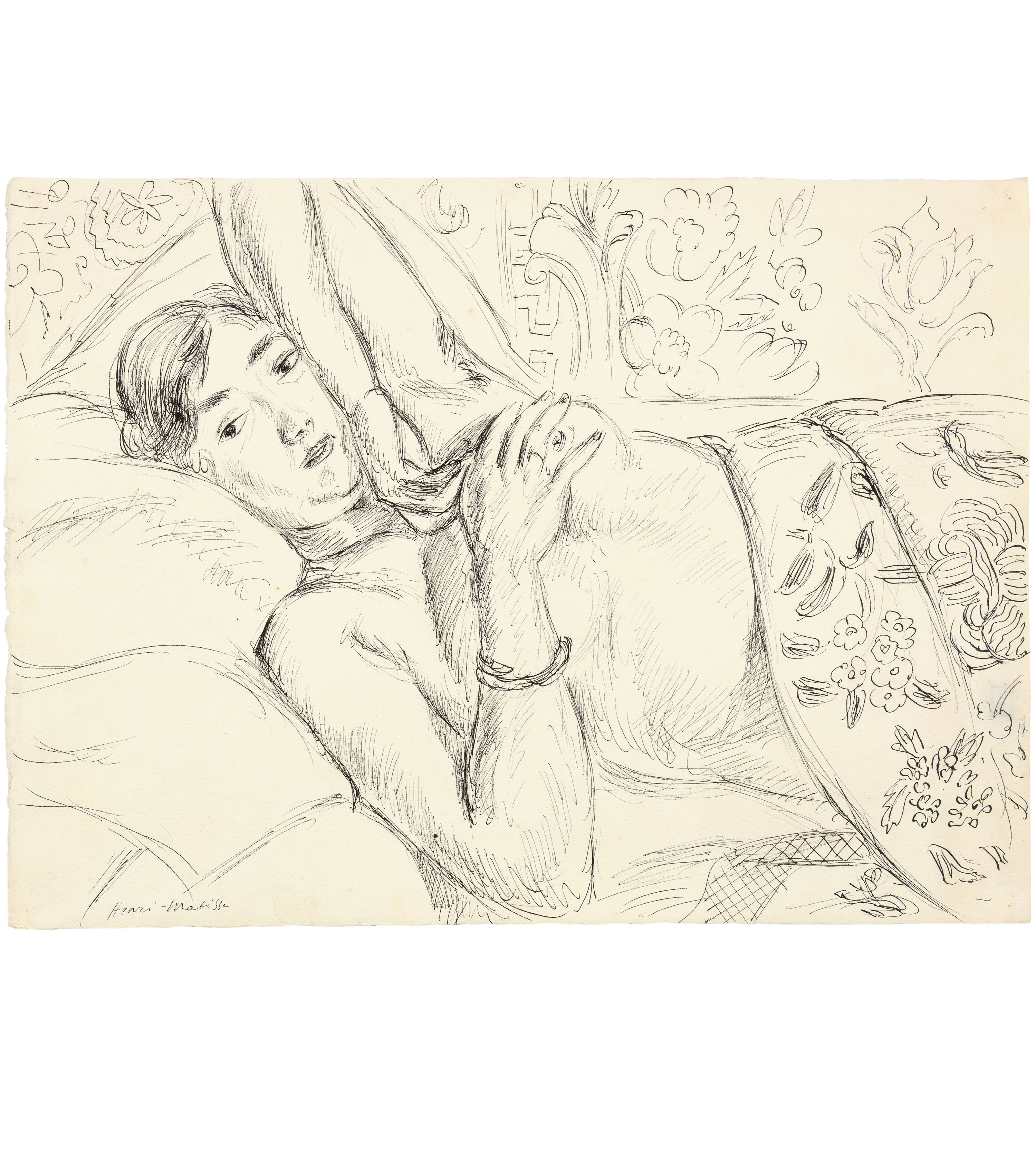
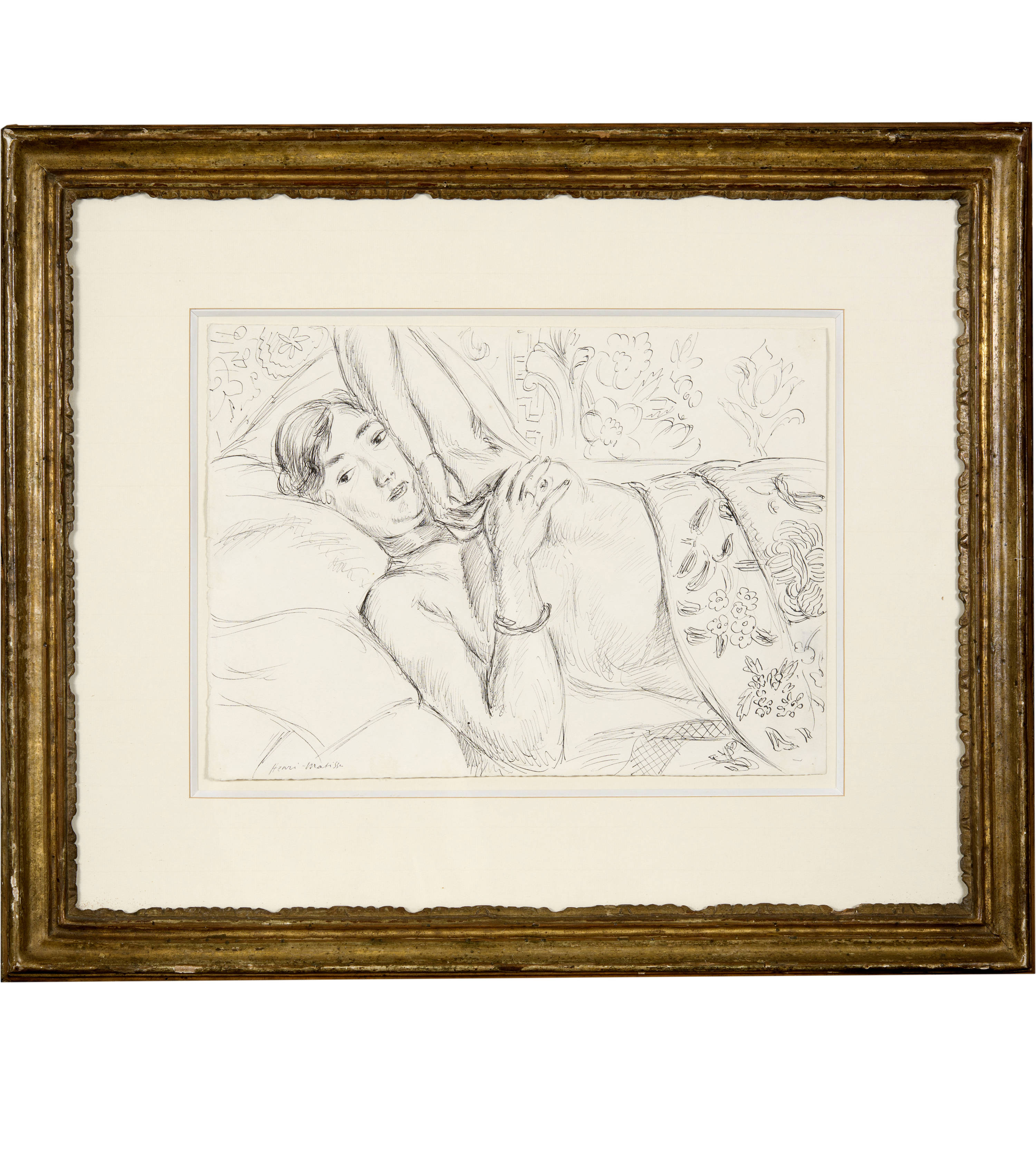
Cateau 1869 - 1954 Nizza



1921
Indian ink on beige MBM wove paper with watermark
28.2x38.6 cm
Lower left signed by the artist in ink "Henri - Matisse"
The present drawing is known to the Archives Henri Matisse, Issy-les-Moulineaux. The buyer can request a confirmation upon request
Estate of the artist, by inheritance to
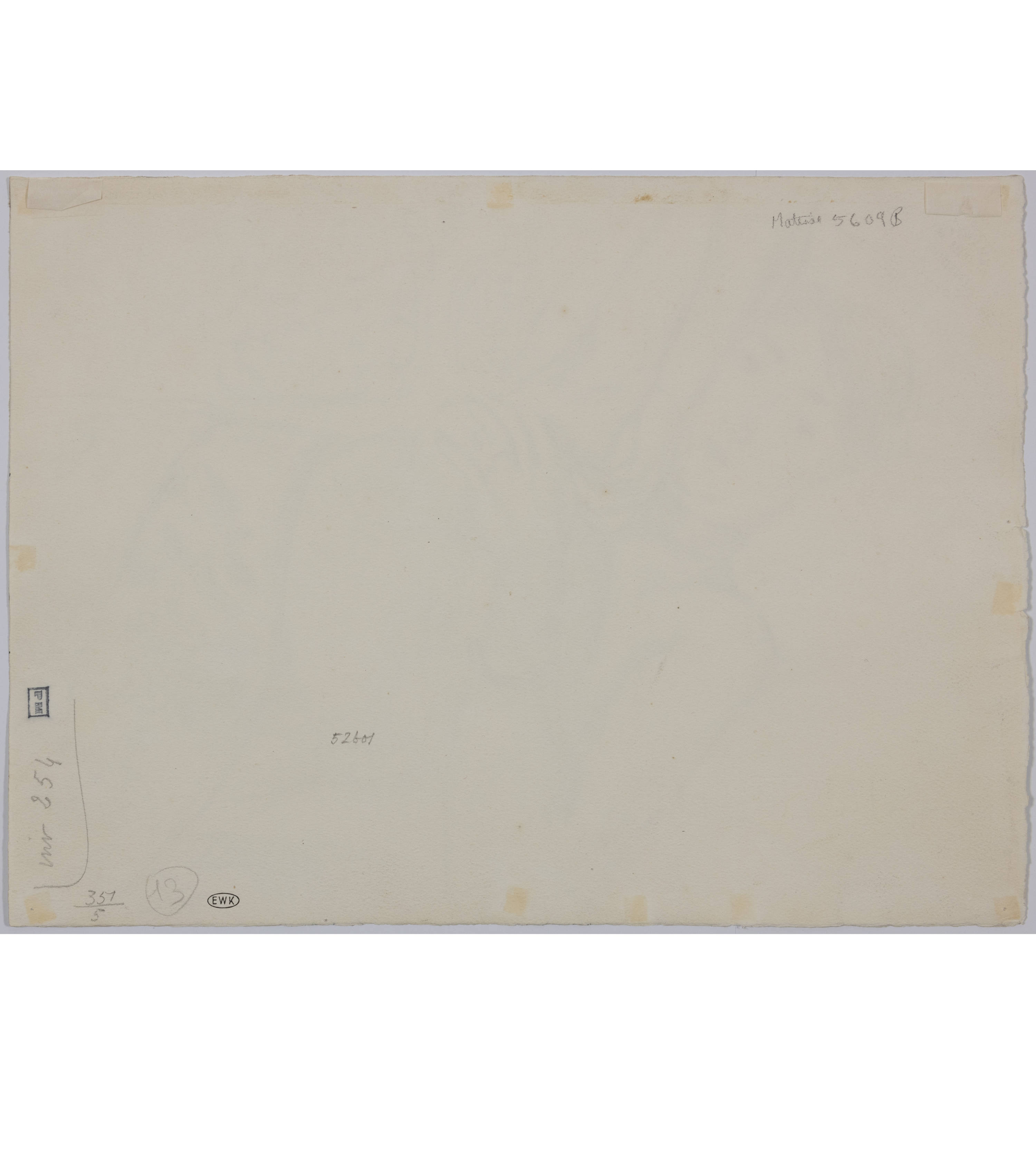
Pierre Matisse, New York, with stamp on the reverse, there acquired in 1971 by
Frumkin Gallery, Chicago, there acquired on 15 December 1972 by
Kornfeld & Cie., Bern, there acquired by
The Eberhard W. Kornfeld Collection, Bern, with the collector's stamp on the reverse, Lugt 913b
Waldemar George, Henri Matisse, Dessins, Paris 1926, fig. Tf. 37
Alexander Romm, Matisse, A Social Critique, New York 1947, p. 69
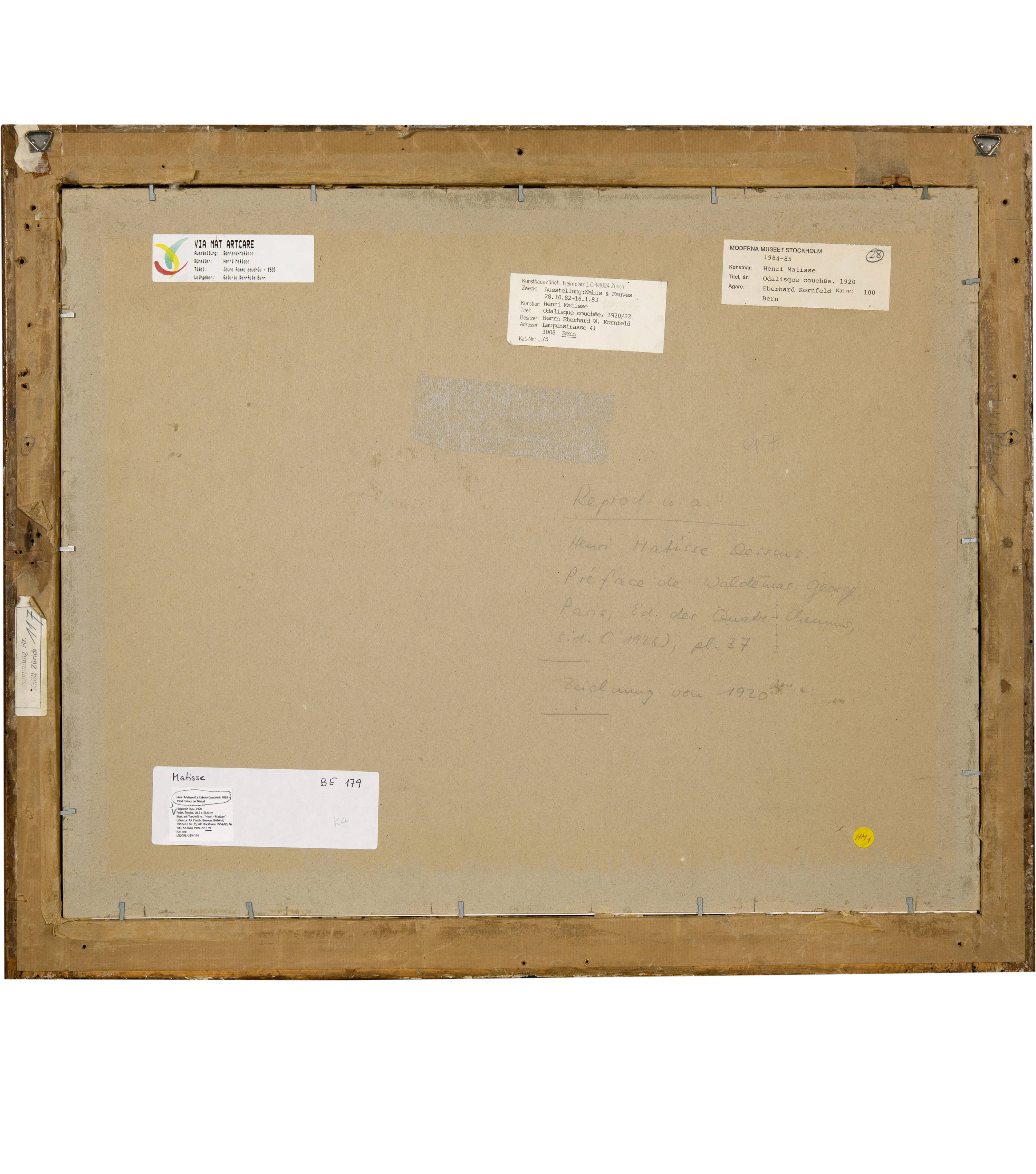
Baltimore/San Francisco/Chicago 1971, Baltimore Museum of Art/Palace of the Legion of Honor/Art Institute of Chicago, Matisse as a Draughtsman, cat. no. 39, Dort betitelt "Reclining Model"
Zurich/Bremen/Bielefeld 1982/1983, Kunsthaus/Kunsthalle/Kunsthalle, Nabis und Fauves, cat. no. 75
Stockholm/Humlebaek 1984/1985, Moderna Museet/Louisiana, Henri Matisse, cat. no. 100
Bern 1989, Kunstmuseum Bern, Von Goya bis Tinguely, Aquarelle und Zeichnungen aus einer Privatsammlung [The Eberhard W. Kornfeld Collection], cat. no. 179
Linz 1995/1996, Neue Galerie der Stadt Linz, Henri Matisse, cat. no. 27
Rome 2006/2007, Complesso del Vittoriano, Bonnard, Matisse, cat. no. 156
Vienna 2008/2009, Albertina, Wege der Moderne, Aus der Sammlung Eberhard W. Kornfeld, cat. no. 22
Artist's pinholes in the upper corners. Two minimal tears on the left sheet edge. On the reverse with traces of old mounting
On medical advice, Henri Matisse stayed in Menton on the Côte d'Azur from 1916, later moving to Nice, which was to become his permanent residence. After initially living in hotels, he moved into an apartment on Place Charles-Félix at the beginning of the 1920s.
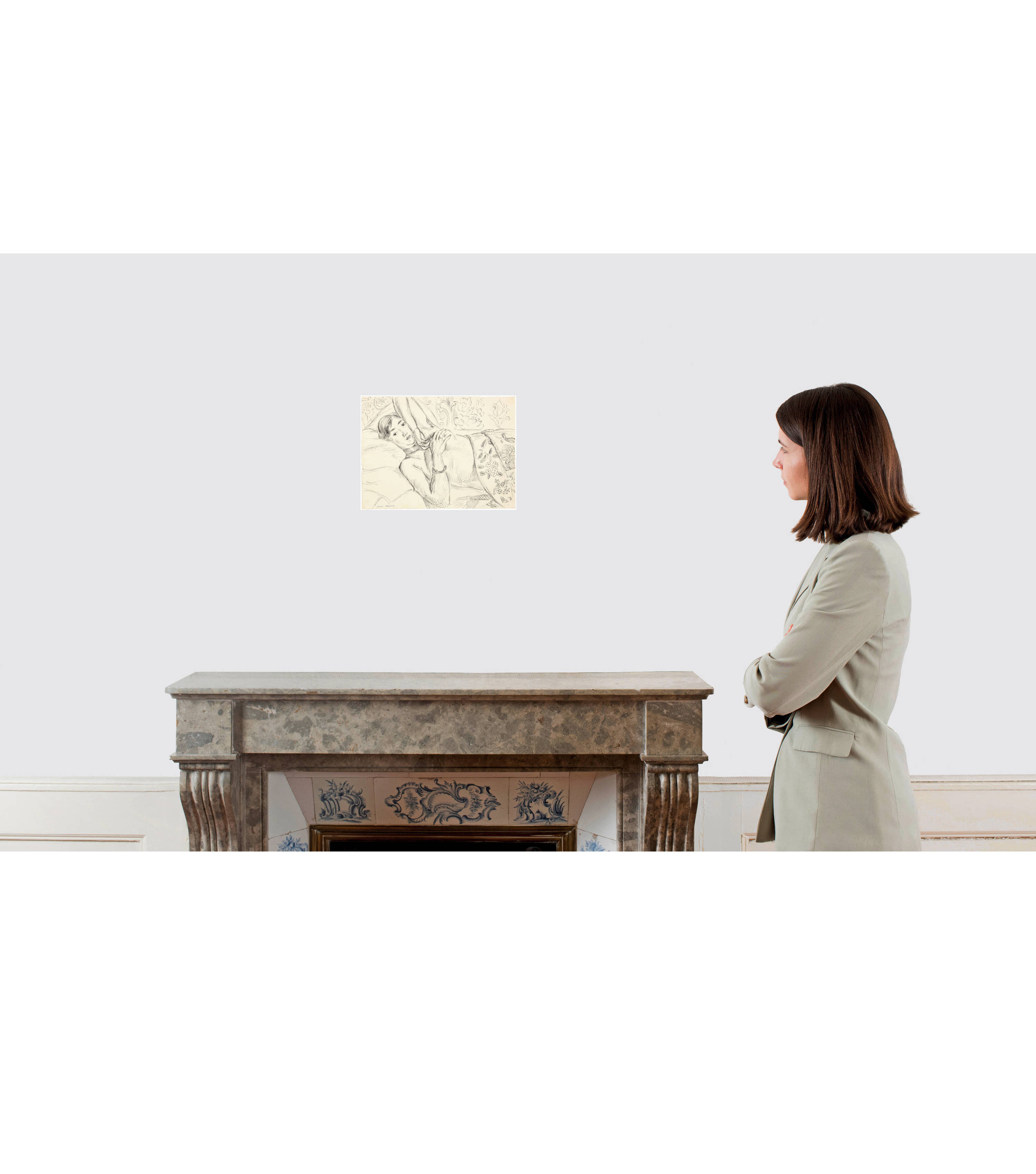
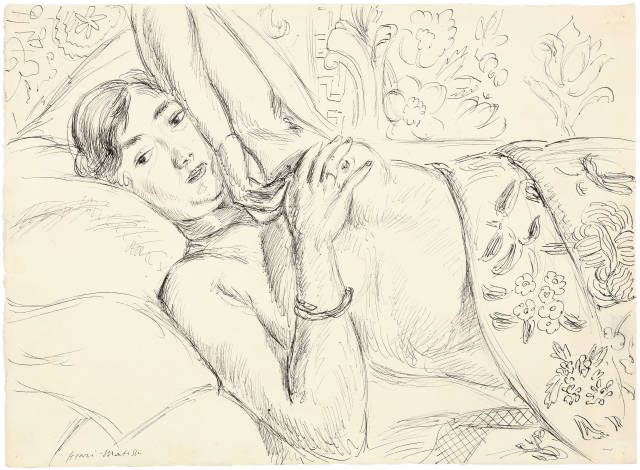
In 1920, Igor Stravinsky's "Le Chant du Rossignol" was premiered in a ballet production by Léonide Massine at the Théâtre National de l'Opéra in Paris. Matisse designed the costumes and stage set. Probably inspired by dance, he returned to working on sculptures, which he had neglected in previous years, and further developed his painting and drawing. The collaboration with Henriette Darricarrère can be seen as a stroke of luck. From 1920 to 1927, she was his most important model, and with her, the group of works known in art history as the "Odalisques" was created. Patterns and ornaments became important; the works were often created in the apartment in Nice. From 1923, Matisse also returned to lithography. The Odalisques created at that time are among the highlights of his graphic art. The sheet offered here is a very early, finely and richly detailed drawing from this group, which can be regarded as an introduction to his engagement with the theme. Matisse always worked in front of the model. It has been reported that Henriette had to hold the same pose for up to ten hours. "Jeune femme couchée" is considered a particularly beautiful example of Matisse's draughtsmanship.
1921
Tusche auf beigem Velin MBM mit Wasserzeichen
28,2x38,6 cm
Unten links vom Künstler in Tusche signiert "Henri - Matisse"
Die vorliegende Zeichnung ist den Archiven Henri Matisse, Issy-les-Moulineaux, bekannt. Der Käufer kann auf Anfrage eine Bestätigung beantragen
Nachlass des Künstlers, durch Erbschaft an
Pierre Matisse, New York, rückseitig mit Stempel, dort 1971 erworben von
Frumkin Gallery, Chicago, dort am 15. Dezember 1972 erworben von
Kornfeld & Cie., Bern, dort erworben von
Slg. Eberhard W. Kornfeld, Bern, rückseitig mit dem Sammlerstempel, Lugt 913b
Waldemar George, Henri Matisse, Dessins, Paris 1926, Abb. Tf. 37
Alexander Romm, Matisse, A Social Critique, New York 1947,
Baltimore/San Francisco/Chicago 1971, Baltimore Museum of Art/Palace of the Legion of Honor/Art Institute of Chicago, Matisse as a Draughtsman,
Zürich/Bremen/Bielefeld 1982/1983, Kunsthaus/Kunsthalle/Kunsthalle, Nabis und Fauves,
Stockholm/Humlebaek 1984/1985, Moderna Museet/Louisiana, Henri Matisse,
Bern 1989, Kunstmuseum Bern, Von Goya bis Tinguely, Aquarelle und Zeichnungen aus einer Privatsammlung [Slg. Eberhard W. Kornfeld],
Linz 1995/1996, Neue Galerie der Stadt Linz, Henri Matisse,
Rom 2006/2007, Complesso del Vittoriano, Bonnard, Matisse,
Wien 2008/2009, Albertina, Wege der Moderne, Aus der Sammlung Eberhard W. Kornfeld,
Oben in den Ecken mit Reissnagellöchern. Auf der linken Blattkante mit zwei minimen Rissen. Auf der Rückseite mit Spuren einer alten Montierung
Henri Matisse hielt sich ab 1916 auf ärztliches Anraten hin in Menton an der Côte d'Azur auf, später in Nizza, das zu seinem festen Domizil werden sollte. Nachdem er zuerst in Hotels gewohnt hatte, zog er Anfang der 1920er-Jahre in eine Wohnung am Place Charles-Félix.
Im Jahr 1920 wurde Igor Stravinskys "Le Chant du Rossignol" in einer Ballettproduktion von Léonide Massine am Théâtre National de l'Opéra in Paris uraufgeführt. Matisse entwarf die Kostüme und das Bühnenbild. Wohl angeregt durch den Tanz widmete er sich erneut der Arbeit an Skulpturen, die er in den vorhergehenden Jahren vernachlässigt hatte, und entwickelte seine Malerei und Zeichnung weiter. Als Glücksfall kann die Zusammenarbeit mit Henriette Darricarrère bezeichnet werden. Von 1920 bis 1927 war sie sein wichtigstes Modell und mit ihr entstand auch die als "Odalisques" in die Kunstgeschichte eingegangene Werkgruppe. Wichtig wurden Muster und Ornamente; die Werke entstanden oft in der Wohnung in Nizza. Ab 1923 beschäftigte sich Matisse dann auch wieder mit der Lithografie. Gerade die damals entstandenen Odalisken gehören zu den Höhepunkten seiner grafischen Kunst. Das hier angebotene Blatt ist eine sehr frühe, fein und detailreich ausgearbeitete Zeichnung aus der Gruppe, die man getrost als Einstieg in die Auseinandersetzung mit dem Thema verstehen kann. Matisse arbeitete jeweils vor dem Modell. Es wurde berichtet, dass Henriette bis zu zehn Stunden in der gleichen Pose ausharren musste. "Jeune femme couchée" gilt als besonders schönes Beispiel von Matisses Zeichenkunst.
| Switzerland | CHF | Individual offer |
| Europe | CHF | Individual offer |
| USA | CHF | Individual offer |
| Overseas | CHF | Individual offer |