- EN


 Log in
-
- Live Auctions
- Past auctions
- More
- Kornfeld today
- The Story of Kornfeld
- Information










Münchenbuchsee bei Bern 1879 - 1940 Muralto


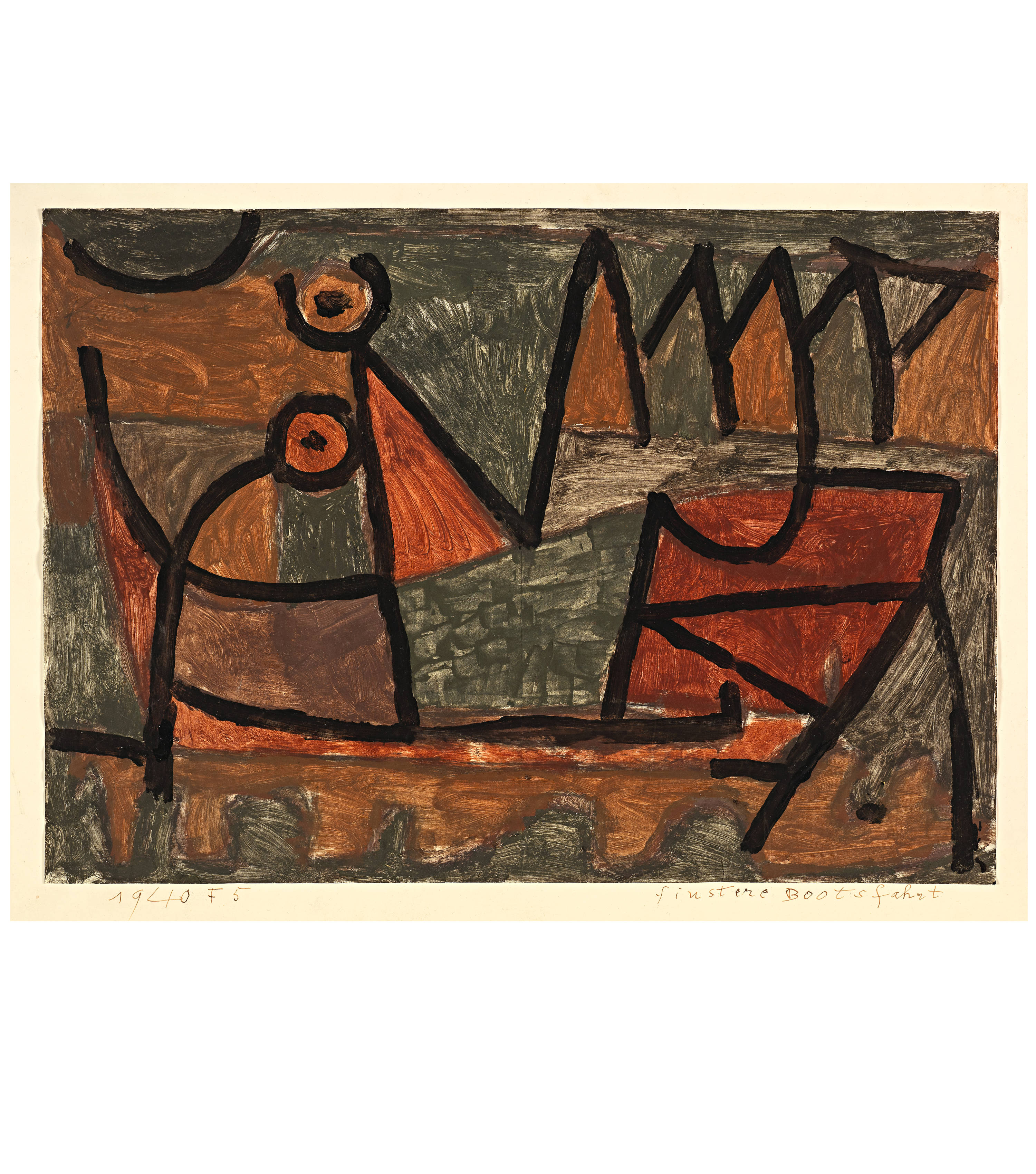
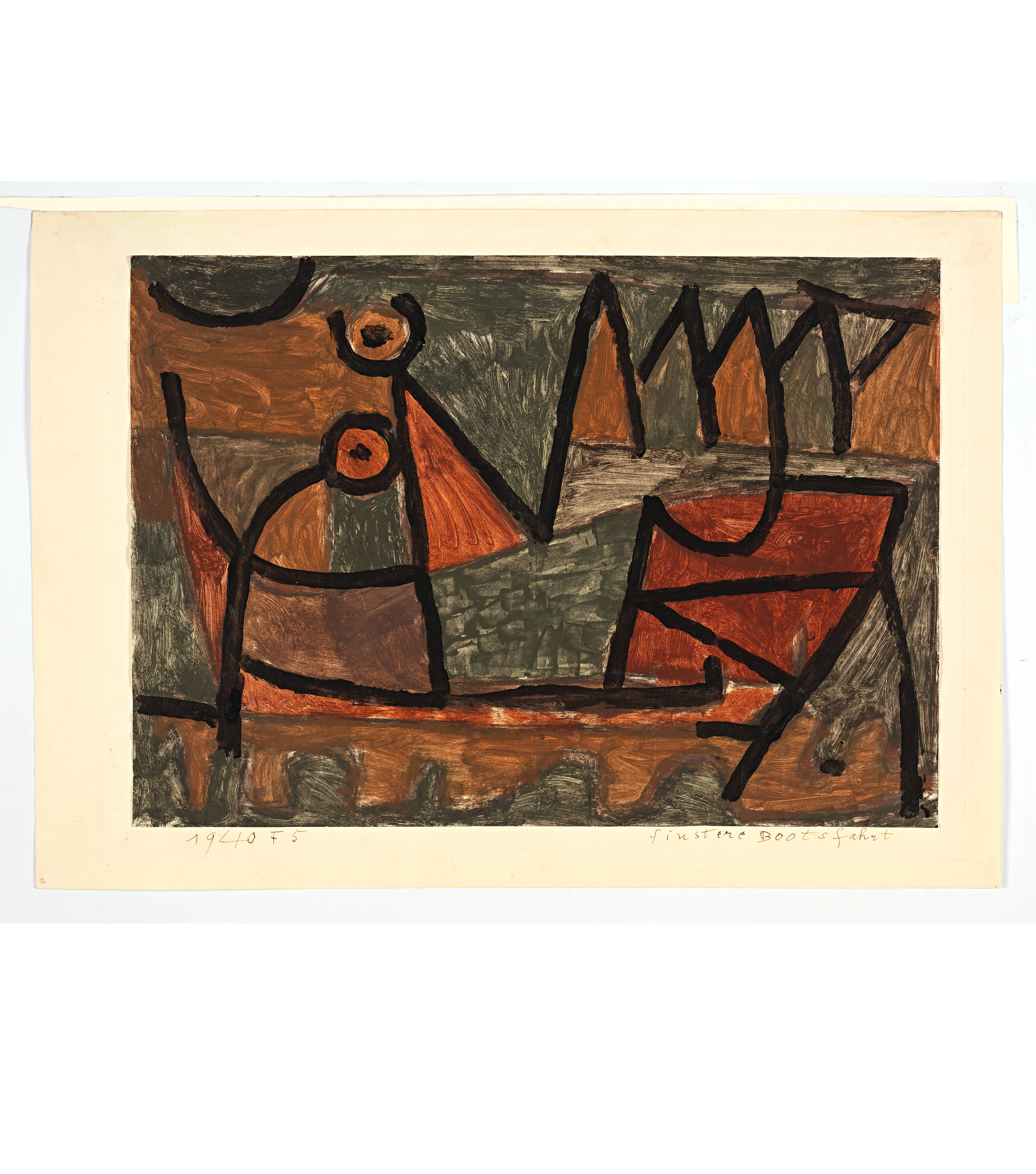
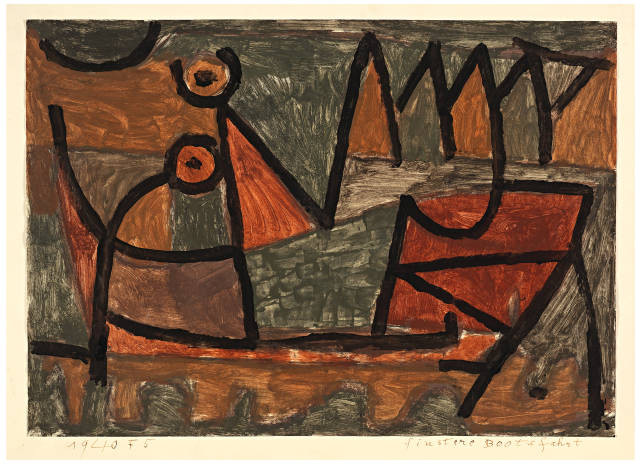
1940 – Work number 1940.345 (F 5)
Paste paint on paper on cardboard
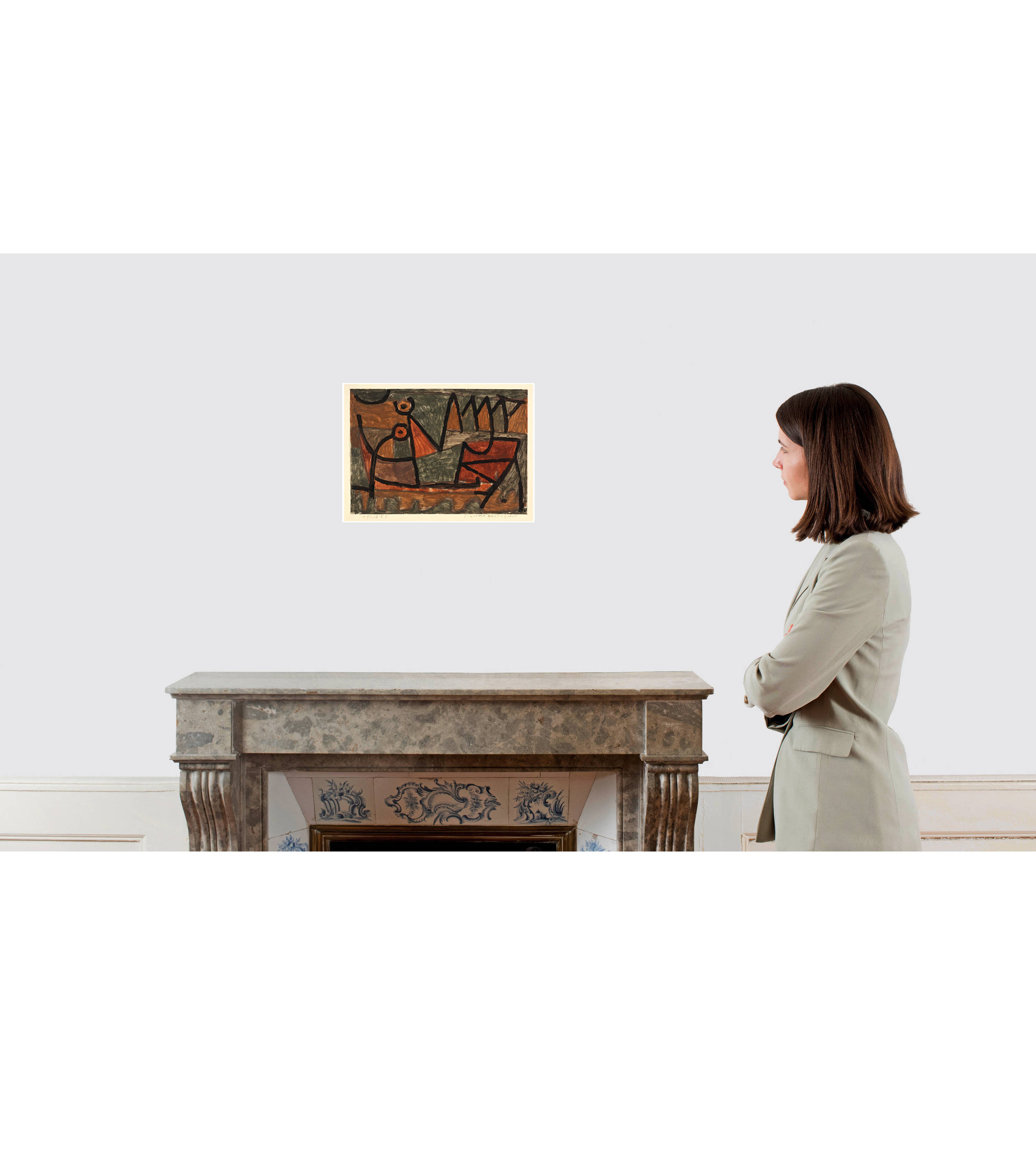
29.4x41.5 cm, image; 34.9x49.9 cm, support
Upper left signed by the artist in paste paint "Klee", below the image in brown ink the work number and the title "1940 F5 finstere Bootsfahrt"
Paul Klee Stiftung, Catalogue raisonné, vol. 9, Werke 1940, Bern 2004, no. 9364
Estate of the artist
Collection Lily Klee, Bern (1940-1946), there acquired by
Klee Society, Bern (1946-1952)
Collection Felix Klee, Bern (1953-1990), by inheritance to
Private collection Switzerland
Werner Haftmann, Paul Klee, Wege bildnerischen Denkens, Munich 1950, p. 173
Will Grohmann, Paul Klee, Stuttgart 1954, p. 357
Nello Ponente, Klee, Biographisch-kritische Studie, aus dem Italienischen von Karl Georg Hemmerich, Geneva 1960, p. 105/117
Walter Ueberwasser, Paul Klees grosses Spätwerk, in: Das Werk, Schweizer Monatsschrift für Architektur, Kunst, Künstlerisches Gewerbe, Winterthur 1965, p. 459/466
Walter Ueberwasser, 35 Finstere Bootsfahrt, 1940, in: Klee. Spätwerke, Basel 1965, fig.
Will Grohmann, Der Maler Paul Klee, Cologne 1966, p. 42
Christina Kröll, Die Bildtitel Paul Klees, Eine Studie zur Beziehung von Bild und Sprache in der Kunst des zwanzigsten Jahrhunderts, Dissertation, Bonn 1968, p. 175
Alfred Eggenspieler, Kunst?! Dekadenz oder Offenbarung, Ettal 1969, p. 152
Max Huggler, Paul Klee, Die Malerei als Blick in den Kosmos, Frauenfeld/Stuttgart 1969, p. 224
Denys Chevalier, Klee, Munich 1979, p. 89
Sadao Wada, Paul Klee and his Travels, Tokyo 1979, no. 490
Lothar Lang, Hrsg., Paul Klee, Die Zwitschermaschine und andere Grotesken, Berlin 1981, p. 206
Delphine Renard, Actualité des dernières œuvres de Paul Klee, in: Ausstellungskatalog Paul Klee. ŒUvres de 1933 à 1940, Nîmes 1984, p. 84
Otto Karl Werckmeister, Paul Klee in Exile, in: Ausstellungskatalog Paul Klee in Exile 1933-1940, Himeji 1985, p. 61
Michèle Vishny, Paul Klee's Self-Images, in: PPA Psychoanalytic Perspectives on Art, hrsg. Von Mary Mathews Gedo, Hillsdale/London 1985, p. 161
Werner Haftmann, Verfemte Kunst, Bildende Künstler der inneren und äusseren Emigration in der Zeit des Nationalsozialismus, Cologne 1986, p. 124/125
Constance Naubert-Riser, Klee, mit einer Einführung von Gualtieri di San Lazzaro, Zug 1990, p. 124
Paul Klee, Verzeichnis der Werke des Jahres 1940, hrsg. Von der Paul-Klee-Stiftung, Kunstmuseum Bern, bearbeitet von Stefan Frey und Josef Helfenstein unter Mithilfe von Irene Rehmann, Stuttgart 1991, p. 206
Ulrich Bischoff, Paul Klee, Munich 1992, p. 135
Kathryn Elaine Kramer, Mythopoetic Politics and the Transformation of the Classical Underworld Myth in the Late Work of Paul Klee, Dissertation, New York 1993, p. 79/101
Kathryn E. Kramer, Paul Klees ägyptische Idyllen, in: Paul Klee, Reisen in den Süden. Reisefieber praecisiert, Ostfildern-Ruit 1997, p. 106
Marco Vozza, Klee e le forme del visibile, in: Paul Klee, Figure e metamorfosi, Bologna 2000, p. 60
Matthias Bärmann, als ob es mich selber anginge, Emigration, Krankheit und Schaffensprozess im letzten Lebensabschnitt von Paul Klee / As if it concerned myself, Emigration, Illness and the Creative Process in Paul Klee's Last Years, in: Paul Klee, Die Erfüllung im Spätwerk, Fulfillment in the Late Work, Wabern/Bern 2003, p. 16/160
Tilman Osterwold, Zeichnung nach Innen, in: Paul Klee, Kein Tag ohne Linie, hrsg. Vom Zentrum Paul Klee, Ostfildern-Ruit 2005, p. 28/169
Makoto Miyashita, Paul Klee, Der überschreitende Engel, Tokyo 2009, p. 240
Makoto Shindo, Paul Klee, Chichukai no tabi [Paul Klees Reisen durch das Mittelmeergebiet], Tokyo 2014, p. 110
Hajo Düchting, Paul Klee, Cologne/Paris 2016, p. 279
Ingrid Riedel, finstere Bootsfahrt, 1940, 345 (F5), in: Paul Klee, Zwischen Himmel und Erde, Bilderwelten von Paul Klee, Lindau 2017, p. 138/139
Brigitte Uhde-Stahl, Paul Klees geheime Symbolik, Berlin 2018, p. 235
Barbara Smitmans-Vajda, Die Zeit, Aktuelle Gedichte zu Bildern aus Paul Klees Spätwerk (1933-1940), Würzburg 2019, p. 52/53
Fabienne Eggelhöfer, Auf den Spuren der Zeitlosigkeit, Eine Illusion der Moderne, in: Kunst der Vorzeit, Felsbilder der Frobenius-Expeditionen, hrsg. Von Karl-Heinz Kohl, Richard Kuba und Hélène Ivanoff, Munich 2021, p. 243
Düsseldorf/Mannheim/Freiburg i.Br. 1948/1949, Hetjens-Museum/Kunsthalle/Kunstverein, Late Works by Paul Klee (1879-1940), Loans from the Paul Klee Society Bern, cat. no. 30
Munich 1954, Haus der Kunst, Paul Klee, cat. no. 214
St. Gallen 1955, Kunstverein im Kunstmuseum, Klee, Works from the Family Collection, cat. no. 396
Recklinghausen 1956, Kunsthalle, 10th Ruhr Festival, Beginning and Maturity, cat. no. 139
Grenoble 1960, Musée de Peinture et de Sculpture, Exposition Paul Klee, 1879-1940, cat. no. 64
Berlin 1960, Akademie der Künste, Paul Klee, Works from the Felix Klee Estate Collection, cat. no. 186
Stockholm 1961, Moderna Museet, Paul Klee, cat. no. 164
Helsinki-Helsingfors 1961, Ateneumin Taidemuseo, Paul Klee, Maalauksia, piirustuksia ja grafiikkaa, Målningar, teckningar och grafiska blad, cat. no. 164
Wiesbaden/Baden-Baden 1962, Städtisches Museum/Staatliche Kunsthalle, Klee, Coloured Sheets from the Late Work, cat. no. 53
Ulm 1962/1963, Museum Ulm, Paul Klee, cat. no. 88
Basel 1965, Galerie Beyeler, Klee, Late Works, cat. no. 35
Bern 1966, Kunstmuseum, From the Felix Klee Collection, Paul Klee, Kandinsky, Jawlensky, Marc, Feininger et al., cat. no. 149
London 1966, Marlborough Fine Art Ltd., Kandinsky and his Friends, Centenary Exhibition, cat. no. 78
Bremen 1967, Kunsthalle, Paul Klee, Watercolours, Drawings, cat. no. 209
Essen 1969, Museum Folkwang, Paul Klee, Watercolours and Drawings, cat. no. 161
Paris 1969/1970, Musée national d'Art Moderne, Paul Klee, cat. no. 141
Munich 1970, Haus der Kunst, Paul Klee 1879-1940, cat. no. 295
London 1971, Roland, Browse & Delbanco, Paul Klee, 60 Watercolours From the Collection of Felix Klee (on loan), cat. no. 60
Braunschweig/Goslar 1975/1976, Kunstverein/Junior Galerie, Paul Klee, Bilder, Aquarelle, Zeichnungen, Sammlung Felix Klee, cat. no. 79
Tokyo/Takasaki/Nagoya/Kobe/Kamakura 1976, Odakyu Department Store/Gumma Museum/Matsuzakaya Department Store/Sogo Department Store/The Museum of Modern Art, Paul Klee and his Painter Friends, cat. no. 111
Delmenhorst 1977, Städtische Galerie, Haus Coburg, Paul Klee, Paintings, Watercolours, Drawings from the Felix Klee Collection, Bern, cat. no. 42
Ottawa/Toronto 1979, The National Gallery of Canada/Art Gallery of Ontario, A Tribute to, Hommage à Paul Klee 1879-1940, cat. no. 76
Rome 1979, Casino dell'Aurora, Palazzo Pallavicini-Rospigliosi, Paul Klee- Oli (1924-1940), acquarelli (1910–1940), disegni (1927–1940), cat. no. 102
Hanover 1980, Kestner-Gesellschaft, Paul Klee- Sammlung Felix Klee, cat. no. 116
Tokyo 1980, The Seibu Museum of Art, Paul Klee, cat. no. 234
Madrid/Barcelona 1981, Fundación Juan March/Fundació Juan Miró, Klee- Oleos, acuarelas, dibujos y grabados, Klee, Olis, aquarelles, dibuixos i gravats, cat. no. 93
Ludwigshafen am Rhein 1981/1982, Wilhelm-Hack-Museum, Paul Klee (1879-1940), Inner Paths, cat. no. 196
Frankfurt-Hoechst/Munich 1983, Jahrhunderthalle/Museum Villa Stuck, Paul Klee, Paintings, Watercolours, Drawings, Prints, cat. no. 73
Nîmes 1984, Musée des Beaux-Arts, Paul Klee, Œuvres de 1933 à 1940, cat. no. 85
Dresden 1984, Staatliche Kunstsammlungen/Kupferstich-Kabinett, Albertinum, Paul Klee, Paintings, Coloured Sheets, Drawings, Prints from the Kunstmuseum Bern, Paul Klee Foundation and Bern Private Collection, cat. no. 315
Paris 1985, Galerie Karl Flinker, Paul Klee, Les dix dernières années, cat. no. 46
Himeji/Sendai/Kamakura/Shiga/Niigata 1985/1986, City Museum of Art/Miyagi Museum of Art/The Museum of Modern Art/The Museum of Modern Art/City Art Museum, Paul Klee in Exile 1933-1940, cat. no. 39
Copenhagen 1986, Gallerihuset, Paul Klee (1879-1940), p. 89
Kiel 1987, Kunsthalle, In Balance, Paul Klee and Modernism, Nestler, Ruthenbeck, Visch, cat. no. 39
Visp 1989, Schützenlaube/Dreikönigskirche/Burgenerhaus, Paul Klee, cat. no. 72
Mendrisio 1990, Museo d'arte, Paul Klee, Ultimo decennio/Letztes Jahrzehnt 1930-1940, without cat.
Bern 1990, Kunstmuseum, Paul Klee, The Work in the Year of Death, cat. no. 314
Kanazawa/Tokyo/Kochi/Kyoto/Kasama/Hamamatsu/Osaka 1995/1996, Ishikawa Prefectural Museum of Art/Daimaru Museum/The Museum of Art/Daimaru Museum/Nichido Museum of Art/Municipal Museum of Art/Daimaru Museum, Klee aus der Sammlung der Familie, Die Zeit der Reife, cat. no. 111
Mannheim 1996, Städtische Kunsthalle, Paul Klee, Die Zeit der Reife, Werke aus der Sammlung der Familie Klee, p. 149
Hamm/Leipzig 1997, Gustav-Lübcke Museum/Museum der bildenden Künste, Paul Klee, Reisen in den Süden, Reisefieber praecisiert, cat. no. 97
Kamakura/Morioka/Tsu/Matsumoto 2002, The Museum of Modern Art/Iwate Museum of Art/Mie Prefectural Art Museum/City Museum of Art, Paul Klee and His Travels, cat. no. 240
Riehen/Hanover 2003/2004, Fondation Beyeler/Sprengel Museum, Paul Klee, Tod und Feuer, Die Erfüllung im Spätwerk, cat. no. 118
Bern/Cologne 2005/2006, Zentrum Paul Klee/Museum Ludwig, Paul Klee, Kein Tag ohne Linie, p. 169
Bern 2012, Zentrum Paul Klee, Unheimlich, Hexen, Geister und Dämonen bei Paul Klee, without catalogue
Lugano 2013, Museo d'Arte, Klee, Melotti, cat. no. 140
Bern 2015, Zentrum Paul Klee, Klee in Bern [2nd part], without catalogue
Lindau 2017, Stadtmuseum, Paul Klee, Zwischen Himmel und Erde, Bilderwelten von Paul Klee, p. 139
Bern 2019, Zentrum Paul Klee, Kandinsky, Arp, Picasso… Klee & Friends, without cat.
Zurich 2021, Museum Rietberg, Art of Prehistory, Rock Paintings of the Frobenius Expeditions
Bern 2021, Zentrum Paul Klee, Paul Klee, Ich will nichts wissen, without cat.
Villeneuve d'Ascq 2021/2022, LaM, Paul Klee, Entre mondes, without cat.
The paper slightly browned and with a barely visible light margin, traces of old mounting on the reverse. Fresh in colour and in outstanding condition
"Finstere Bootsfahrt" was created in 1940, during the last months of Paul Klee's life, and is one of the very typical creations of his late work. Despite the progression of scleroderma, his artistic productivity reached a final peak in 1939 and 1940. In 1939, 1,253 registered works were created, and in 1940, another 398. Apart from the approximately 30 last untitled works in the oeuvre, the works bear, until the end, Klee's typically well-considered titles. The works of this period are characterized by an extraordinary compression of visual language: generous black lines, simplified symbolic forms, and a palette reduced to a few tones give them an intense, almost archaic effect. The large gestures and the emblematic formal language are pronounced, both also conditioned by the progression of his illness.
The shadowy figures do not appear as individual persons, but as symbols of an existential journey. With the simplest of artistic means, Klee creates an atmosphere of uncertainty and suspension, without fixing the scene narratively. It is precisely this openness that is one of the great qualities of his late work.
Since antiquity, the boat has been a symbol of the transition between worlds. Against the background of Klee's serious illness and his awareness of his own mortality, a connection to the passage to the hereafter is suggested. As in many of his late works, he transforms personal experiences and historical events into a timeless visual language whose poetic power arises precisely from its ambiguity.
1940 - Werknummer 1940.345 (F 5)
Kleisterfarbe auf Papier auf Karton
29,4x41,5 cm, Darstellung; 34,9x49,9 cm, Unterlage
Oben links vom Künstler in Kleisterfarbe signiert "Klee", unter der Darstellung mit brauner Tinte die Werknummer und der Titel "1940 F5 finstere Bootsfahrt"
Paul Klee Stiftung, Catalogue raisonné, Band 9, Werke 1940, Bern 2004,
Nachlass des Künstlers
Slg. Lily Klee, Bern (1940-1946), dort erworben von
Klee-Gesellschaft, Bern (1946-1952)
Slg. Felix Klee, Bern (1953-1990), durch Erbschaft an
Privatsammlung Schweiz
Werner Haftmann, Paul Klee, Wege bildnerischen Denkens, München 1950,
Will Grohmann, Paul Klee, Stuttgart 1954,
Nello Ponente, Klee, Biographisch-kritische Studie, aus dem Italienischen von Karl Georg Hemmerich, Genf 1960,
Walter Ueberwasser, Paul Klees grosses Spätwerk, in: Das Werk, Schweizer Monatsschrift für Architektur, Kunst, Künstlerisches Gewerbe, Winterthur 1965,
Walter Ueberwasser, 35 Finstere Bootsfahrt, 1940, in: Klee. Spätwerke, Basel 1965, Abb.
Will Grohmann, Der Maler Paul Klee, Köln 1966,
Christina Kröll, Die Bildtitel Paul Klees, Eine Studie zur Beziehung von Bild und Sprache in der Kunst des zwanzigsten Jahrhunderts, Dissertation, Bonn 1968,
Alfred Eggenspieler, Kunst?! Dekadenz oder Offenbarung, Ettal 1969,
Max Huggler, Paul Klee, Die Malerei als Blick in den Kosmos, Frauenfeld/Stuttgart 1969,
Denys Chevalier, Klee, München 1979,
Sadao Wada, Paul Klee and his Travels, Tokyo 1979,
Lothar Lang, Hrsg., Paul Klee, Die Zwitschermaschine und andere Grotesken, Berlin 1981,
Delphine Renard, Actualité des dernières œuvres de Paul Klee, in: Ausstellungskatalog Paul Klee. Œuvres de 1933 à 1940, Nîmes 1984,
Otto Karl Werckmeister, Paul Klee in Exile, in: Ausstellungskatalog Paul Klee in Exile 1933-1940, Himeji 1985,
Michèle Vishny, Paul Klee's Self-Images, in: PPA Psychoanalytic Perspectives on Art, hrsg. von Mary Mathews Gedo, Hillsdale/London 1985,
Werner Haftmann, Verfemte Kunst, Bildende Künstler der inneren und äusseren Emigration in der Zeit des Nationalsozialismus, Köln 1986,
Constance Naubert-Riser, Klee, mit einer Einführung von Gualtieri di San Lazzaro, Zug 1990,
Paul Klee, Verzeichnis der Werke des Jahres 1940, hrsg. von der Paul-Klee-Stiftung, Kunstmuseum Bern, bearbeitet von Stefan Frey und Josef Helfenstein unter Mithilfe von Irene Rehmann, Stuttgart 1991,
Ulrich Bischoff, Paul Klee, München 1992,
Kathryn Elaine Kramer, Mythopoetic Politics and the Transformation of the Classical Underworld Myth in the Late Work of Paul Klee, Dissertation, New York 1993,
Kathryn E. Kramer, Paul Klees ägyptische Idyllen, in: Paul Klee, Reisen in den Süden. Reisefieber praecisiert, Ostfildern-Ruit 1997,
Marco Vozza, Klee e le forme del visibile, in: Paul Klee, Figure e metamorfosi, Bologna 2000,
Matthias Bärmann, als ob es mich selber anginge, Emigration, Krankheit und Schaffensprozess im letzten Lebensabschnitt von Paul Klee / As if it concerned myself, Emigration, Illness and the Creative Process in Paul Klee's Last Years, in: Paul Klee, Die Erfüllung im Spätwerk, Fulfillment in theLate Work, Wabern/Bern 2003,
Tilman Osterwold, Zeichnung nach Innen, in: Paul Klee, Kein Tag ohne Linie, hrsg. vom Zentrum Paul Klee, Ostfildern-Ruit 2005,
Makoto Miyashita, Paul Klee, Der überschreitende Engel, Tokyo 2009,
Makoto Shindo, Paul Klee, Chichukai no tabi [Paul Klees Reisen durch das Mittelmeergebiet], Tokyo 2014,
Hajo Düchting, Paul Klee, Köln/Paris 2016,
Ingrid Riedel, finstere Bootsfahrt, 1940, 345 (F5), in: Paul Klee, Zwischen Himmel und Erde, Bilderwelten von Paul Klee, Lindau 2017,
Brigitte Uhde-Stahl, Paul Klees geheime Symbolik, Berlin 2018,
Barbara Smitmans-Vajda, Die Zeit, Aktuelle Gedichte zu Bildern aus Paul Klees Spätwerk (1933-1940), Würzburg 2019,
Fabienne Eggelhöfer, Auf den Spuren der Zeitlosigkeit, Eine Illusion der Moderne, in: Kunst der Vorzeit, Felsbilder der Frobenius-Expeditionen, hrsg. von Karl-Heinz Kohl, Richard Kuba und Hélène Ivanoff, München 2021,
Düsseldorf/Mannheim/Freiburg i.Br. 1948/1949, Hetjens-Museum/Kunsthalle/Kunstverein, Späte Werke von Paul Klee (1879-1940), Leihgaben der Paul-Klee-Gesellschaft Bern,
München 1954, Haus der Kunst, Paul Klee,
St. Gallen 1955, Kunstverein im Kunstmuseum, Klee, Werke aus dem Familienbesitz,
Recklinghausen 1956, Kunsthalle, 10. Ruhr-Festspiele, Beginn und Reife,
Grenoble 1960, Musée de Peinture et de Sculpture, Exposition Paul Klee, 1879-1940,
Berlin 1960, Akademie der Künste, Paul Klee, Werke aus der Nachlass-Sammlung Felix Klee,
Stockholm 1961, Moderna Museet, Paul Klee,
Helsinki-Helsingfors 1961, Ateneumin Taidemuseo, Paul Klee, Maalauksia, piirustuksia ja grafiikkaa, Målningar, teckningar och grafiska blad,
Wiesbaden/Baden-Baden 1962, Städtisches Museum/Staatliche Kunsthalle, Klee, Farbige Blätter aus dem Spätwerk,
Ulm 1962/1963, Museum Ulm, Paul Klee,
Basel 1965, Galerie Beyeler, Klee, Spätwerke,
Bern 1966, Kunstmuseum, Aus der Sammlung Felix Klee, Paul Klee, Kandinsky, Jawlensky, Marc, Feininger u.a.,
London 1966, Marlborough Fine Art Ltd., Kandinsky and his Friends, Centenary Exhibition,
Bremen 1967, Kunsthalle, Paul Klee, Aquarelle, Handzeichnungen,
Essen 1969, Museum Folkwang, Paul Klee, Aquarelle und Zeichnungen,
Paris 1969/1970, Musée national d'Art Moderne, Paul Klee,
München 1970, Haus der Kunst, Paul Klee 1879-1940,
London 1971, Roland, Browse & Delbanco, Paul Klee, 60 Watercolours From the Collection of Felix Klee (on loan),
Braunschweig/Goslar 1975/1976, Kunstverein/Junior Galerie, Paul Klee, Bilder, Aquarelle, Zeichnungen, Sammlung Felix Klee,
Tokyo/Takasaki/Nagoya/Kobe/Kamakura 1976, Odakyu Kaufhaus/Gumma Museum/Kaufhaus Matsuzakaya/Kaufhaus Sogo/The Museum of Modern Art, Paul Klee und seine Malerfreunde,
Delmenhorst 1977, Städtische Galerie, Haus Coburg, Paul Klee, Bilder, Aquarelle, Zeichnungen aus der Sammlung Felix Klee, Bern,
Ottawa/Toronto 1979, The National Gallery of Canada/Art Gallery of Ontario, A Tribute to, Hommage à Paul Klee 1879-1940,
Rom 1979, Casino dell'Aurora, Palazzo Pallavicini-Rospigliosi, Paul Klee- Oli (1924-1940), acquarelli (1910–1940), disegni (1927–1940),
Hannover 1980, Kestner-Gesellschaft, Paul Klee- Sammlung Felix Klee,
Tokyo 1980, The Seibu Museum of Art, Paul Klee,
Madrid/Barcelona 1981, Fundación Juan March/Fundació Juan Miró, Klee- Oleos, acuarelas, dibujos y grabados, Klee, Olis, aquarelles, dibuixos i gravats,
Ludwigshafen am Rhein 1981/1982, Wilhelm-Hack-Museum, Paul Klee (1879-1940), Innere Wege,
Frankfurt-Hoechst/München 1983, Jahrhunderthalle/Museum Villa Stuck, Paul Klee, Gemälde, Aquarelle, Zeichnungen, Druckgraphik,
Nîmes 1984, Musée des Beaux-Arts, Paul Klee, Œuvres de 1933 à 1940,
Dresden 1984, Staatliche Kunstsammlungen/Kupferstich-Kabinett, Albertinum, Paul Klee, Gemälde, farbige Blätter, Zeichnungen, Graphik aus dem Kunstmuseum Bern, Paul Klee-Stiftung und Berner Privatbesitz,
Paris 1985, Galerie Karl Flinker, Paul Klee, Les dix dernières années,
Himeji/Sendai/Kamakura/Shiga/Niigata 1985/1986, City Museum of Art/Miyagi Museum of Art/The Museum of Modern Art/The Museum of Modern Art/City Art Museum, Paul Klee in Exile 1933-1940,
Kopenhagen 1986, Gallerihuset, Paul Klee (1879-1940),
Kiel 1987, Kunsthalle, Im Gleichgewicht, Paul Klee und die Moderne, Nestler, Ruthenbeck, Visch,
Visp 1989, Schützenlaube/Dreikönigskirche/Burgenerhaus, Paul Klee,
Mendrisio 1990, Museo d'arte, Paul Klee, Ultimo decennio/Letztes Jahrzehnt 1930-1940, ohne Kat.
Bern 1990, Kunstmuseum, Paul Klee, Das Schaffen im Todesjahr,
Kanazawa/Tokyo/Kochi/Kyoto/Kasama/Hamamatsu/Osaka 1995/1996, Ishikawa Prefectural Museum of Art/Daimaru Museum/The Museum of Art/Daimaru Museum/Nichido Museum of Art/Municipal Museum of Art/Daimaru Museum, Klee aus der Sammlung der Familie, Die Zeit der Reife,
Mannheim 1996, Städtische Kunsthalle, Paul Klee, Die Zeit der Reife, Werke aus der Sammlung der Familie Klee,
Hamm/Leipzig 1997, Gustav-Lübcke Museum/Museum der bildenden Künste, Paul Klee, Reisen in den Süden, Reisefieber praecisiert,
Kamakura/Morioka/Tsu/Matsumoto 2002, The Museum of Modern Art/Iwate Museum of Art/Mie Prefectural Art Museum/City Museum of Art, Paul Klee and His Travels,
Riehen/Hannover 2003/2004, Fondation Beyeler/Sprengel Museum, Paul Klee, Tod und Feuer, Die Erfüllung im Spätwerk,
Bern/Köln 2005/2006, Zentrum Paul Klee/Museum Ludwig, Paul Klee, Kein Tag ohne Linie,
Bern 2012, Zentrum Paul Klee, Unheimlich, Hexen, Geister und Dämonen bei Paul Klee, ohne Katalog
Lugano 2013, Museo d'Arte, Klee, Melotti,
Bern 2015, Zentrum Paul Klee, Klee in Bern [2. Teil], ohne Katalog
Lindau 2017, Stadtmuseum, Paul Klee, Zwischen Himmel und Erde, Bilderwelten von Paul Klee,
Bern 2019, Zentrum Paul Klee, Kandinsky, Arp, Picasso… Klee & Friends, ohne Kat.
Zürich 2021, Museum Rietberg, Kunst der Vorzeit, Felsbilder der Frobenius-Expeditionen
Bern 2021, Zentrum Paul Klee, Paul Klee, Ich will nichts wissen, ohne Kat.
Villeneuve d'Ascq 2021/2022, LaM, Paul Klee, Entre mondes, ohne Kat.
Das Papier minim gebräunt und mit kaum sichtbarem Lichtrand, rückseitig Spuren alter Montierungen. Farbfrisch und in hervorragender Erhaltung
"Finstere Bootsfahrt" entstand 1940, in den letzten Lebensmonaten Paul Klees, und gehört zu den sehr typischen Schöpfungen seines Spätwerks. Trotz der fortschreitenden Sklerodermie erreichte seine künstlerische Produktivität in den Jahren 1939 und 1940 einen letzten Höhepunkt. 1939 entstanden 1253 registrierte Werke, 1940 noch 398. Abgesehen von den etwa 30 letzten unbetitelt gebliebenen Arbeiten im Œuvre, tragen die Werke bis zuletzt die für Klee typischen, stets wohlüberlegten Titel. Die Werke dieser Zeit zeichnen sich durch eine aussergewöhnliche Verdichtung der Bildsprache aus: Grosszügige schwarze Linien, vereinfachte Zeichenformen und eine auf wenige Töne reduzierte Farbigkeit verleihen ihnen eine eindringliche, beinahe archaische Wirkung. Ausgeprägt sind die grossen Gesten und die zeichenhafte Formensprache, beides auch bedingt durch den fortschreitenden Krankheitsverlauf.
Die schemenhaft angedeuteten Figuren erscheinen nicht als individuelle Personen, sondern als Sinnbilder einer existenziellen Reise. Mit denkbar einfachen bildnerischen Mitteln erzeugt Klee eine Atmosphäre von Unsicherheit und Schwebezustand, ohne die Szene narrativ festzulegen. Gerade diese Offenheit gehört zu den grossen Qualitäten seines Spätwerks.
Seit der Antike gilt das Boot als Sinnbild des Übergangs zwischen den Welten. Vor dem Hintergrund Klees schwerer Krankheit und seines Bewusstseins der eigenen Endlichkeit liegt eine Verbindung zur Überfahrt ins Jenseits nahe. Wie in vielen seiner späten Werke verwandelt er persönliche Erlebnisse und historische Erfahrungen in eine zeitlose Bildsprache, deren poetische Kraft gerade aus ihrer Vieldeutigkeit erwächst.
| Switzerland | CHF | 150 |
| Europe | CHF | 250 |
| USA | CHF | 320 |
| Overseas | CHF | 325 |