- EN


 Log in
-
- Live Auctions
- Past auctions
- More
- Kornfeld today
- The Story of Kornfeld
- Information










1834 Paris 1917



Circa 1879
Gouache on silk, slightly heightened with gold, laid down on cardboard
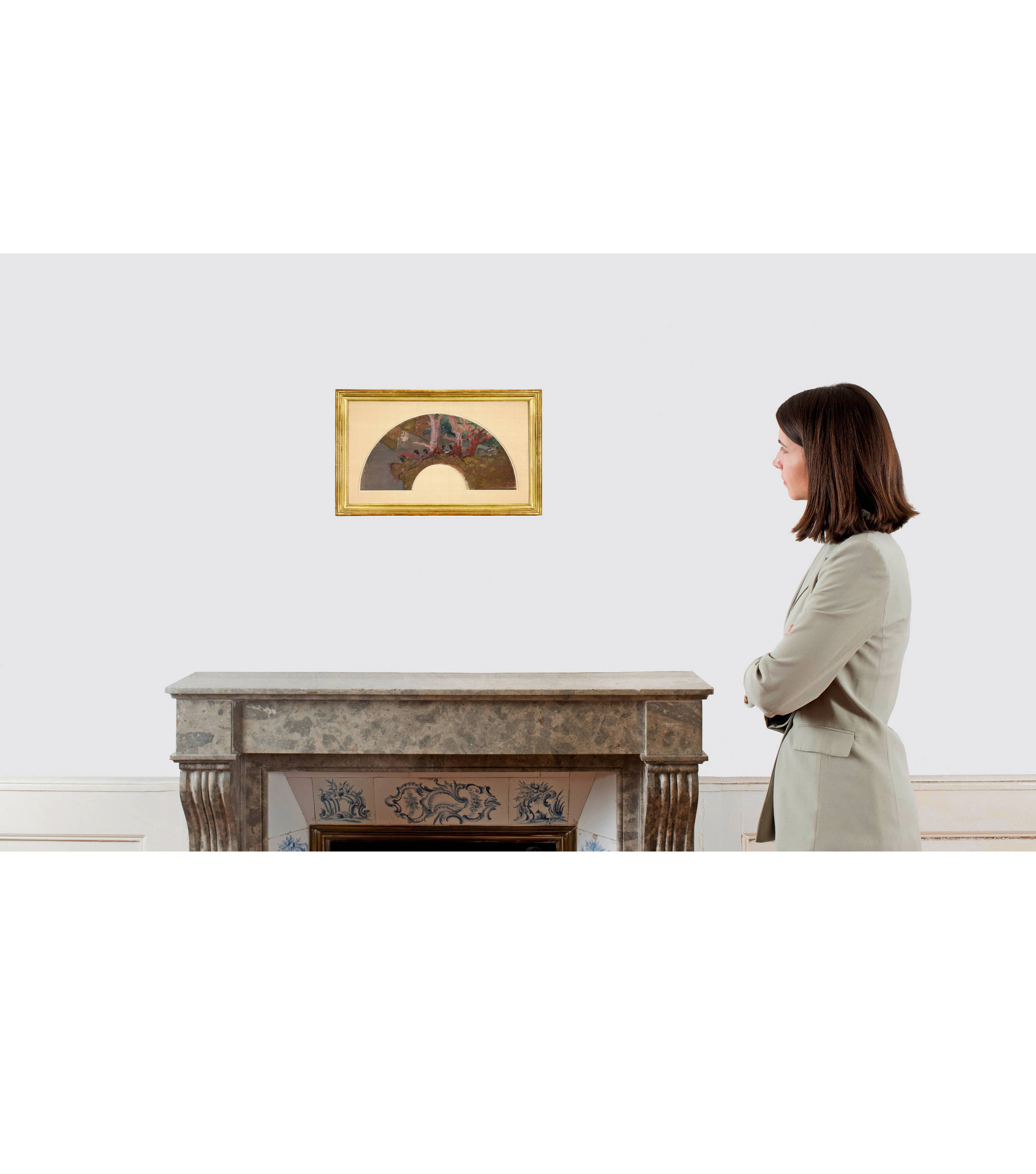
31.2x61.2 cm, silk; 35.4x65.5 cm, cardboard
Upper left signed by the artist in gouache "Degas"
Paul-André Lemoisne, Degas et son œuvre, vol. II, New York/London 1984, no. 556
Jacques Lassaigne/Fiorella Minervino, Tout l'œuvre peint de Degas, Paris 1974, no. 551
Michel Schulman, Edgar Degas, Online Catalogue Raisonné, no. 3932
Galerie Durand-Ruel, Paris
Collection Gustave Pellet, Paris
Collection Maurice Exsteens, Paris
Kornfeld & Klipstein, Bern, acquired at the exhibition in 1960 by
Collection Eberhard W. Kornfeld, Bern, with the collector's stamp on the back, Lugt 913b
Paul-André Lemoisne, Degas et son œuvre, Paris 1954, fig. after p. 88
Yujiro Shinoda, Degas, Der Einzug der japanischen in die französische Malerei, Dissertation, Cologne/Tokyo 1957, p. 87/88
Monika Kopplin, Das Fächerblatt von Manet bis Kokoschka, Dissertation, Saulgau 1981, p. 77/78
Götz Adriani, Edgar Degas, Pastels, Dessins, Esquisses, Paris 1985, no. 120
Denis Rouart, Degas à la recherche de sa technique, Geneva 1988, p. 25
Anne Sefrioui, Eventails impressionnistes, Paris, Citadelles & Mazenod, 2012, p. 128/129
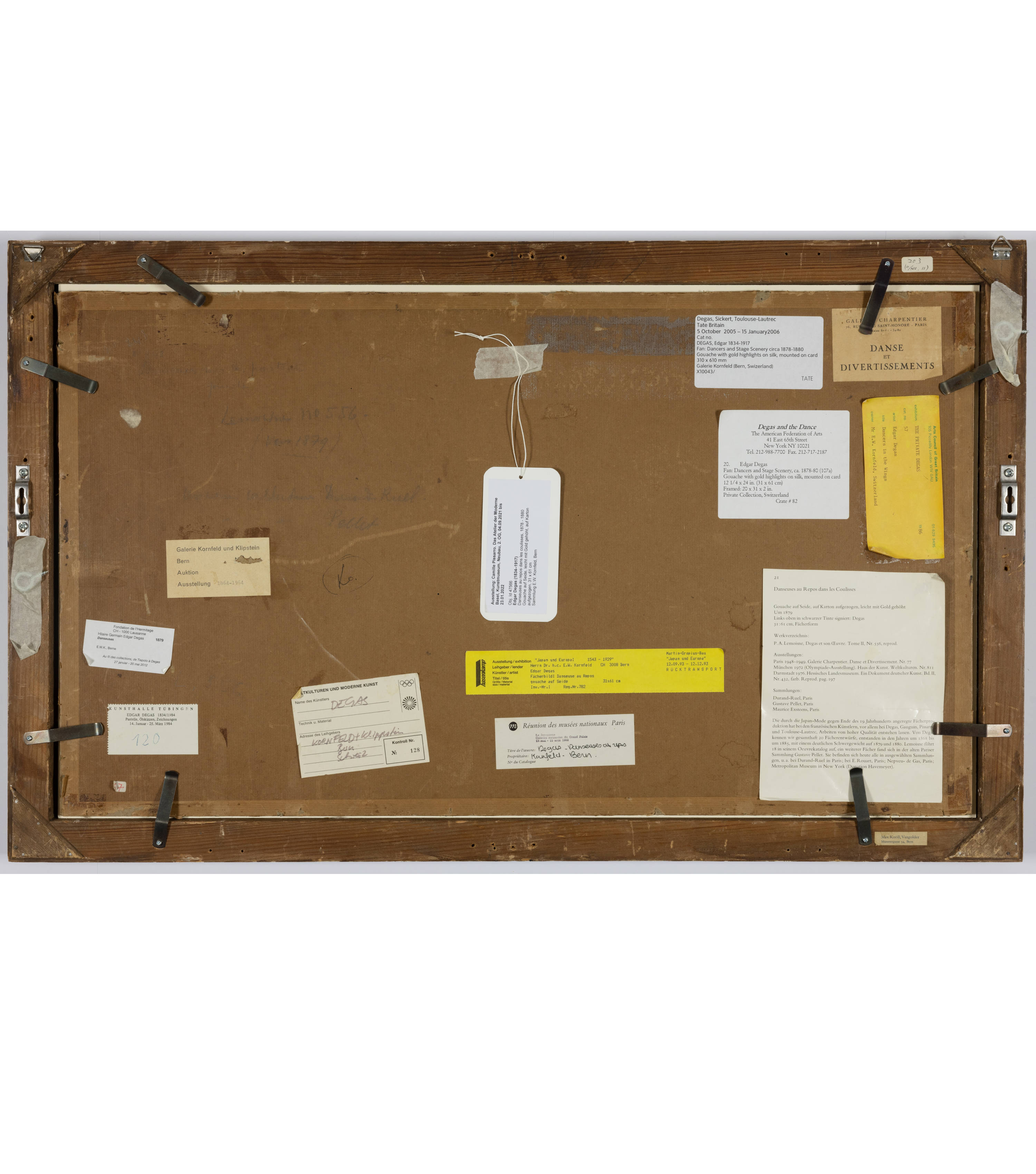
Paris 1948/1949, Galerie Charpentier, Danse et divertissement, cat. no. 77
Bern 1960, Klipstein und Kornfeld, Choix d'une collection privée, Collections G.P. [Gustave Pellet] and M.E. [Maurice Exteens], cat. no. 14
Berlin 1965, Haus am Waldsee, Japonism in Painting and Graphics of the 19th Century, cat. no. 23
Tokyo 1968, The National Museum of Modern Art, Mutual Influences between Japanese and Western Arts, p. 88
Munich 1972, Haus der Kunst, Olympiad Exhibition, cat. no. 811
Tübingen/Berlin 1984, Kunsthalle/Nationalgalerie, Edgar Degas, Pastels, Oil Sketches, Drawings, cat. no. 120
Stuttgart/Zurich 1984, Staatsgalerie/Museum Bellerive, Composition in the Semicircle, Fan Leaves from Four Centuries, cat. no. 67
Paris 1984, Centre culturel du Marais, Degas, Le modelé et l'espace, cat. no. 151
Manchester/Cambridge 1987, Whitworth Art Gallery/Fitzwilliam Museum, The Private Degas, cat. no. 137
Paris/Tokyo 1988, Grand Palais/Musée national d'art occidental, Le Japonisme, cat. no. 203
Bern 1989, Kunstmuseum Bern, From Goya to Tinguely, Watercolours and Drawings from a Private Collection [The Eberhard W. Kornfeld Collection], cat. no. 15
Berlin 1993, Martin Gropius-Bau, Japan and Europe, 1543-1929, cat. no. 14/37A
Davos 1998/1999, Kirchner Museum, Works from the Eberhard W. Kornfeld Collection, cat. no. 3
Ingelheim 2001, Internationale Tage, Altes Rathaus, Japan, Source of Inspiration, cat. no. 88
Detroit/Philadelphia 2002/2003, The Detroit Institute of Arts/Philadelphia Museum of Art, Degas and the Dance, p. 289
Rome 2004/2005, Complesso del Vittoriano, Degas, Classico e modern, cat. no. 36
London/Washington 2005/2006, Tate Britain/The Phillips Collection, Degas, Sickert and Toulouse-Lautrec, London and Paris 1870-1910, cat. no. 38
Lausanne 2012, Fondation de l'Hermitage, Au fil des collections, de Tiepolo à Degas, cat. no. 53
Karlsruhe 2014/2015, Staatliche Kunsthalle, Edgar Degas, Classic and Experiment, cat. no. 63
Essen/Zurich 2014/2015, Museum Folkwang/Kunsthaus, Monet, Gauguin, van Gogh … Inspiration Japan, cat. no. 84 (Exhibited only in Zurich)
Giverny 2018, Musée des impressionnismes, L'éventail impressionniste, fig. P. 28
Basel 2021/2022, Kunstmuseum, Camillo Pissarro, Das Atelier der Moderne, cat. no. 69
Frankfurt am Main 2022, Städel Museum, Renoir, Rococo Revival, Impressionism and French Art of the 18th Century, cat. no. 39
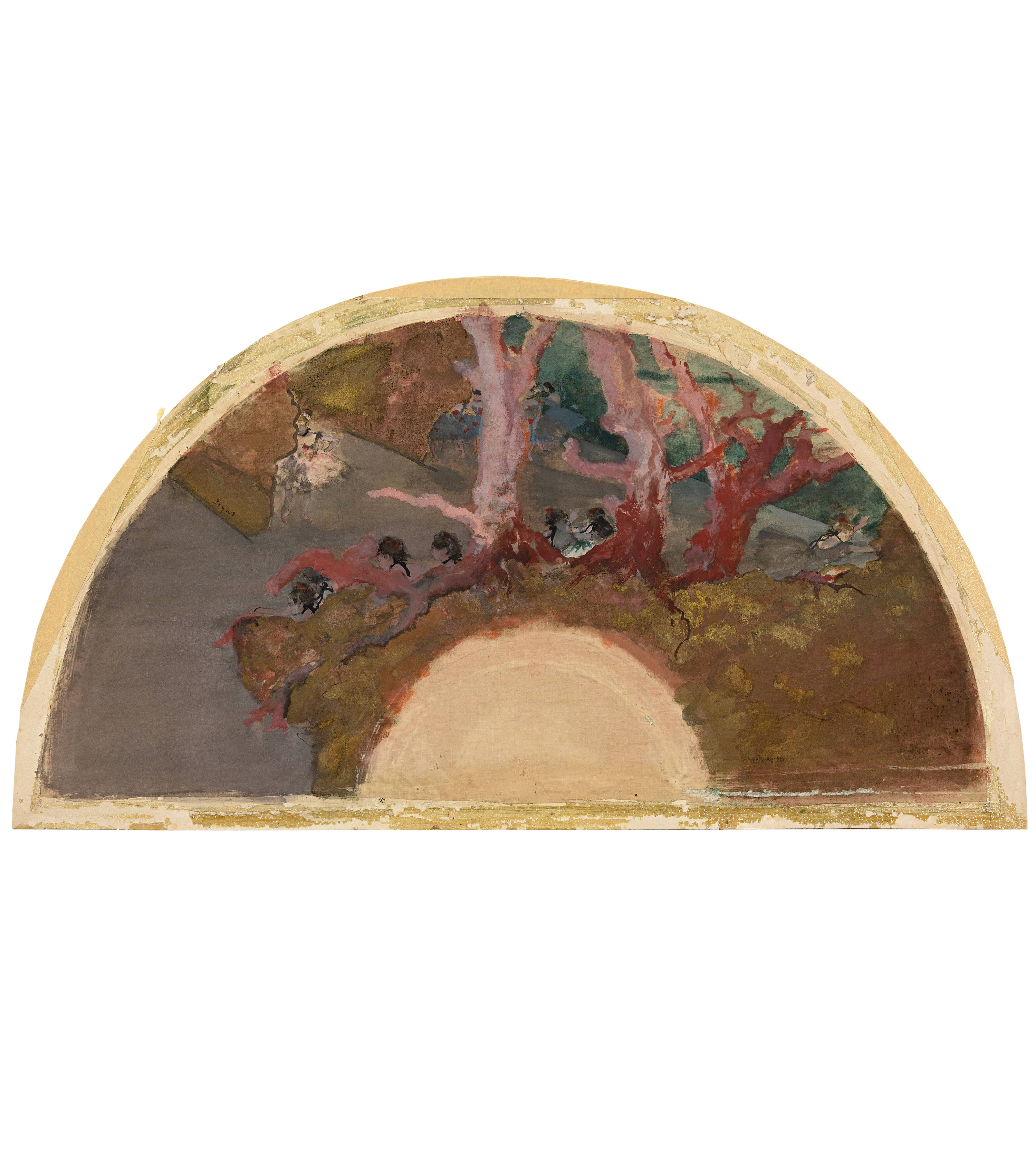
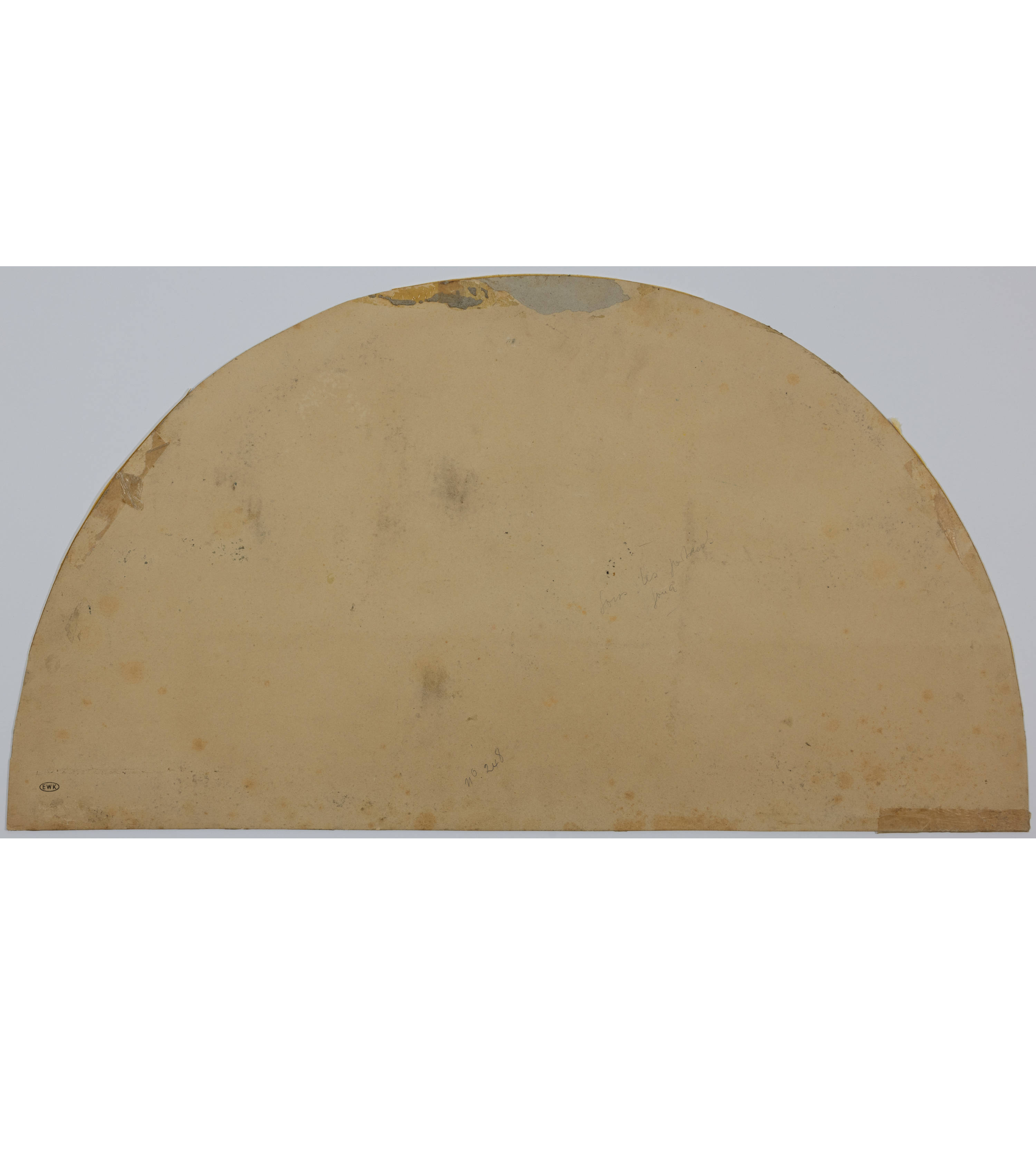
Upper left with a small tear in the silk. The cardboard with glue residue and traces of old mounting. In good condition
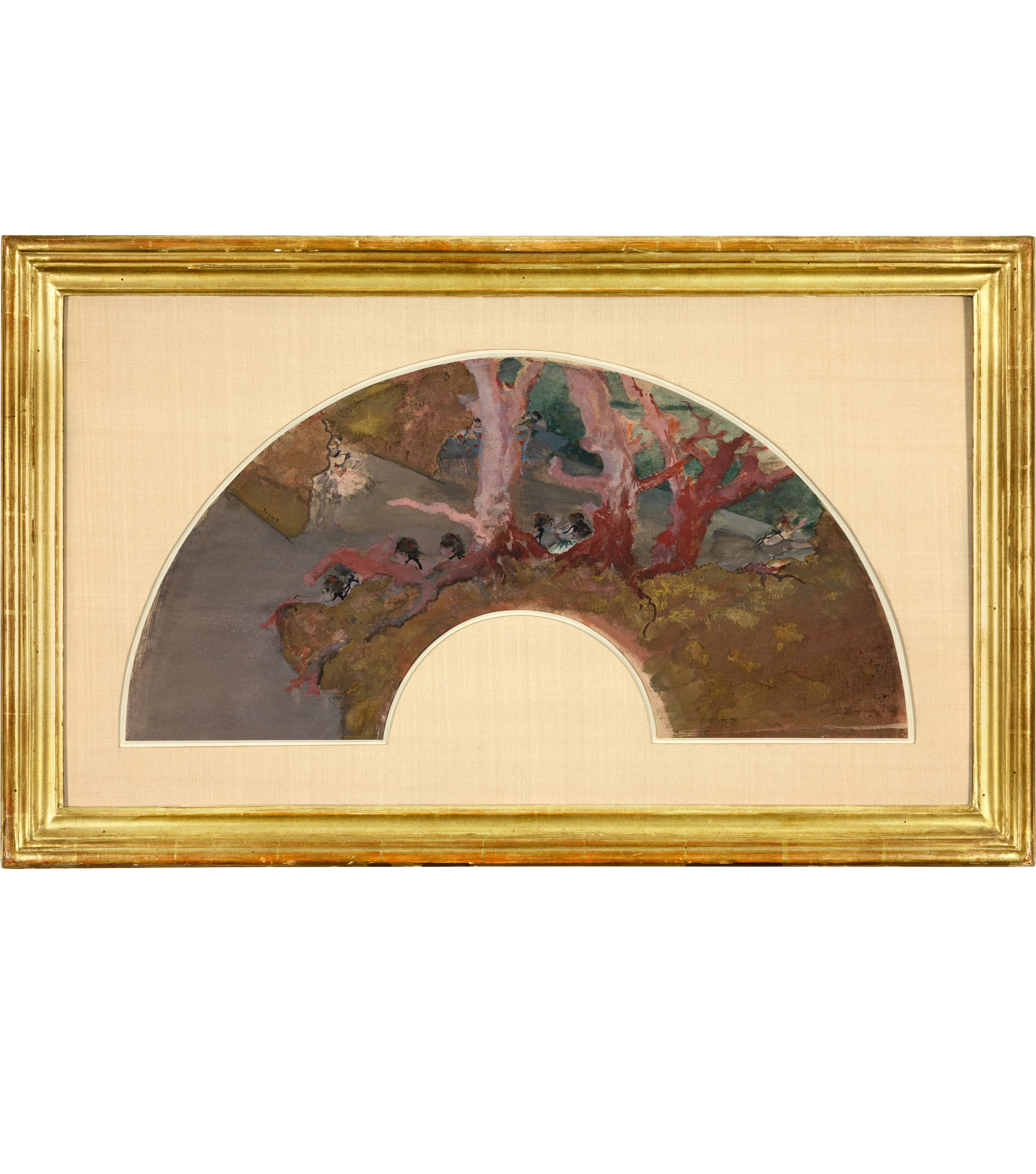
The fan leaf offered here takes up a tradition in painting that came back into fashion from the second third of the 19th century onwards through the spread of Japanese woodcut depictions in Europe. The growing interest in painted fans suited the taste of Belle Époque society and, as a theme and motif, found its way into Edgar Degas’ art in various ways.
Edgar Degas began in 1871 with studies of dancers at the Paris Opera, which from then on became perhaps his most important motifs. The great era of romantic ballet in Paris was over by the last third of the 19th century, and so the artist’s interest shifted more towards the "Corps de ballet" with the dancers’ postures and poses rather than individual stage stars.
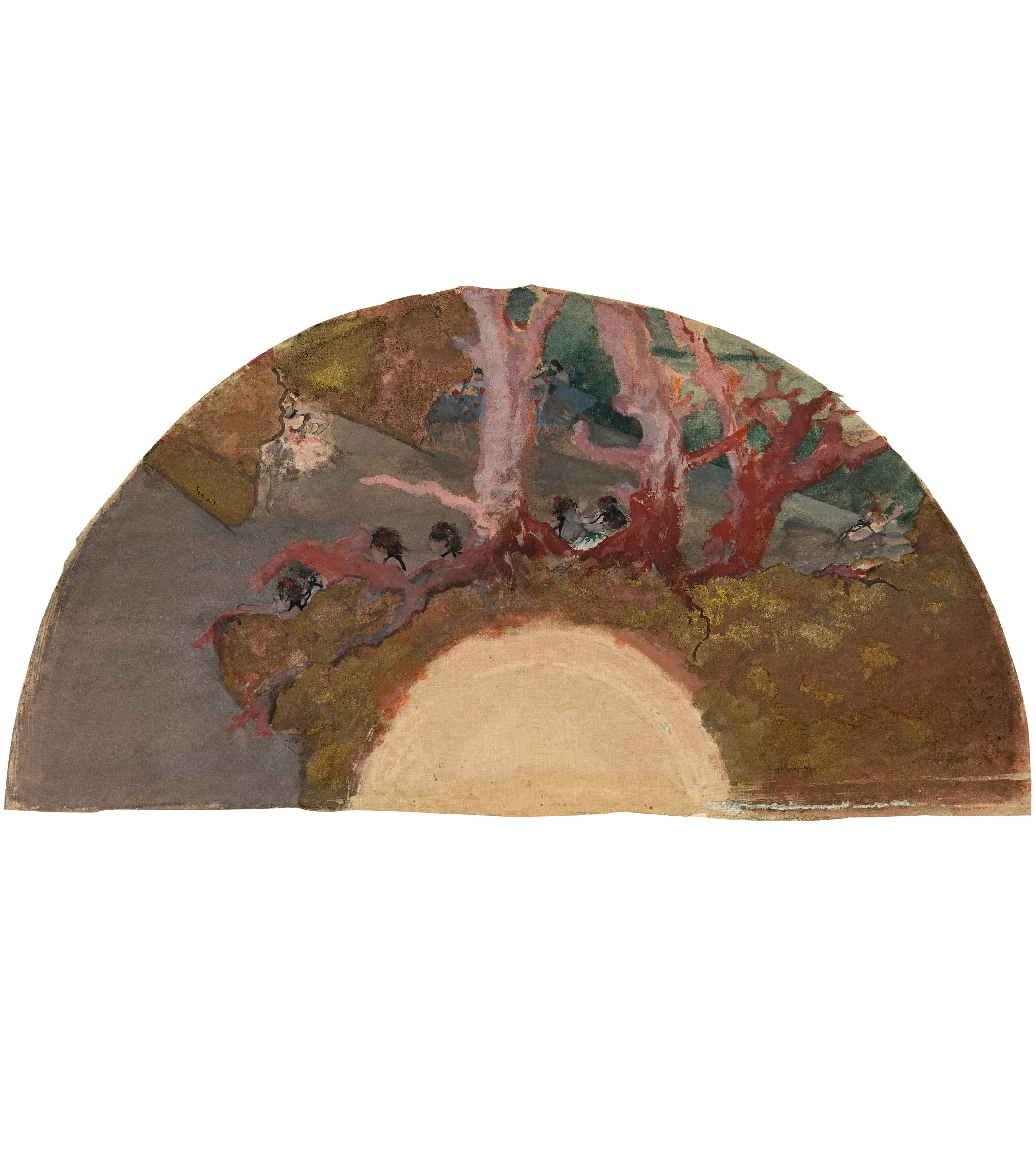
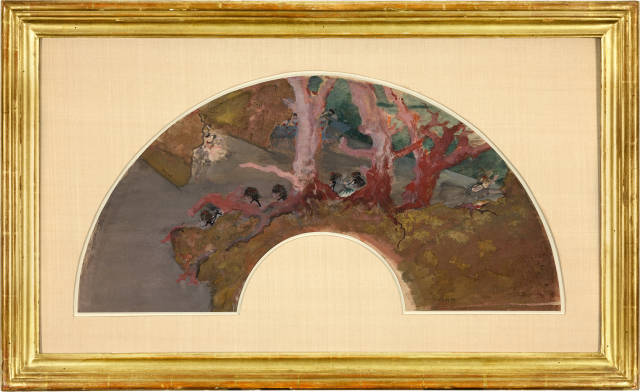
In the present work, seen from a slightly elevated perspective, a stage space is depicted with a group of twelve dancers with colourful hairbands. The painter’s viewpoint is from the rear of the stage, looking across the parquet towards the suggested auditorium. The view of the stage and ballroom is largely concealed by set-like, red-coloured trees.
"Danseuses" is a high-quality and charming work as well as a rarity: only 25 painted fans by Degas are known. All works created between 1878 and 1880 depict ballet scenes.
Um 1879
Gouache auf Seide, leicht mit Gold gehöht, auf Karton aufgezogen
31,2x61,2 cm, Seide; 35,4x65,5 cm, Karton
Oben links vom Künstler in Gouache signiert "Degas"
Paul-André Lemoisne, Degas et son œuvre, Band II, New York/London 1984,
Jacques Lassaigne/Fiorella Minervino, Tout l'œuvre peint de Degas, Paris 1974,
Michel Schulman, Edgar Degas, Online Werkverzeichnis,
Galerie Durand-Ruel, Paris
Slg. Gustave Pellet, Paris
Slg. Maurice Exsteens, Paris
Kornfeld & Klipstein, Bern, 1960 an der Ausstellung erworben von
Slg. Eberhard W. Kornfeld, Bern, rückseitig mit dem Sammlerstempel, Lugt 913b
Paul-André Lemoisne, Degas et son œuvre, Paris 1954,
Yujiro Shinoda, Degas, Der Einzug der japanischen in die französische Malerei, Dissertation, Köln/Tokyo 1957,
Monika Kopplin, Das Fächerblatt von Manet bis Kokoschka, Dissertation, Saulgau 1981,
Götz Adriani, Edgar Degas, Pastels, Dessins, Esquisses, Paris 1985,
Denis Rouart, Degas à la recherche de sa technique, Genève 1988,
Anne Sefrioui, Eventails impressionnistes, Paris, Citadelles & Mazenod, 2012,
Paris 1948/1949, Galerie Charpentier, Danse et divertissement,
Bern 1960, Klipstein und Kornfeld, Choix d'une collection privée, Sammlungen G.P. [Gustave Pellet] und M.E. [Maurice Exteens],
Berlin 1965, Haus am Waldsee, Der Japonismus in der Malerei und Graphik des 19. Jahrhunderts,
Tokyo 1968, The National Museum of Modern Art, Mutual Influences between Japanese and Western Arts,
München 1972, Haus der Kunst, Olympiade-Ausstellung,
Tübingen/Berlin 1984, Kunsthalle/Nationalgalerie, Edgar Degas, Pastelle, Ölskizzen, Zeichnungen,
Stuttgart/Zürich 1984, Staatsgalerie/Museum Bellerive, Komposition im Halbrund, Fächerblätter aus vier Jahrhunderten,
Paris 1984, Centre culturel du Marais, Degas, Le modelé et l'espace,
Manchester/Cambridge 1987, Whitworth Art Gallery/Fitzwilliam Museum, The Private Degas,
Paris/Tokyo 1988, Grand Palais/Musée national d'art occidental, Le Japonisme,
Bern 1989, Kunstmuseum Bern, Von Goya bis Tinguely, Aquarelle und Zeichnungen aus einer Privatsammlung [Slg. Eberhard W. Kornfeld],
Berlin 1993, Martin Gropius-Bau, Japan und Europa, 1543-1929,
Davos 1998/1999, Kirchner Museum, Werke aus der Sammlung Eberhard W. Kornfeld,
Ingelheim 2001, Internationale Tage, Altes Rathaus, Japan, Quelle der Inspiration,
Detroit/Philadelphia 2002/2003, The Detroit Institute of Arts/Philadelphia Museum of Art, Degas and the Dance,
Rom 2004/2005, Complesso del Vittoriano, Degas, Classico e modern,
London/Washington 2005/2006, Tate Britain/The Phillips Collection, Degas, Sickert and Toulouse-Lautrec, London and Paris 1870-1910,
Lausanne 2012, Fondation de l'Hermitage, Au fil des collections, de Tiepolo à Degas,
Karlsruhe 2014/2015, Staatliche Kunsthalle, Edgar Degas, Klassik und Experiment,
Essen/Zürich 2014/2015, Museum Folkwang/Kunsthaus, Monet, Gauguin, van Gogh … Inspiration Japan,
Giverny 2018, Musée des impressionnismes, L'éventail impressionniste,
Basel 2021/2022, Kunstmuseum, Camillo Pissarro, Das Atelier der Moderne,
Frankfurt am Main 2022, Städel Museum, Renoir, Rococo Revival, Der Impressionismus und die französische Kunst des 18. Jahrhunderts,
Oben links mit einem kleinen Riss in der Seide. Der Karton mit Kleberesten und Spuren einer alten Montierung. In guter Erhaltung
Das hier angebotene Fächerblatt greift eine Tradition in der Malerei auf, die seit dem zweiten Drittel des 19. Jahrhunderts durch die Verbreitung japanischer Holzschnittdarstellungen in Europa wieder in Mode kam. Das aufkommende Interesse an bemalten Fächern traf den Geschmack der Gesellschaft der Belle Époque und fand als Thema und Motiv verschiedentlich Eingang in Edgar Degas' Kunstschaffen.
Edgar Degas begann im Jahr 1871 mit Studien zu Tänzerinnen an der Pariser Oper, die von da an zu seinen wohl wichtigsten Motiven wurden. Die grosse Zeit des romantischen Balletts war in Paris im letzten Drittel des 19. Jahrhunderts vorbei, und so richtete sich das Interesse des Künstlers mehr auf das "Corps de ballet" mit den tänzerischen Körperhaltungen und Posen der Ballerinen als auf einzelne Bühnenstars.
Aus leicht erhöhter Perspektive ist bei der hier angebotenen Arbeit ein Bühnenraum mit einer Gruppe von zwölf Tänzerinnen mit bunten Haarbändern dargestellt. Der Standpunkt des Malers ist der hintere Bühnenteil, mit Blick über das Parkett hin zum angedeuteten Zuschauerraum. Die Sicht auf Bühne und Festsaal sind durch kulissenartige, rotgefärbte Bäume weitgehend verdeckt.
"Danseuses" ist eine qualitätsvolle und charmante Arbeit wie auch eine Rarität: Von Degas sind lediglich 25 bemalte Fächer bekannt. Sämtliche zwischen 1878 und 1880 entstandenen Arbeiten zeigen Ballettszenen.
| Switzerland | CHF | Individual offer |
| Europe | CHF | Individual offer |
| USA | CHF | Individual offer |
| Overseas | CHF | Individual offer |