- EN


 Log in
-
- Live Auctions
- Past auctions
- More
- Kornfeld today
- The Story of Kornfeld
- Information










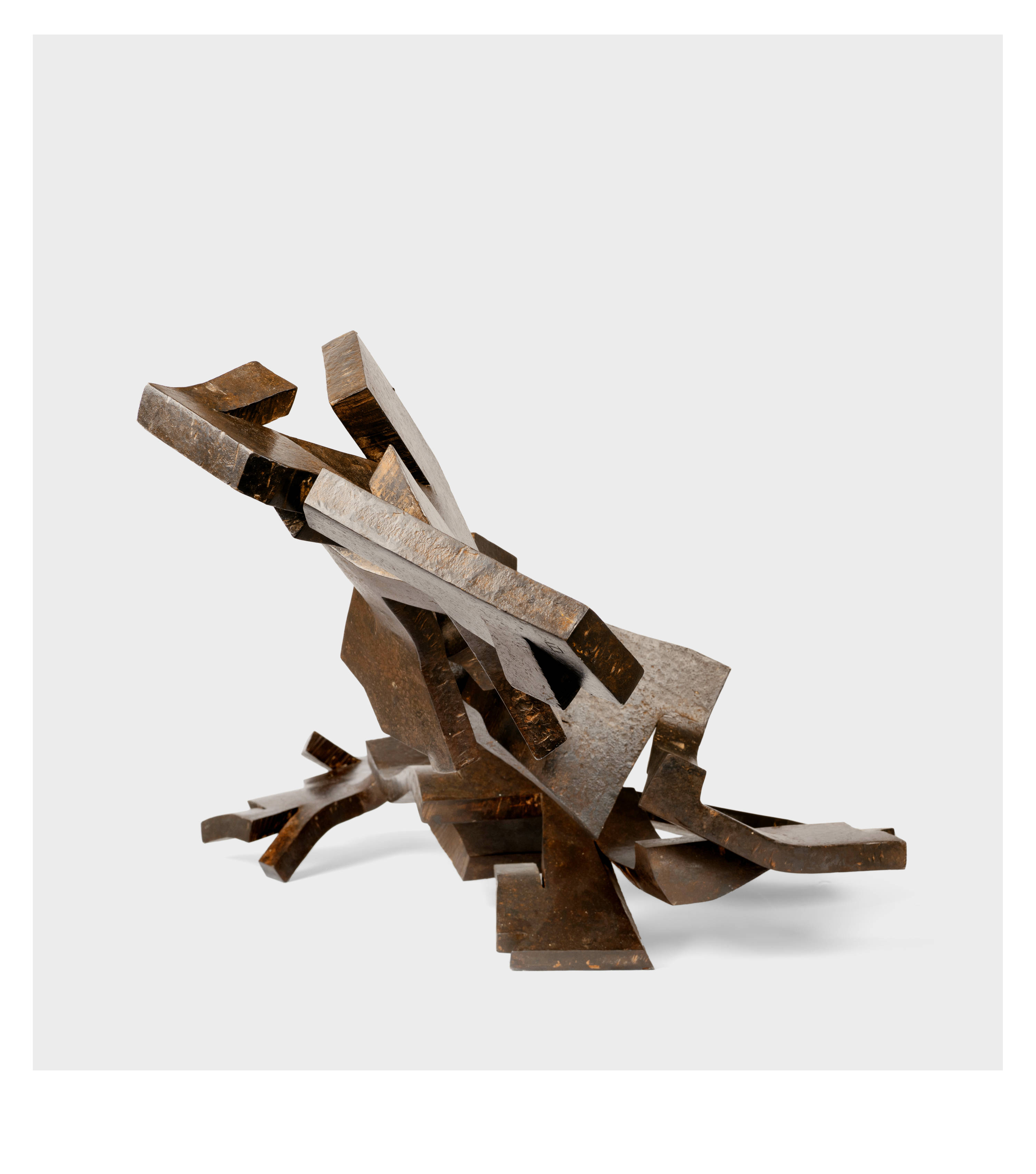
1924 San Sebastián 2002


1957
Forged iron
48x141x68 cm
With stamped monogram
Ignacio Chillida/Alberto Cobo, Eduardo Chillida, Catalogue Raisonné of Sculpture, San Sebastián, 2014, no. 1957001, where the present copy is mentioned (in iron)
We would like to thank the Chillida Archive, Hernani, especially Mr. Alberto Cobo, for the kind information
Galerie Maeght, Paris, probably there acquired in 1961 by
Collection Ida Chagall and Franz Meyer Jr., by inheritance to
Private collection Switzerland
Pierre Volboudt, Chillida, Paris 1967, cat. no. 19
Claude Esteban, Chillida, Paris 1971, cat. no. 7
Santiago Azarna, La aventura espacial de Chillida, Gure Lur 1, San Sebastián 1973, p. 94
Kosme de Barañano y Letamendía, La obra artística de Eduardo Chillida, Bilbao 1988, p. 13
Octavio Paz, Eduardo Chillida, and Gisèle Michelin, Chillida, Paris 1979, cat. no. 49
Christa Lichtenstern, Barbara Münkner, Mario Terés, Chillida und die Musik, Cologne 1997, p. 14
Carla Schulz-Hoffmann, Thomas W. Gaehtgens, Eduardo Chillida, Buscando la luz, Munich 2002, cat. no. 8
Klaus Bussmann, Chillida, Hauptwerke, Munich 2003, p. 30
Rosalía Torrent Esclapés, Enriqueta Antolín, Luis González Robles, Un siglo de arte español en el exterior, España en la Bienal de Venecia 1895-2003, Madrid 2003, p. 135
Since four bronzes of the iron sculpture were cast shortly after its creation, it cannot always be clearly determined, even with the support of the Chillida Archive, Hernani, whether the iron original or one of the casts was represented in the exhibitions.
Venice 1958, XXIX Biennale d'arte di Venezia, Giardini della Biennale, p. 331, Iron
Paris 1961, Galerie Maeght, Chillida, Sculptures récentes, cat. no. 11, Iron
Basel 1962, Kunsthalle, Eduardo Chillida, cat. no. 16, Iron
New York 1964, New York World's Fair, Contemporary Sculptors of Spain at the New Yorker world's Fair, cat. no. 5
London 1965, McRoberts & Tunnard Gallery, Chillida, cat. no. 8
Duisburg 1966, Wilhelm-Lehmbruck-Museum, Eduardo Chillida, cat. no. 16, Iron
Houston 1966, Museum of Fine Arts, Eduardo Chillida, cat. no. 13, Iron
Zurich 1969, Kunsthaus, Eduardo Chillida, Plastik, Zeichnungen, Graphik, cat. no. 3, Iron
Amsterdam 1969, Stedelijk Museum, Eduardo Chillida, cat. no. 18, Iron
Mexico City 1970, Galerías del Palacio de Bellas Artes, Pintura y escultura vasca contemporáneas, p. 15
Strasbourg 1971, Ancienne Douane, Musée d'Art Moderne, Agora l, cat. no. 19
Treigny-Perreuse-Sainte-Colombe 1974, Château de Ratilly, Chillida, cat. no. 6, Iron
Pittsburgh 1979, Carnegie Museum of Art, Chillida, de Kooning, cat. no. 49
Madrid 1980, Palacio de Cristal, Exposición antológica de Eduardo Chillida, cat. no. 49
Basel 1982, Galerie Beyeler, Eduardo Chillida, cat. no. 7, Iron
Pforzheim 1987, Stadtmuseum, Eduardo Chillida, cat. no. 4
Venice 1990, Galleria Internazionale d'Arte Moderna di Ca' Pesaro, Omaggio a Eduardo Chillida, p. 58/59
Gijón/Bilbao/Caracas 1991/1992, Palacio Revillagigedo/Sala Rekalde/Centro Cultural Consolidado de Caracas, Chillida, Escala humana, cat. no. 152
Donostia-San Sebastián 1992, Palacio de Miramar, Chillida en San Sebastián, cat. no. 78
Frankfurt am Main 1993, Schirn Kunsthalle, Eduardo Chillida, Eine Retrospektive, cat. no. 11
Lisbon 1995, Fundação Calouste Gulbenkian, Chillida, Balerdi, Larrea, p. 29
Burgos 1996, Casa del Cordón, Chillida, p. 64
Barcelona 1997, La Pedrera, Chillida-Leku, p. 35
Madrid/Bilbao 1998/1999, Museo Nacional Centro de Arte Reina Sofía/Museo Guggenheim, Chillida 1948-1998, cat. no. 11
Valencia 1998, IVAM Centre Julio González, Eduardo Chillida, Elogio del Hierro, p. 64/65
Barcelona 2003, Fundació Joan Miró, Chillida, p. 73
Donostia-San Sebastián 2014, Sala kubo-kutxa Aretoa, Eduardo Chillida, Bideak, Caminos, p. 166/196
The iron with wonderfully red-brown patina. In fine condition
With his return to the Basque Country at the beginning of the 1950s, Eduardo Chillida underwent a decisive turning point in his artistic career. After his early years in Paris, where he worked on figurative pieces in plaster and clay, he discovered, through working with forged iron, the independent form of expression that would shape his later work. In his studio in Hernani, which had its own forge, the first major experiments with the material took place. Here he developed the characteristic combination of strength, movement, and spatial tension that makes his oeuvre unmistakable.
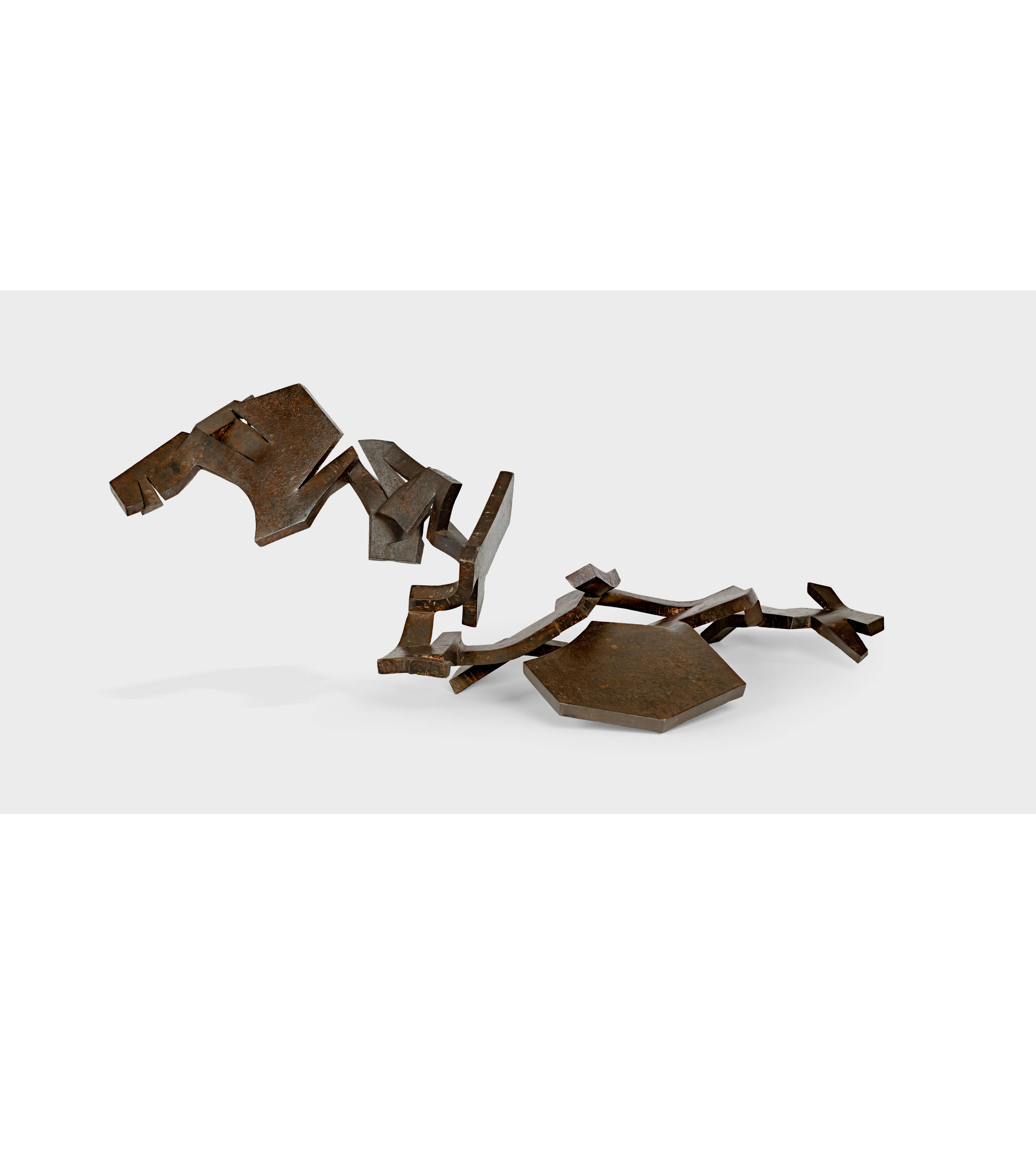
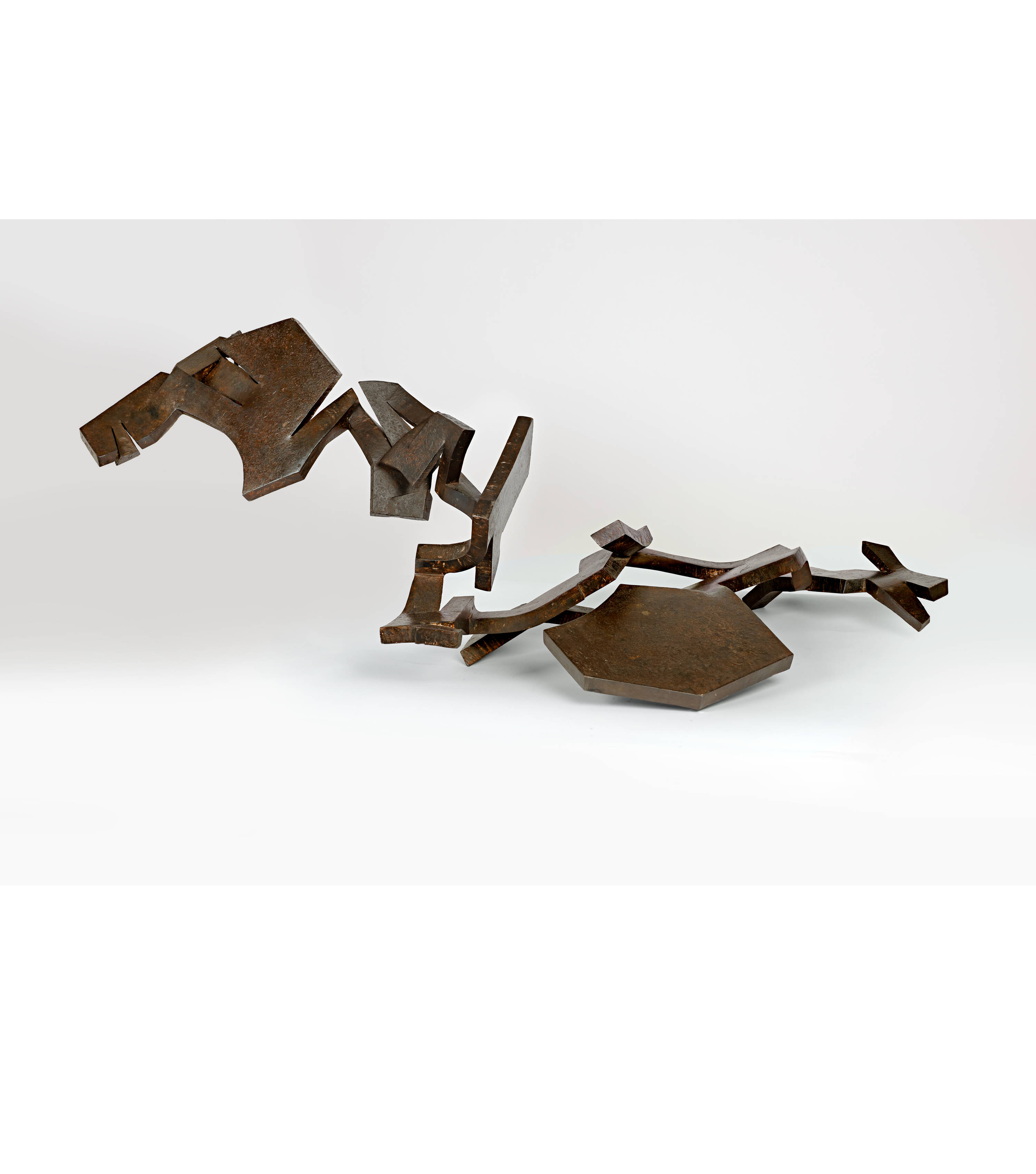
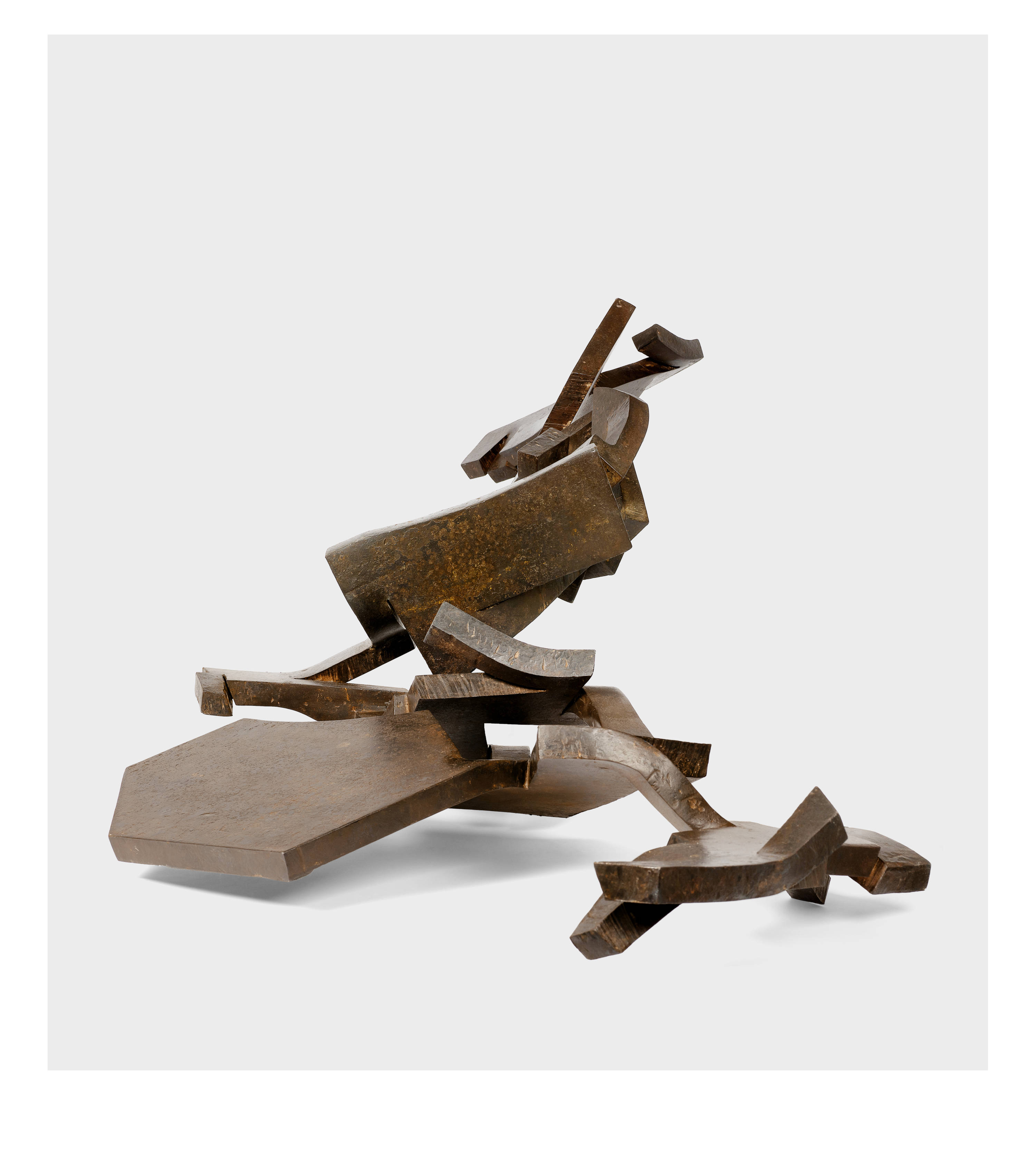
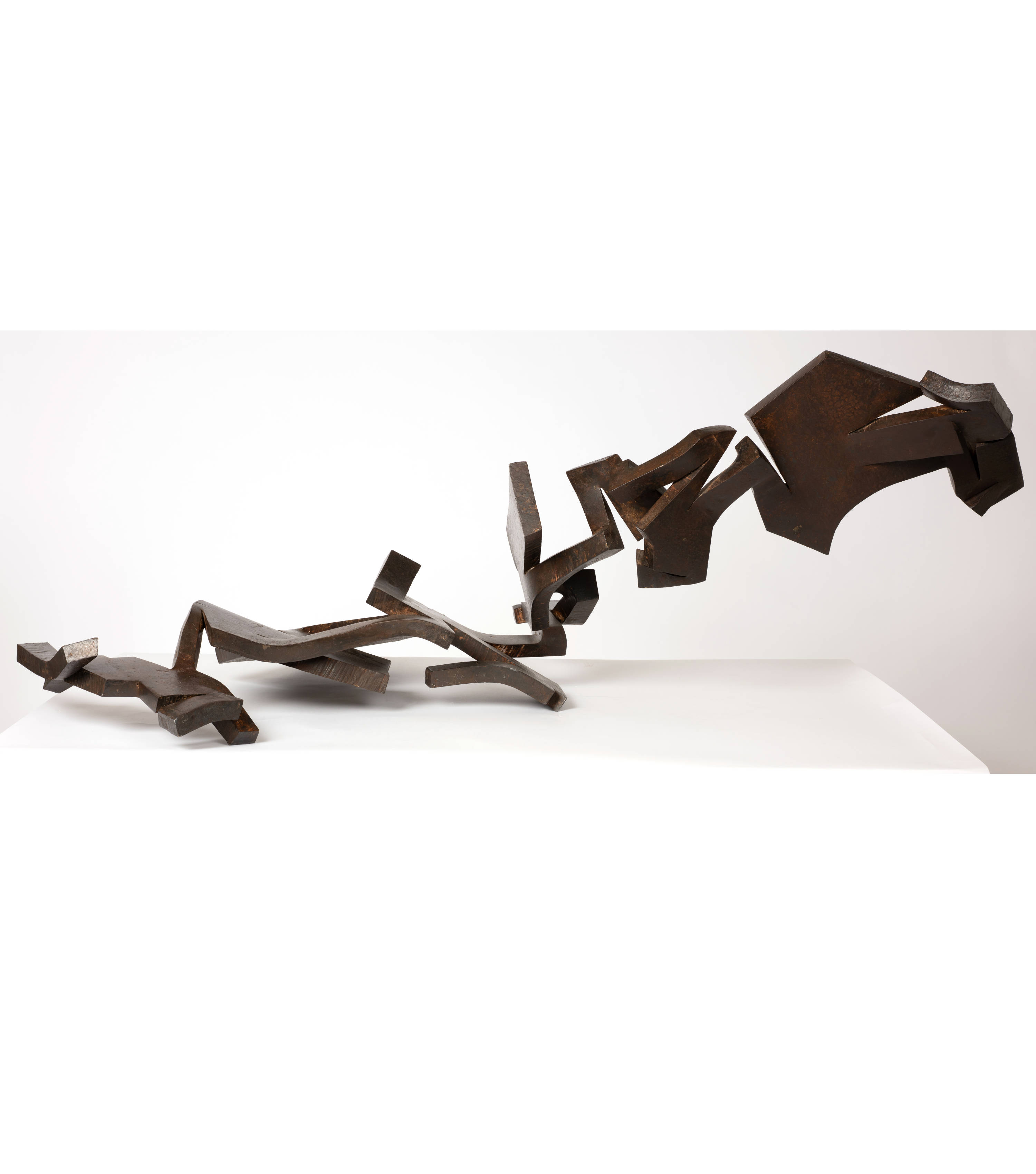
The sculpture "Ikaraundi", created in 1957, occupies a special position within this creative period. It is one of the few iron works that was later also reproduced in a small bronze edition. The present work is the original iron version forged by the artist and thus the starting point for the four bronze casts.
The title can be translated from Basque as "Great Tremor" and refers to the animated, almost pulsating effect of the form. The sculpture consists of a single metal band, which, through cutting, bending, and forging, was transformed into a complex network of lines, surfaces, and angles. Despite its material weight, the work conveys a surprising lightness and dynamism. The curved and staggered elements seem to set the surrounding space into vibration, making it an active component of the composition. Chillida put it this way: "The sculpture is a function of space. By this I do not mean the space outside the form, which surrounds the volume and in which the forms exist, but rather the space generated by the forms, which exists within them and which is all the more effective the more inconspicuous it appears. One might compare it to breath, which expands and contracts forms, opening up their space […] to the gaze. I do not regard it as something abstract, but as a reality as tangible as the volume that envelops it.
During these years, Chillida developed a visual language that consciously broke away from any representational depiction. Instead of figures or narratives, he was interested in the possibilities of the material and the relationship between form and void. The art historian Kosme de Barañano y Letamendía aptly described this attitude in 1999 in the exhibition catalogue Madrid/Bilbao 1998/1999: "Chillida demonstrates that a sculpture also needs an inner fire to convey its own music and create its own space. A clear example is the 1957 sculpture ‘Ikaraundi’, a broken line like a musical score emerging from the fire. Bach’s chords are chiselled here into the well-tuned iron."
James Johnson Sweeney recognized a new artistic freedom in the works of the 1950s. He saw in them "a style of expression that was particularly in keeping with his temperament – perhaps not only his personal temperament, but even the Spanish temperament: an expression of the contrast between extremes […] we see this, for example, in ‘Ikaraundi’ from 1957 and in the works that followed over the next three years. We see how he takes a single piece of metal – or, later, a metal rod – cuts it and bends it in such a way that the flow of form remains unbroken, and the unity of the design is emphasised by the contrast between the resulting diversity of forms and our awareness of the single, unbroken piece from which they originate." (Exhibition catalogue Valencia 1998).
Carola Giedion-Welcker characterized the work in the Ausstellungskatalog Zürich 1969 as "the fortissimo of a vibration that rises from a deep reservoir within the earth and continues to reverberate through space as a rhythmically organised movement." This aptly describes the special quality of "Ikaraundi": a sculpture that brings mass and void, tension and harmony, material and space into an extraordinary balance.
Today, the work is considered one of the key pieces and is even described by some authors as the main work of Chillida's early creative phase, marking an important moment in the development of modern sculpture.
1957
Geschmiedetes Eisen
48x141x68 cm
Mit eingeschlagenem Monogramm
Ignacio Chillida/Alberto Cobo, Eduardo Chillida, Catalogue Raisonné of Sculpture, San Sebastián, 2014,
Wir danken dem Archiv Chillida, Hernani, namentlich Alberto Cobo, für die freundliche Auskunft
Galerie Maeght, Paris, dort wohl 1961 erworben von
Slg. Ida Chagall und Franz Meyer jun., durch Erbschaft an
Privatsammlung Schweiz
Pierre Volboudt, Chillida, Paris 1967,
Claude Esteban, Chillida, Paris 1971,
Santiago Azarna, La aventura espacial de Chillida, Gure Lur 1, San Sebastián 1973,
Kosme de Barañano y Letamendía, La obra artística de Eduardo Chillida, Bilbao 1988,
Octavio Paz, Eduardo Chillida, and Gisèle Michelin, Chillida, Paris 1979,
Christa Lichtenstern, Barbara Münkner, Mario Terés, Chillida und die Musik, Köln 1997,
Carla Schulz-Hoffmann, Thomas W. Gaehtgens, Eduardo Chillida, Buscando la luz, München 2002,
Klaus Bussmann, Chillida, Hauptwerke, München 2003,
Rosalía Torrent Esclapés, Enriqueta Antolín, Luis González Robles, Un siglo de arte español en el exterior, España en la Bienal de Venecia 1895-2003, Madrid 2003,
Da bereits kurz nach Erschaffung der Eisenplastik vier Bronzen davon gegossen wurden, kann auch mit Unterstützung des Archivs Chillida, Hernani, nicht immer klar festgestellt werden, ob das Eisenoriginal oder einer der Güsse in den Ausstellungen vertreten war.
Venedig 1958, XXIX Biennale d'arte di Venezia, Giardini della Biennale,
Paris 1961, Galerie Maeght, Chillida, Sculptures récentes,
Basel 1962, Kunsthalle, Eduardo Chillida,
New York 1964, New York World's Fair, Contemporary Sculptors of Spain at the New Yorker world's Fair,
London 1965, McRoberts & Tunnard Gallery, Chillida,
Duisburg 1966, Wilhelm-Lehmbruck-Museum, Eduardo Chillida,
Houston 1966, Museum of Fine Arts, Eduardo Chillida,
Zürich 1969, Kunsthaus, Eduardo Chillida, Plastik, Zeichnungen, Graphik,
Amsterdam 1969, Stedelijk Museum, Eduardo Chillida,
Mexiko Stadt 1970, Galerías del Palacio de Bellas Artes, Pintura y escultura vasca contemporáneas,
Strassburg 1971, Ancienne Douane, Musée d'Art Moderne, Agora l,
Treigny-Perreuse-Sainte-Colombe 1974, Château de Ratilly, Chillida,
Pittsburgh 1979, Carnegie Museum of Art, Chillida, de Kooning,
Madrid 1980, Palacio de Cristal, Exposición antológica de Eduardo Chillida,
Basel 1982, Galerie Beyeler, Eduardo Chillida,
Pforzheim 1987, Stadtmuseum, Eduardo Chillida,
Venedig 1990, Galleria Internazionale d'Arte Moderna di Ca' Pesaro, Omaggio a Eduardo Chillida,
Gijón/Bilbao/Caracas 1991/1992, Palacio Revillagigedo/Sala Rekalde/Centro Cultural Consolidado de Caracas, Chillida, Escala humana,
Donostia-San Sebastián 1992, Palacio de Miramar, Chillida en San Sebastián,
Frankfurt am Main 1993, Schirn Kunsthalle, Eduardo Chillida, Eine Retrospektive,
Lissabon 1995, Fundação Calouste Gulbenkian, Chillida, Balerdi, Larrea,
Burgos 1996, Casa del Cordón, Chillida,
Barcelona 1997, La Pedrera, Chillida-Leku,
Madrid/Bilbao 1998/1999, Museo Nacional Centro de Arte Reina Sofía/Museo Guggenheim, Chillida 1948-1998,
Valencia 1998, IVAM Centre Julio González, Eduardo Chillida, Elogio del Hierro,
Barcelona 2003, Fundació Joan Miró, Chillida,
Donostia-San Sebastián 2014, Sala kubo-kutxa Aretoa, Eduardo Chillida, Bideak, Caminos,
Das Eisen mit wunderbar rot-brauner Patina. In sehr schönem Zustand
Mit der Rückkehr ins Baskenland Anfang der 1950er-Jahre vollzog Eduardo Chillida einen entscheidenden Wendepunkt in seinem künstlerischen Schaffen. Nach ersten Jahren in Paris, wo er sich mit figurativen Arbeiten aus Gips und Ton beschäftigte, fand er in der Arbeit mit geschmiedetem Eisen zu jener eigenständigen Ausdrucksform, die sein späteres Werk prägen sollte. In seinem Atelier in Hernani, das über eine eigene Schmiede verfügte, entstanden die ersten grossen Experimente mit dem Material. Hier entwickelte er die charakteristische Verbindung von Kraft, Bewegung und räumlicher Spannung, die sein Œuvre unverwechselbar macht.
Die 1957 entstandene Skulptur "Ikaraundi" nimmt innerhalb dieser Werkphase eine besondere Stellung ein. Sie gehört zu den wenigen Eisenarbeiten, die später zusätzlich in einer kleinen Bronzeedition vervielfältigt wurde. Das vorliegende Werk ist die ursprüngliche, vom Künstler geschmiedete Eisenfassung und damit Ausgangspunkt der vier Bronzeabgüsse.
Der Titel lässt sich aus dem Baskischen mit "Grosses Zittern" übersetzen und verweist auf die bewegte, beinahe pulsierende Wirkung der Form. Die Skulptur besteht aus einem einzigen Metallband, das durch Schneiden, Biegen und Schmieden in ein komplexes Geflecht aus Linien, Flächen und Winkeln verwandelt wurde. Trotz ihrer materiellen Schwere vermittelt die Arbeit eine überraschende Leichtigkeit und Dynamik. Die geschwungenen und gegeneinander versetzten Elemente scheinen den umgebenden Raum in Schwingung zu versetzen und machen ihn als aktiven Bestandteil der Komposition erfahrbar. Chillida formulierte dies so: "Die Skulptur ist eine Funktion des Raums. Ich meine damit nicht den Raum ausserhalb der Form, der das Volumen umgibt und in dem die Formen existieren, sondern den Raum, der von den Formen erzeugt wird, der in ihnen existiert und der umso wirkungsvoller ist, je unauffälliger er wirkt. Man könnte ihn mit dem Atem vergleichen, der Formen ausdehnt und zusammenzieht, der ihren Raum […] für den Blick öffnet. Ich betrachte ihn nicht als etwas Abstraktes, sondern als eine Realität, die so greifbar ist wie das Volumen, das ihn umhüllt." (zitiert aus: Ausstellungskatalog Madrid/Bilbao 1998/1999).
In diesen Jahren entwickelte Chillida eine Bildsprache, die sich bewusst von jeder gegenständlichen Darstellung löste. Statt Figuren oder Erzählungen interessierten ihn die Möglichkeiten des Materials und die Beziehung zwischen Form und Leere. Der Kunsthistoriker Kosme de Barañano y Letamendía beschreibt diese Haltung 1999 im Ausstellungskatalog Madrid/Bilbao 1998/1999 treffend: "Chillida zeigt, dass eine Skulptur auch ein inneres Feuer braucht, um eine eigene Musik zu vermitteln und ihren Raum zu schaffen. Ein klares Beispiel ist die Plastik "Ikaraundi" von 1957, eine gebrochene Linie wie eine Partitur, die aus dem Feuer hervorgeht. Bachs Akkorde sind hier auf dem gut gestimmten Eisen gemeisselt."
James Johnson Sweeney erkannte in den Arbeiten der 1950er-Jahre eine neue künstlerische Freiheit. Er sah darin "eine Ausdrucksweise, die seinem Temperament besonders entsprach, vielleicht nicht nur seinem persönlichen Temperament, sondern sogar dem spanischen Temperament: ein Ausdruck des Kontrasts zwischen Extremen […] wir sehen dies beispielsweise in "Ikaraundi" von 1957 und in den Werken, die in den folgenden drei Jahren darauf folgten. Wir sehen, wie er ein einzelnes Stück Metall oder später einen Metallstab nimmt, es schneidet und so biegt, dass der Formfluss ununterbrochen bleibt und die Einheit der Gestaltung durch den Kontrast zwischen der daraus resultierenden Vielfalt der Formen und unserem Bewusstsein für das einzelne, ununterbrochene Stück, aus dem sie stammen, betont wird." (Ausstellungskatalog Valencia 1998).
Carola Giedion-Welcker charakterisierte die Arbeit im Ausstellungskatalog Zürich 1969 als "das Fortissimo einer Schwingung, die aus einem tiefen Reservoir in der Erde aufsteigt und als rhythmisch organisierte Bewegung im Raum weitervibriert." Damit beschreibt sie treffend die besondere Qualität von "Ikaraundi": eine Skulptur, die Masse und Leere, Spannung und Harmonie, Material und Raum in ein aussergewöhnliches Gleichgewicht bringt.
Das Werk zählt heute zu den Schlüsselarbeiten und wird von einigen Autorinnen und Autoren sogar als Hauptwerk der frühen Schaffensphase Chillidas bezeichnet und markiert einen wichtigen Moment in der Entwicklung der modernen Skulptur.
| Switzerland | CHF | Individual offer |
| Europe | CHF | Individual offer |
| USA | CHF | Individual offer |
| Overseas | CHF | Individual offer |