- EN


 Log in
-
- Live Auctions
- Past auctions
- More
- Kornfeld today
- The Story of Kornfeld
- Information


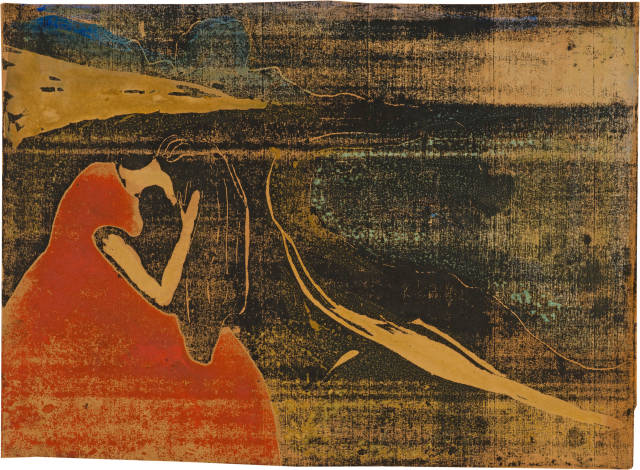







Løten 1863 - 1944 Oslo


1898
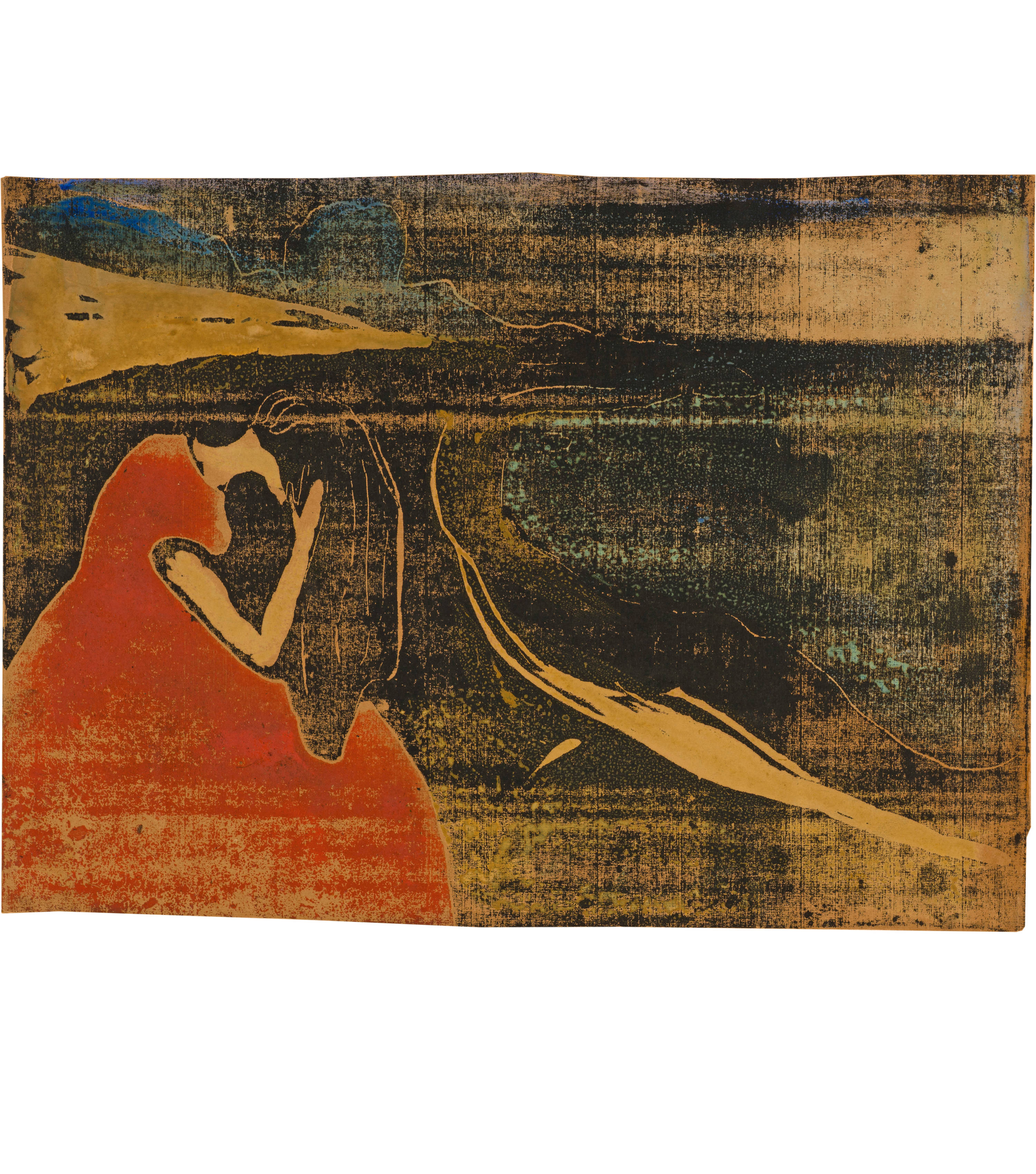
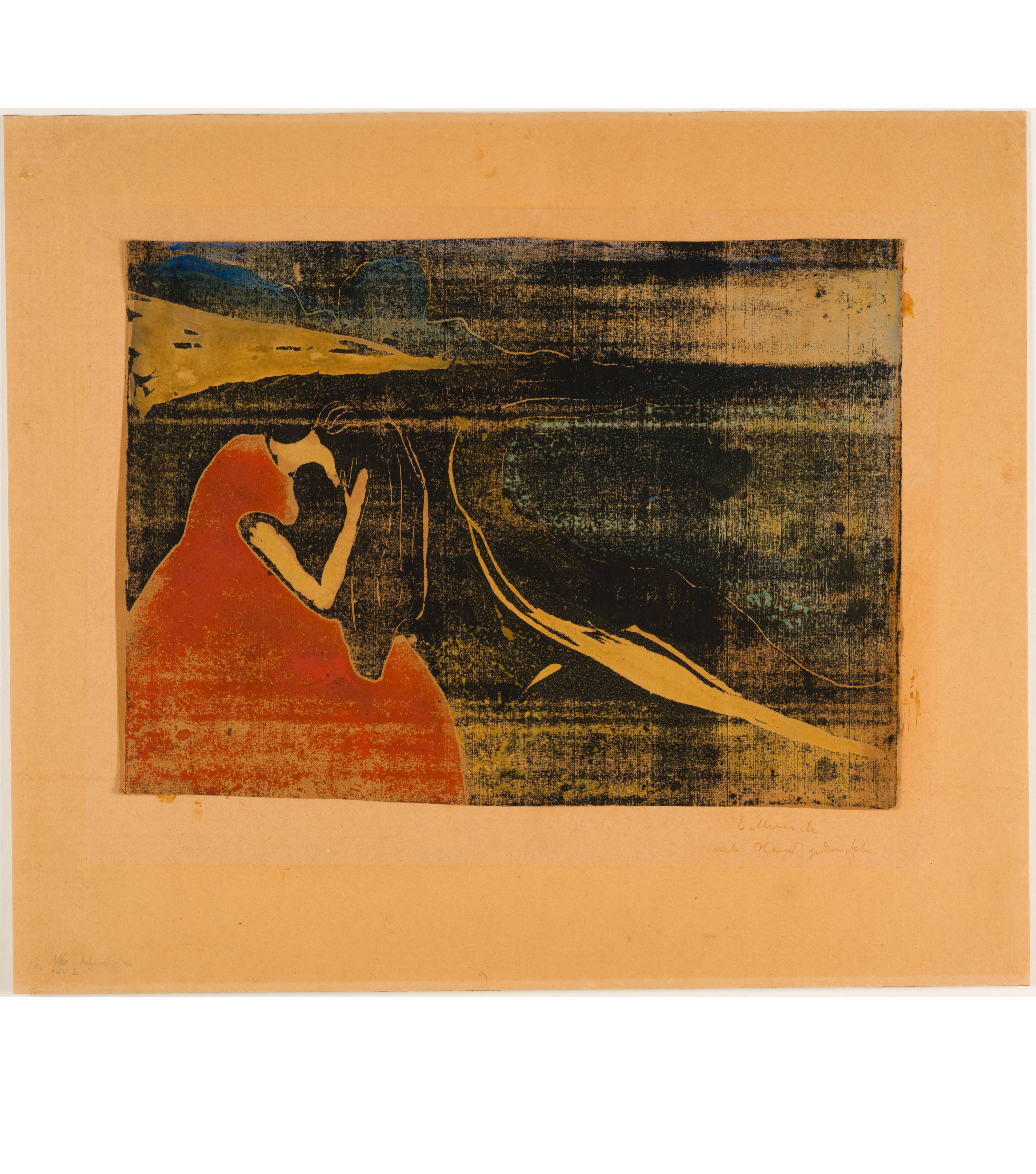
Colour woodcut, hand-coloured on brownish paper, mounted on light cardboard
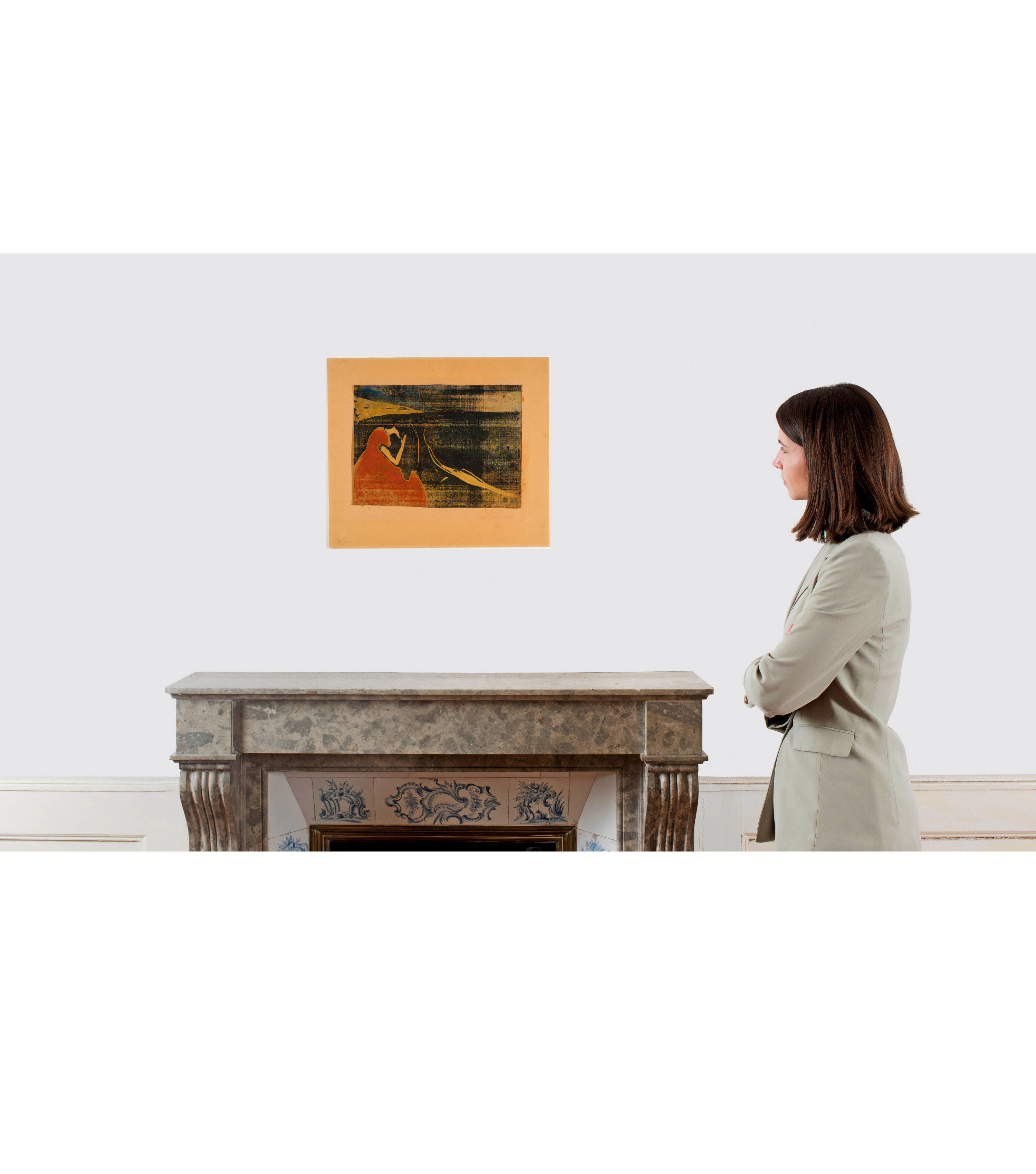
30x42.7 cm, sheet size (irregular); 47.5x55.3 cm, support
On the support right signed by the artist 'E Munch', below inscribed 'mit Hand gedruckt'
Gerd Woll, Edvard Munch, The Complete Graphic Works, Oslo 2012, no. 132, one of the copies mentioned there
Collection Prof. Dr. Curt Glaser (1879-1943), Berlin, auctioned at
Auction Max Perl, Berlin, 19 May 1933, lot 1129, acquired there by
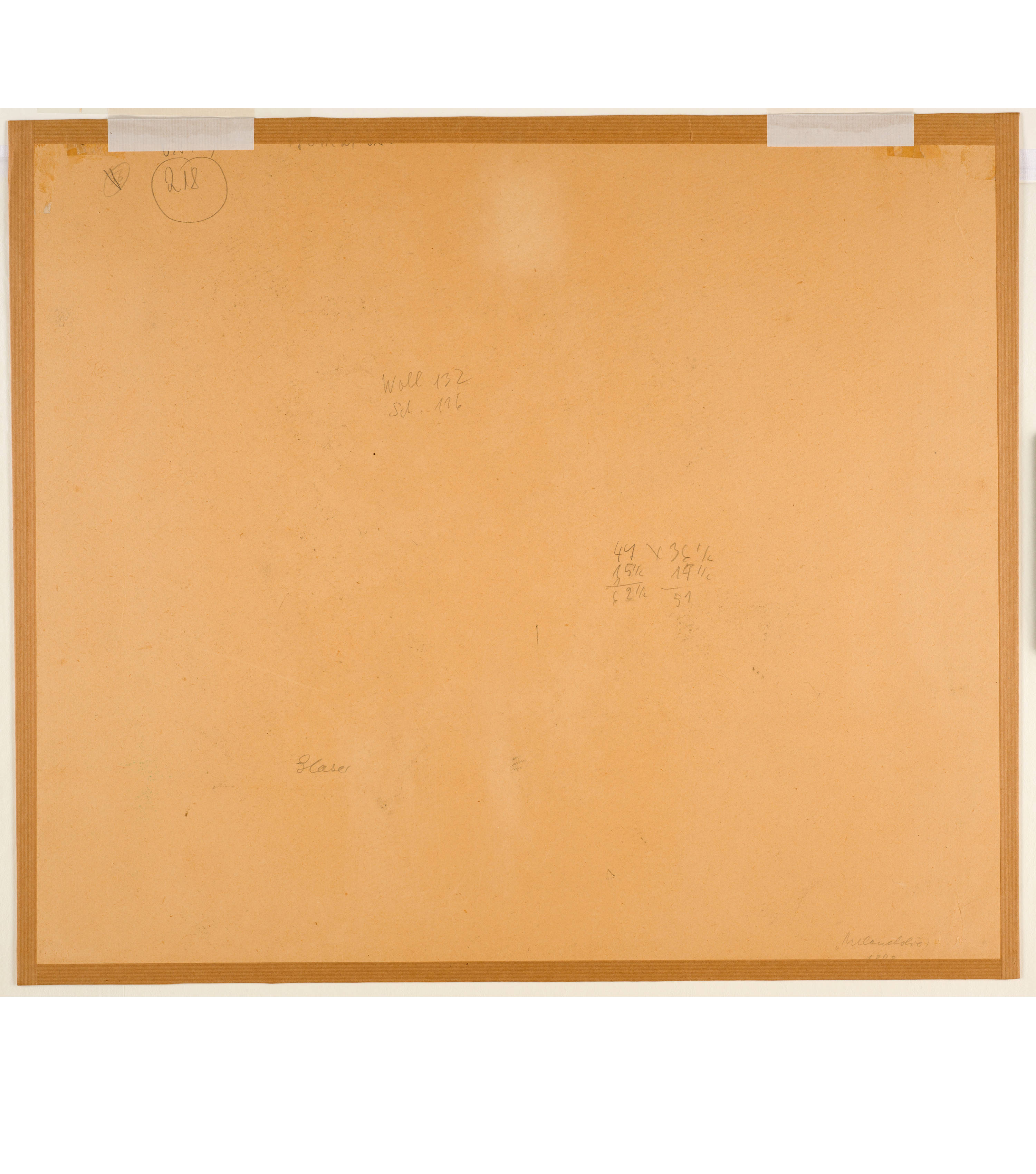
Collection Arnold Budczies, Berlin, with the collector's stamp on the back
Frankfurt am Main 1952, Städelsches Kunstinstitut, Edvard Munch. Graphik, cat. no. 54
Bremen 1970, Kunsthalle, Edvard Munch, Druckgraphik, Auswahl aus einer bremischen Privatsammlung, cat. no. 61
Hamburg 2006, Kunsthalle, Edvard Munch, '... aus dem modernen Seelenleben', cat. no. 229
Riehen 2007, Fondation Beyeler, Edvard Munch, Zeichen der Moderne, cat. no. 84
A small tear in the lower right corner. Studio traces and slight light-struck area on the support cardboard. The signature slightly faded. The woodcut by Munch laid down on a support
The woodcut 'Melancholie II' was created in 1898 in Kristiania (now Oslo) during a productive creative phase in which Edvard Munch made decisive advances in his printmaking. After intensively studying the fundamentals of colour printmaking in Paris in 1896, he returned to Norway and set up his own print workshop, where he began to experiment more extensively. 'Melancholie II' is one of the most important results of these Norwegian workshop years.
The image, unlike the two thematic versions 'Melancholie I' and 'Melancholie III' (see lot 867), shows a woman in a bent-forward posture at a shoreline. Behind her, the coastline stretches into the distance. The scene appears calm, almost idyllic, but the state of mind of the figure tells a different story. It is about withdrawal, absorption and grief or, indeed, melancholy. The composition reduces the image to clear, tensely arranged areas and a strong separation between figure and background. The woman is isolated both spatially and emotionally.
Technically, Munch uses the wood not only as a support but as part of the expression: the grain runs through the image like a second voice. His characteristic method of sawing the block into several parts and inking them separately in different colours is also present here. From 1885 onwards, he often visited Åsgårdstrand on the Oslo Fjord. In 1897, he acquired a house there and also set up a studio. In the coastline of the present sheet, one can clearly recognise the fjord shore in front of Munch's house. Thus, the sheet becomes a very personal manifesto of his own state of mind. The depicted loneliness refers to Munch's own biographical experiences with complicated relationships, emotional setbacks and the death of people close to him.
Printed by the artist himself and then hand-coloured. Of the greatest rarity.
An amicable agreement was reached with the heirs of Curt Glaser, represented by the Berlin law firm 'S+N Rechtsanwälte'. The current sale takes place with the consent of the heirs of Curt Glaser and is therefore free from any claims. The amicable agreement has been recorded in the Lost Art Database of the German Lost Art Foundation.
1898
Farbholzschnitt, handkoloriert auf bräunlichem Papier, aufgelegt auf leichten Karton
30x42,7 cm, Blattgrösse (unregelmässig); 47,5x55,3 cm, Unterlage
Auf der Unterlage rechts vom Künstler signiert "E Munch", darunter bezeichnet "mit Hand gedruckt"
Gerd Woll, Edvard Munch, The Complete Graphic Works, Oslo 2012,
Slg. Prof. Dr. Curt Glaser (1879-1943), Berlin, versteigert bei
Auktion Max Perl, Berlin, 19. Mai 1933, Los 1129, dort erworben von
Slg. Arnold Budczies, Berlin, rückseitig mit dem Sammlerstempel
Frankfurt am Main 1952, Städelsches Kunstinstitut, Edvard Munch. Graphik,
Bremen 1970, Kunsthalle, Edvard Munch, Druckgraphik, Auswahl aus einer bremischen Privatsammlung,
Hamburg 2006, Kunsthalle, Edvard Munch, "... aus dem modernen Seelenleben",
Riehen 2007, Fondation Beyeler, Edvard Munch, Zeichen der Moderne,
Unten rechts in der Ecke ein kleiner Einriss. Atelierspuren und leichter Lichtrand auf dem Unterlagekarton. Die Signatur leicht verblichen. Der Holzschnitt von Munch auf eine Unterlage aufgezogen.
Der Holzschnitt "Melancholie II" entstand 1898 in Kristiania (heute Oslo) während einer produktiven Schaffensphase, in der Edvard Munch seine Druckgraphik entscheidend weiterentwickelte. Nachdem er 1896 in Paris die Grundlagen der Farbdruckgraphik intensiv studiert hatte, kehrte er nach Norwegen zurück und richtete sich eine eigene Druckwerkstatt ein, in der er nun verstärkt experimentierte. "Melancholie II" gehört zu den bedeutendsten Resultaten dieser norwegischen Werkstattjahre.
Das Bild zeigt - abweichend von den beiden thematischen Versionen "Melancholie I" und "Melancholie III" (vgl. Los 867) - eine Frau in vornübergebeugter Haltung an einem Ufer. Hinter ihr zieht sich die Küstenlinie in die Ferne. Die Szene scheint ruhig, fast idyllisch, aber der Gemütszustand der Dargestellten spricht eine andere Sprache. Es geht um Rückzug, Versunkenheit und Trauer, oder eben um Melancholie. Die Komposition reduziert das Bild auf klare, spannungsvoll gesetzte Flächen und eine starke Trennung von Figur und Hintergrund. Die Frau ist sowohl räumlich als auch seelisch isoliert.
Technisch nutzt Munch das Holz nicht nur als Trägermaterial, sondern als Teil des Ausdrucks: Die Maserung durchzieht das Bild wie eine zweite Stimme. Auch seine für ihn charakteristische Methode, den Druckstock in mehrere Teile zu sägen und diese farbig getrennt einzufärben, findet sich hier wieder. Ab 1885 besuchte er oft den Ort Åsgårdstrand am Oslo-Fjord. 1897 erwarb er dort ein Haus und richtete sich auch ein Atelier ein. Im Küstenverlauf des vorliegenden Blattes erkennt man klar das Fjord-Ufer vor Munchs Haus. Das Blatt wird also faktisch zu einem sehr persönlichen Manifest des eigenen Gemütszustands. Die dargestellte Einsamkeit verweist auf Munchs eigene biographische Erfahrungen mit komplizierten Beziehungen, emotionalen Rückschlägen und dem Tod nahestehender Menschen.
Vom Künstler selbst gedruckt und danach von Hand koloriert. Von grösster Seltenheit.
Es wurde eine gütliche Einigung mit den Erben nach Curt Glaser, vertreten durch die Berliner Kanzlei "S+N Rechtsanwälte", getroffen. Der aktuelle Verkauf erfolgt mit dem Einverständnis der Erben nach Curt Glaser und ist daher frei von jeglichen Ansprüchen. Die gütliche Einigung wurde in der Lost Art-Datenbank des Deutschen Zentrums Kulturgutverluste vermerkt.
| Switzerland | CHF | 150 |
| Europe | CHF | 250 |
| USA | CHF | 320 |
| Overseas | CHF | 325 |