- EN


 Log in
-
- Live Auctions
- Past auctions
- More
- Kornfeld today
- The Story of Kornfeld
- Information









Münchenbuchsee bei Bern 1879 - 1940 Muralto



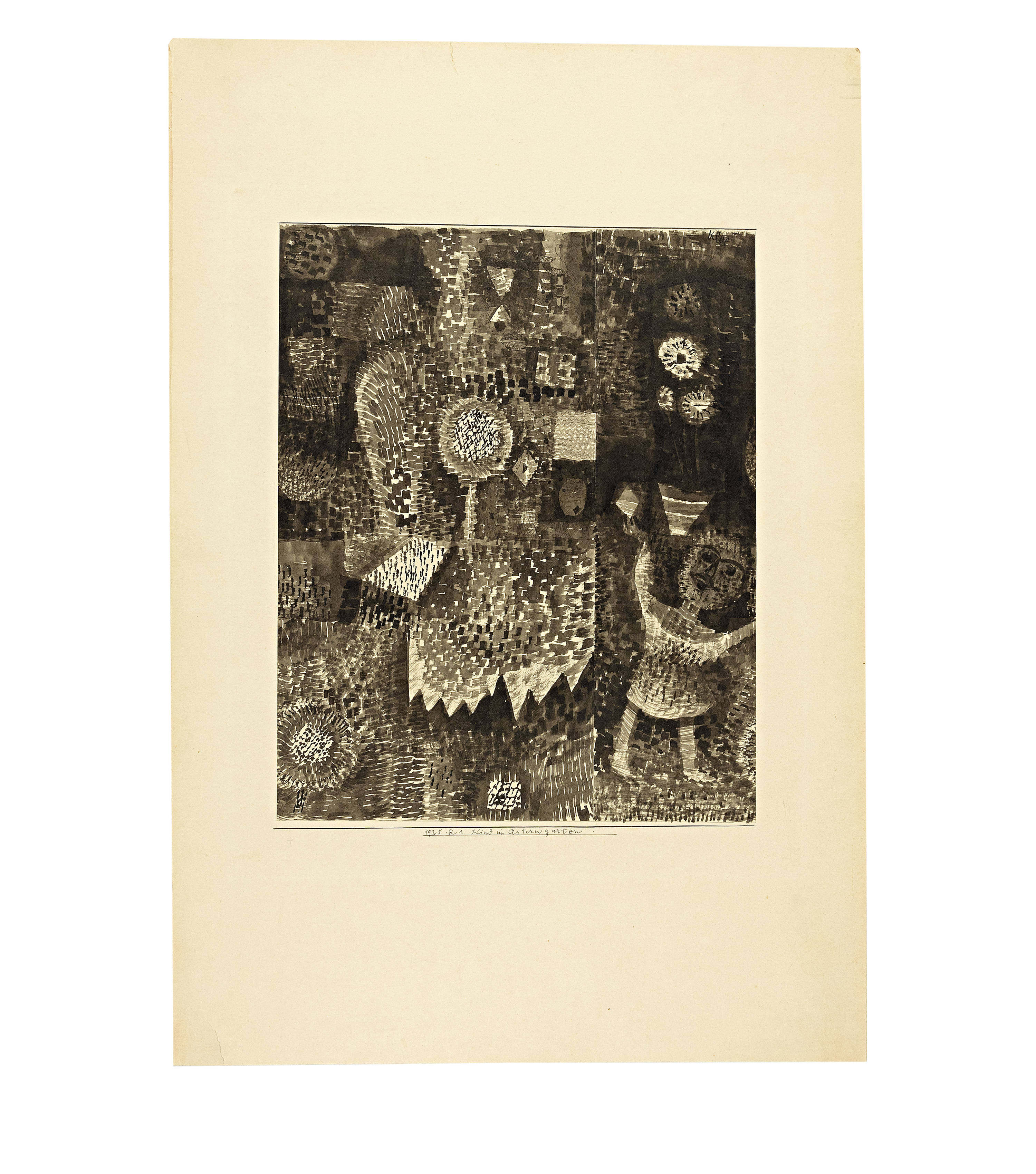
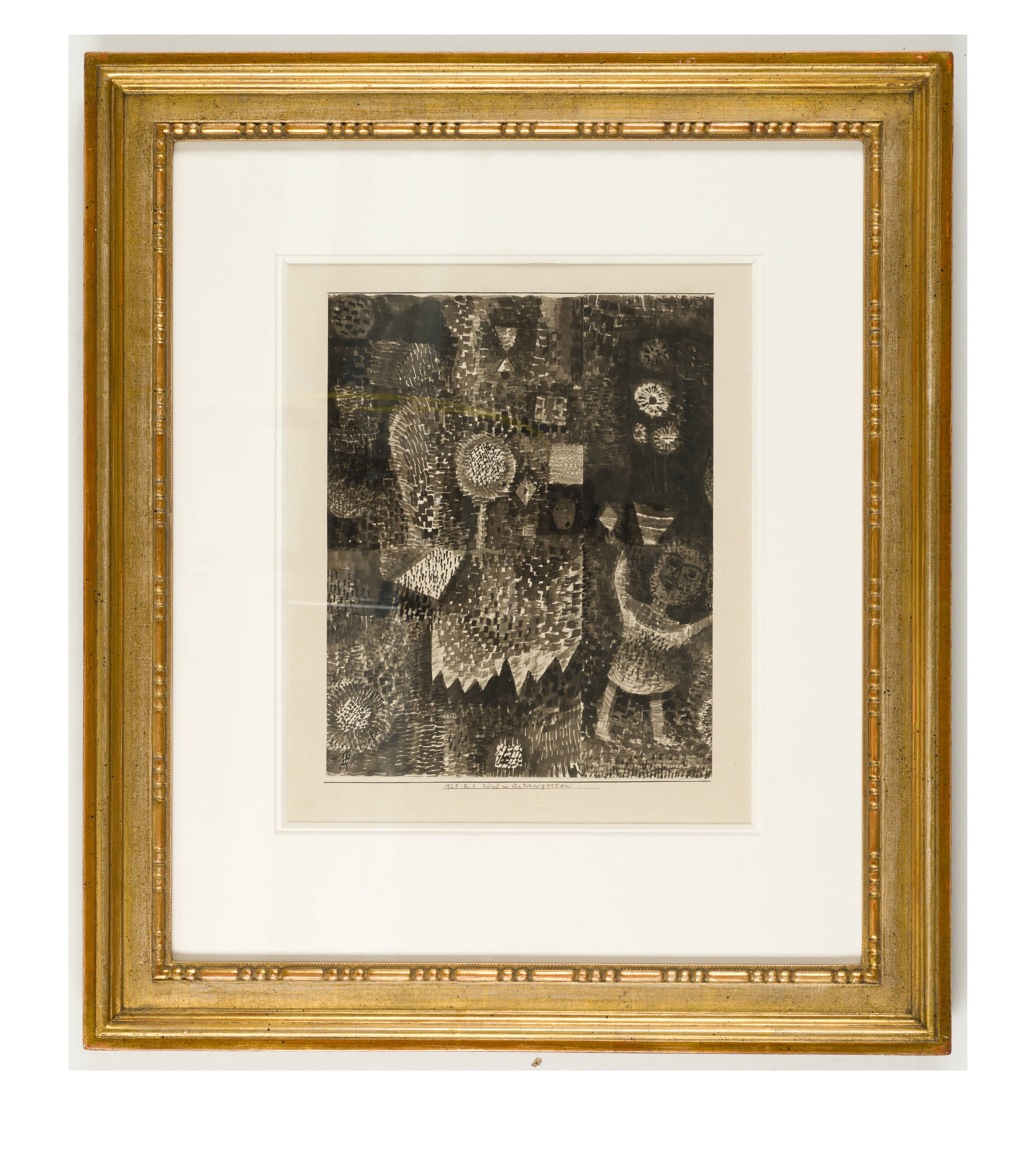
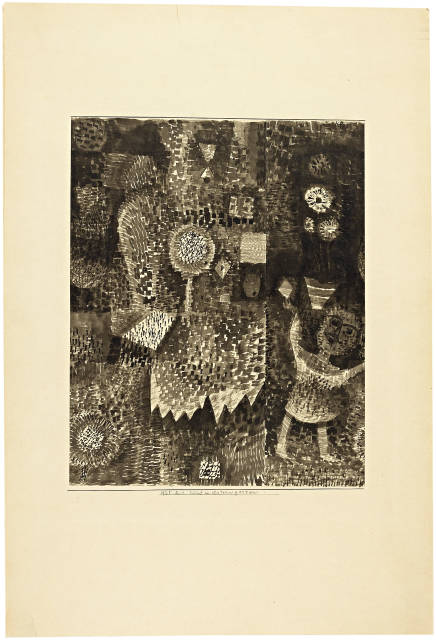
1925. Work number 1925.81 (R 1)
Black watercolour in various shades, heightened with pen and ink, on letter paper, mounted on cardboard
28.2x22.4 cm, letter paper; 48.4x32.2 cm, backing cardboard
Upper right signed by the artist in ink 'Klee', on the mount board at the top and bottom with an end line in ink, below the lower end line centre in ink with the work number and title '1925. R 1. Kind im Asterngarten', lower left numbered in pencil 'I'
Paul Klee Stiftung, Catalogue raisonné, vol. 4, Werke 1923-1926, Bern 2000, no. 3762
Collection Hans and Erika Meyer-Benteli, Bern
Collection Ted and Meret Schaap-Meyer, Vallamand-Dessous (until 1990)
Auction Christie's, London, 4 December 1990, lot 165
Auction Villa Grisebach, Berlin, 26 May 1995, lot 57
Auction Galerie Kornfeld, Bern, 17 June 2005, lot 93, acquired there by
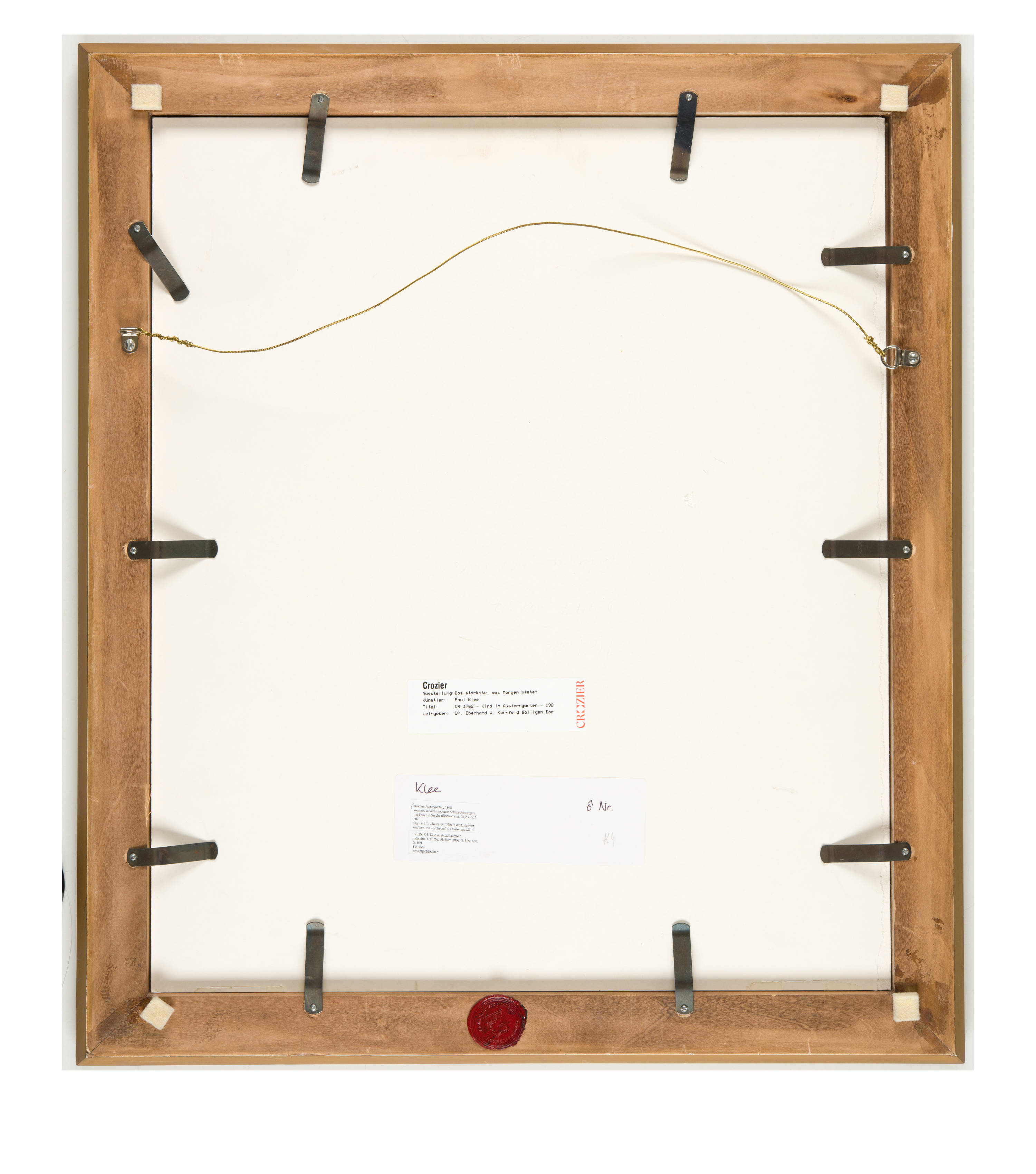
Collection Eberhard W. Kornfeld, Bern, with the collector's stamp on the back, Lugt 913b
Will Grohmann, Paul Klee, Handzeichnungen 1921-1930, Potsdam/Berlin 1934, no. 32
Will Grohmann, Paul Klee, The Drawings of Paul Klee, New York 1944, no. 23
Will Grohmann, Paul Klee, Geneva/Stuttgart 1954, p. 276
Dover Publications (ed.), Klee Drawings, 60 Works by Paul Klee, New York 1982, p. 27
Maria-Christina Metzler, Paul Klee, Münchenbuchsee near Bern 1879-1940 Muralto-Locarno, in: Wege der Moderne, Aus der Sammlung Eberhard W. Kornfeld, Vienna 2009, p. 200
Munich 1954, Haus der Kunst, Paul Klee, cat. no. 42
Baden-Baden 1964, Staatliche Kunsthalle, Der frühe Klee, cat. no. 125
Bern 2008, Zentrum Paul Klee, In Paul Klees Zaubergarten, p. 109
Oslo/Bergen 2008/2009, Henie Onstad Art Centre/Art Museum, Enchanted Garden, p. 109
Vienna 2008/2009, Albertina, Wege der Moderne, Aus der Sammlung Eberhard W. Kornfeld, cat. no. 134
Bern 2015/2016, Zentrum Paul Klee, Klee in Bern 3, without cat.
Berlin 2018, Liebermann-Villa am Wannsee, Max Liebermann und Paul Klee - Bilder von Gärten, cat. no. 26
Jena 2019, Kunstsammlung Jena, "Das stärkste, was Morgen heute bietet.", Der Sturm in Jena, cat. no. 85
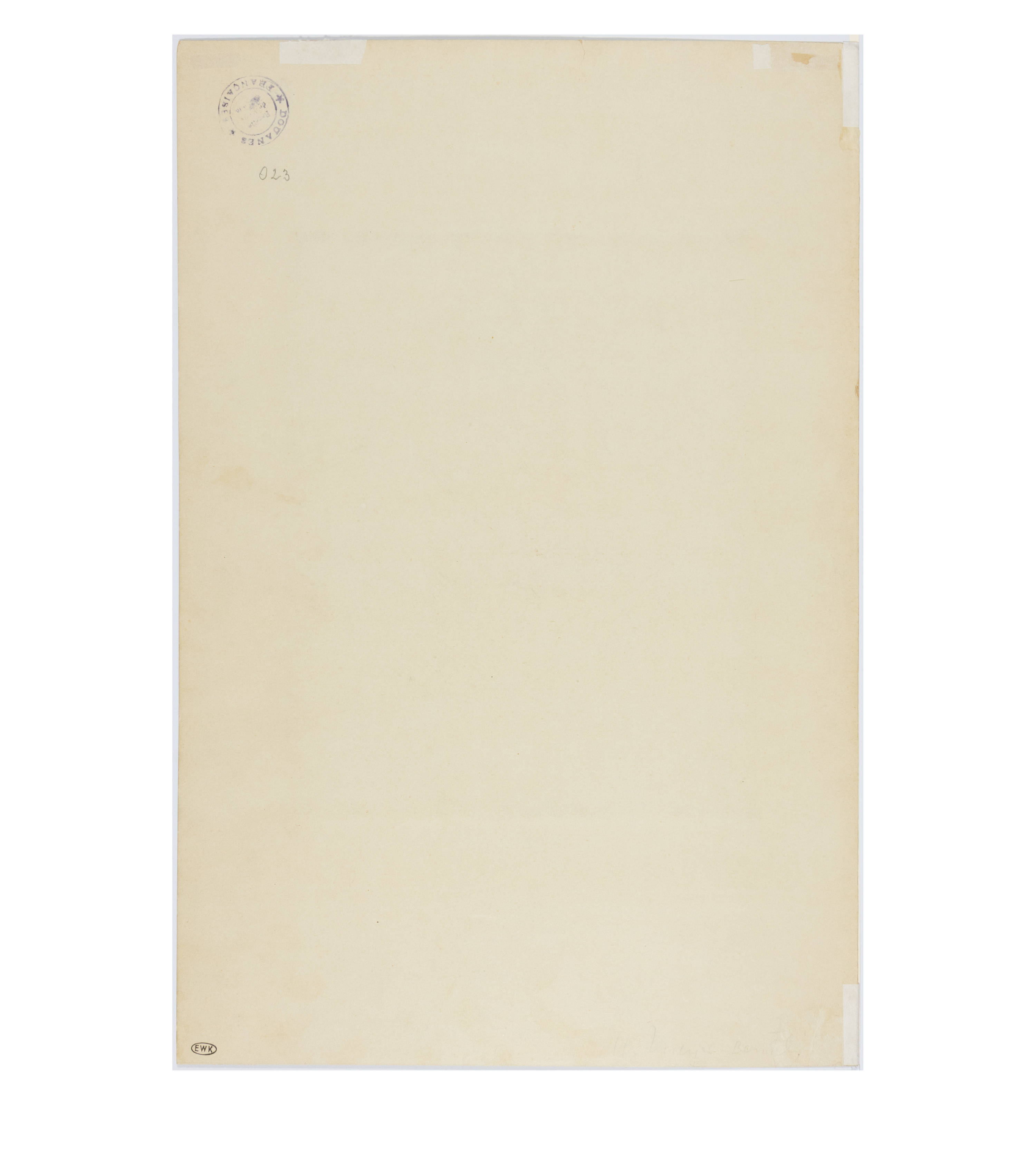
Laid down on cardboard. The cardboard slightly browned, with a tear at the top centre and a crease in the lower left corner. Verso with traces of old mounting. In very fine condition
In October 1920, Walter Gropius appointed Paul Klee as a master at the Staatliches Bauhaus in Weimar. In January 1921, he began his teaching activities. These were very intensive and productive years for the artist. However, due to political pressure, the important teaching institution had to leave Weimar in 1925 and make a new start in Dessau, which also marked a turning point in Klee's work.
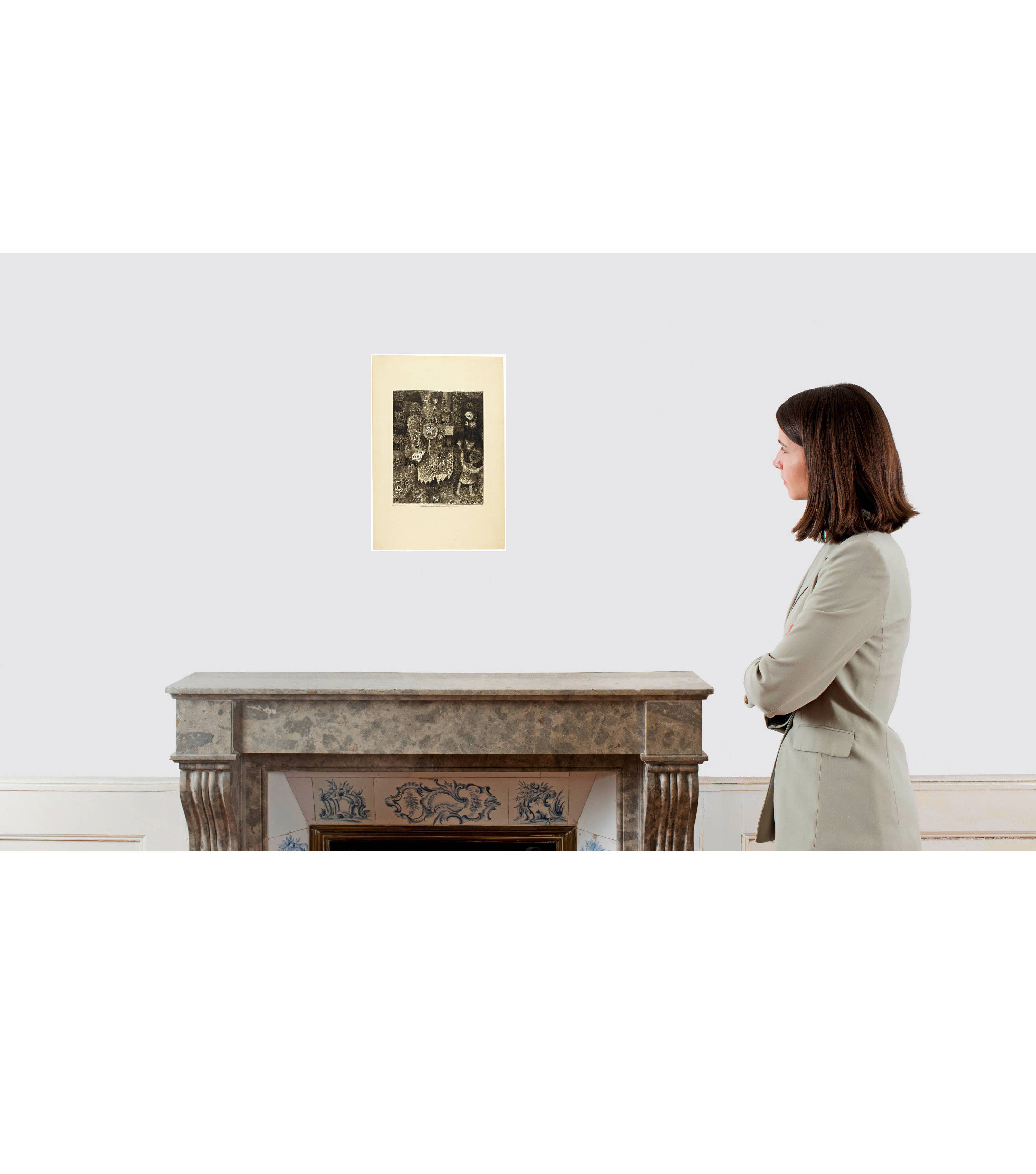
With the black watercolour 'Kind im Asterngarten', Klee created a poetic, dreamlike image during this uncertain time, translating childhood, nature and fantasy into a subtle visual language. His work repeatedly contains references and elements of the childlike world of fairy tales and dreams. Although Paul Klee did not create direct illustrations for Lewis Carroll's book 'Alice in Wonderland', there are indications that he was inspired by the fantasy and absurdity of the story. In terms of content, the present sheet can certainly be read as a homage to childlike perception, to a world in which nature is animated, proportions know no fixed rules, and space and time appear to flow. Klee did not understand the childlike as immaturity, but as the source of creative freedom. 'Kind im Asterngarten' thus becomes a metaphor for creative consciousness - untainted, open and full of wonder.
The picture is also a reminder that art is a play with the visible and the invisible. Klee once noted: 'Art does not reproduce the visible but makes visible.' In the present black watercolour, this becomes palpable. It is a quiet invitation to see the world anew through the eyes of imagination.
1925. Werknummer 1925.81 (R 1)
Schwarzes Aquarell in verschiedenen Tönungen, mit der Feder in Tusche überzeichnet, auf Briefpapier, auf Karton aufgelegt
28,2x22,4 cm, Briefpapier; 48,4x32,2 cm, Unterlagekarton
Oben rechts vom Künstler in Tusche signiert "Klee", auf dem Unterlagekarton oben und unten mit einem Abschlussstrich in Tusche, unter dem unteren Abschlussstrich in der Mitte in Tusche mit der Werknummer und dem Titel "1925. R 1. Kind im Asterngarten", unten links in Bleistift nummeriert "I"
Paul Klee Stiftung, Catalogue raisonné, Bd. 4, Werke 1923-1926, Bern 2000,
Slg. Hans und Erika Meyer-Benteli, Bern
Slg. Ted und Meret Schaap-Meyer, Vallamand-Dessous (bis 1990)
Auktion Christie's, London, 4. Dezember 1990, Los 165
Auktion Villa Grisebach, Berlin, 26. Mai 1995, Los 57
Auktion Galerie Kornfeld, Bern, 17. Juni 2005, Los 93, dort erworben von
Slg. Eberhard W. Kornfeld, Bern, rückseitig mit dem Sammlerstempel, Lugt 913b
Will Grohmann, Paul Klee, Handzeichnungen 1921-1930, Potsdam/Berlin 1934,
Will Grohmann, Paul Klee, The Drawings of Paul Klee, New York 1944,
Will Grohmann, Paul Klee, Genf/Stuttgart 1954,
Dover Publications (Hg.), Klee Drawings, 60 Works by Paul Klee, New York 1982,
Maria-Christina Metzler, Paul Klee, Münchenbuchsee bei Bern 1879-1940 Muralto-Locarno, in: Wege der Moderne, Aus der Sammlung Eberhard W. Kornfeld, Wien 2009,
München 1954, Haus der Kunst, Paul Klee,
Baden-Baden 1964, Staatliche Kunsthalle, Der frühe Klee,
Bern 2008, Zentrum Paul Klee, In Paul Klees Zaubergarten,
Oslo/Bergen 2008/2009, Henie Onstad Art Centre/Art Museum, Enchanted Garden,
Wien 2008/2009, Albertina, Wege der Moderne, Aus der Sammlung Eberhard W. Kornfeld,
Bern 2015/2016, Zentrum Paul Klee, Klee in Bern 3, ohne Kat.
Berlin 2018, Liebermann-Villa am Wannsee, Max Liebermann und Paul Klee - Bilder von Gärten,
Jena 2019, Kunstsammlung Jena, "Das stärkste, was Morgen heute bietet.", Der Sturm in Jena,
Auf Unterlagekarton aufgezogen. Der Karton leicht gebräunt, mit einem Einriss oben in der Mitte und einer Knickfalte in der unteren linken Ecke. Rückseitig mit Spuren einer alten Montierung. In sehr schöner Erhaltung
Im Oktober 1920 wurde Paul Klee von Walter Gropius als Meister an das Staatliche Bauhaus in Weimar berufen. Im Januar 1921 nahm er seine Lehrtätigkeit auf. Es waren sehr intensive und fruchtbare Schaffensjahre für den Künstler. Aufgrund politischen Drucks musste die wichtige Lehrinstitution 1925 Weimar verlassen und in Dessau einen Neuanfang machen, was auch eine Zäsur in Klees Schaffen bewirkte.
Mit dem Schwarzaquarell "Kind im Asterngarten" schuf Klee in dieser unsicheren Zeit ein poetisch-traumartiges Bild, das Kindheit, Natur und Phantasie in eine feinsinnige Bildsprache übersetzt. In seinem Werk finden sich immer wieder Bezüge und Elemente der kindlichen Märchen- und Traumwelt. Zwar hat Paul Klee keine direkten Illustrationen zu Lewis Carrolls Buch "Alice im Wunderland" geschaffen, es gibt jedoch Anzeichen dafür, dass er von der Phantasie und dem Absurden der Geschichte inspiriert war. Inhaltlich lässt sich das hier angebotene Blatt sicherlich als Hommage an die kindliche Wahrnehmung lesen, an eine Welt, in der die Natur beseelt ist, Proportionen keine feste Regel kennen und Raum und Zeit fliessend erscheinen. Klee verstand das Kindliche nicht als Unreife, sondern als Ursprung kreativer Freiheit. "Kind im Asterngarten" wird so zur Metapher für das schöpferische Bewusstsein - unverdorben, offen und staunend.
Das Bild ist auch eine Reminiszenz daran, dass Kunst ein Spiel mit dem Sichtbaren und dem Unsichtbaren ist. Klee notierte einst: "Kunst gibt nicht das Sichtbare wieder, sondern macht sichtbar." Im hier angebotenen Schwarzaquarell wird genau das spürbar. Es ist eine stille Einladung, die Welt mit den Augen der Phantasie neu zu sehen.
| Switzerland | CHF | 130 |
| Europe | CHF | 200 |
| USA | CHF | 250 |
| Overseas | CHF | 255 |