- EN


 Log in
-
- Live Auctions
- Past auctions
- More
- Kornfeld today
- The Story of Kornfeld
- Information


Note: The image cannot be displayed for legal reasons. For more information, see the PDF of the catalogue: Link to PDF


Pistoia 1901 - 1980 Viareggio


1949, cast in 1953
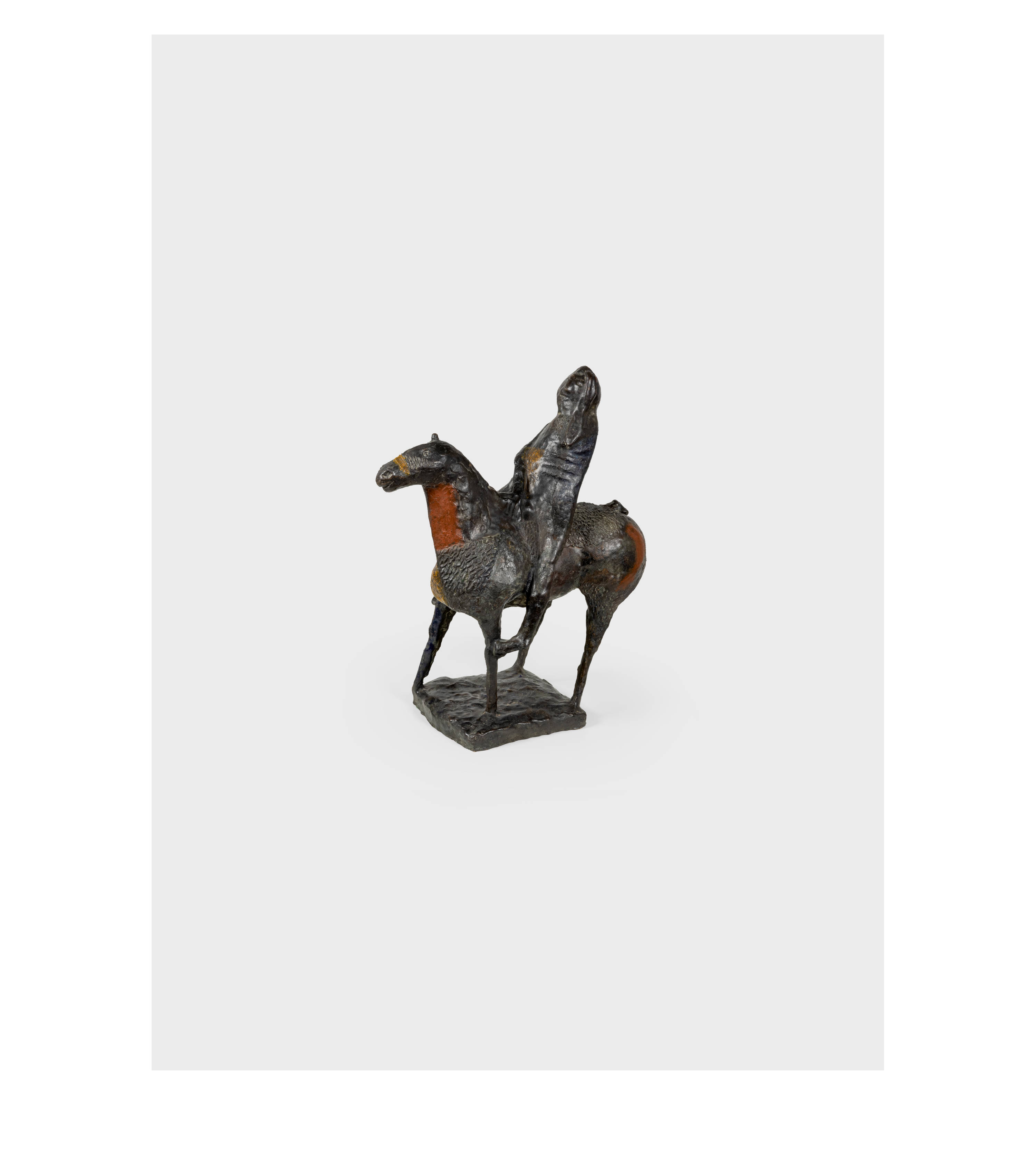
Bronze, coloured
Circa 40.5x33x16.5 cm
With the artist's monogram "M.M" on the base. With the foundry mark "FONDERIA ARTISTICA BATTAGLIA & CO" on the underside.
Fondazione Marino Marini (ed.), Marino Marini, Catalogue Raisonné of the Sculptures, Milan 1998, no. 325/326
Patrick Waldberg, Herbert Read and Gualtieri di San Lazzaro, Marino Marini, Complete Works, New York 1970, no. 251/251a
Private collection Great Britain
Collection Eric Estorick, New York
Private collection, New York
The Grosvenor Gallery, London
European private collection, acquired in 1999
Sotheby's auction, London, 16 October 2006, lot 8
Sotheby's auction, New York, 7 November 2007, lot 49, acquired there by
Private collection Norway, by inheritance to
European private collection
Minimal abrasions. In very good condition
Marino Marini's early sculptural works can be described as neoclassical. The "equestrian statue", which shows the ruler in a victorious pose on his horse, is a classical-antique type that was later taken up again and again. This motif can be found in the artist's oeuvre from the mid-1930s onwards. From 1943 to 1947, he went into exile in Switzerland with his wife Marina. There he met Alberto Giacometti, Fritz Wotruba, Otto Bänninger, Hermann Haller and Germaine Richier, among others; his encounters with these artists had a lasting influence on his style. And so it was above all the works created after his exile in Ticino that became iconic in sculpture after the Second World War. The "Cavalli" (horses) and "Cavalieri" (horsemen) groups of works became iconic in the history of art. They are no longer images of rulers, but symbioses of man and horse, whereby, according to Marini, the man emphasises the "vertical" and the horse the "horizontal". The incomparable sculptures often oscillate between objective representationalism and expressive abstraction. Marini attempts to define the tension of balance. There are rather cheerful-looking riders, as in the present case, or figures with deliberately placed mutilations.
Time and again, a sculpture from the edition is reworked. With elaborate chiselling, carvings in the wax model or subsequently added colour accents, Marini creates wonderful unique pieces. The present "Piccolo cavaliere" appears to occupy a variant between the six versions in bronze (Catalogue Raisonné 326) and the four known ceramic casts (Catalogue Raisonné 325). In the present case, the bronze has been heavily reworked compared to the two edition casts; the horse, for example, has been given an ear. You can also literally feel the horse's coat, the blanket and the rider's chest hair. Marini finally painted the sculpture by hand in shades of orange and yellow, with occasional splashes of blue. The sculpture was created in plaster in 1949 and cast in six bronzes. It is a compact and extremely expressive work that demonstrates the artist's constant will to change and create.
1949, Guss 1953
Bronze, farbig gefasst
Ca. 40,5x33x16,5 cm
Auf der Basis mit dem Künstlermonogramm "M.M". Auf der Unterseite mit dem Giesserstempel "FONDERIA ARTISTICA BATTAGLIA & CO".
Fondazione Marino Marini (Hrsg.), Marino Marini, Catalogue Raisonné of the Sculptures, Mailand 1998,
Patrick Waldberg, Herbert Read und Gualtieri di San Lazzaro, Marino Marini, Complete Works, New York 1970,
Privatsammlung Grossbritannien
Slg. Eric Estorick, New York
Privatsammlung, New York
The Grosvenor Gallery, London
Europäische Privatsammlung, 1999 erworben
Auktion Sotheby's, London, 16. Oktober 2006, Los 8
Auktion Sotheby's, New York, 7. November 2007, Los 49, dort erworben von
Privatsammlung Norwegen, durch Erbschaft an
Europäische Privatsammlung
Minime Abreibungen. In sehr gutem Erhaltungszustand
Marino Marinis frühe plastische Arbeiten können als neoklassisch bezeichnet werden. Ein klassisch-antiker Typus, der später immer wieder aufgegriffen wird, ist das "Reiterstandbild", das den Herrscher in Siegerpose auf seinem Pferd zeigt. Ab Mitte der 1930er-Jahre lässt sich dieses Motiv im Œuvre des Künstlers nachweisen. Von 1943 bis 1947 begibt er sich mit seiner Frau Marina ins Exil in die Schweiz. Dort trifft er sich unter anderem mit Alberto Giacometti, Fritz Wotruba, Otto Bänninger, Hermann Haller oder Germaine Richier; die Begegnungen mit diesen Kunstschaffenden beeinflussen seinen Stil nachhaltig. Und so sind es vor allem die Arbeiten, die nach seinem Tessiner Exil entstehen, die in der Bildhauerei nach dem Zweiten Weltkrieg ikonisch werden. Die Werkgruppen der "Cavalli" (Pferde) und der "Cavalieri" (Reiter) werden bildprägend für die Kunstgeschichte. Es sind keine Herrscherbilder mehr, sondern Symbiosen von Mensch und Pferd, wobei nach Marini der Mensch die "Vertikale" und das Pferd die "Horizontale" betont. Die unvergleichlichen Plastiken oszillieren häufig zwischen der sachlichen Gegenständlichkeit in Richtung expressiver Abstraktion. Marini versucht, den Spannungsbogen des Gleichgewichts zu definieren. Es gibt eher fröhlich anmutende Reiter, wie im vorliegenden Fall, oder Figuren mit bewusst gesetzten Verstümmelungen.
Immer wieder wird eine Plastik aus der Edition überarbeitet. Mit aufwändigen Ziselierungen, Ritzungen ins Wachsmodell oder nachträglich gesetzten Farbakzenten schafft Marini so aus der Auflage heraus wunderbare "Einzelstücke". Der vorliegende "Piccolo cavaliere" scheint eine Variante zwischen den sechs Versionen in Bronze (Catalogue Raisonné 326) und den vier bekannten Keramikgüssen (Catalogue Raisonné 325) einzunehmen. Im vorliegenden Fall wurde die Bronze gegenüber den beiden Auflagegüssen sehr stark überarbeitet, das Pferd etwa hat ein Ohr erhalten. Man kann auch das Fell des Pferdes, die Decke oder das Brusthaar des Reiters förmlich spüren. Marini bemalte die Plastik schliesslich von Hand in Orange- und Gelbtönen sowie vereinzelten blauen Sprenkeln. Die Plastik entstand 1949 in Gips und wurde in sechs Bronzen gegossen. Es handelt sich um eine kompakte und äusserst ausdrucksstarke Arbeit, die den ständigen Veränderungs- und Gestaltungswillen des Künstlers zeigt.
| Switzerland | CHF | Individual offer |
| Europe | CHF | Individual offer |
| USA | CHF | Individual offer |
| Overseas | CHF | Individual offer |
Note: The image cannot be displayed for legal reasons. For more information, see the PDF of the catalogue: Link to PDF