- EN


 Log in
-
- Live Auctions
- Past auctions
- More
- Kornfeld today
- The Story of Kornfeld
- Information









Münchenbuchsee bei Bern 1879 - 1940 Muralto


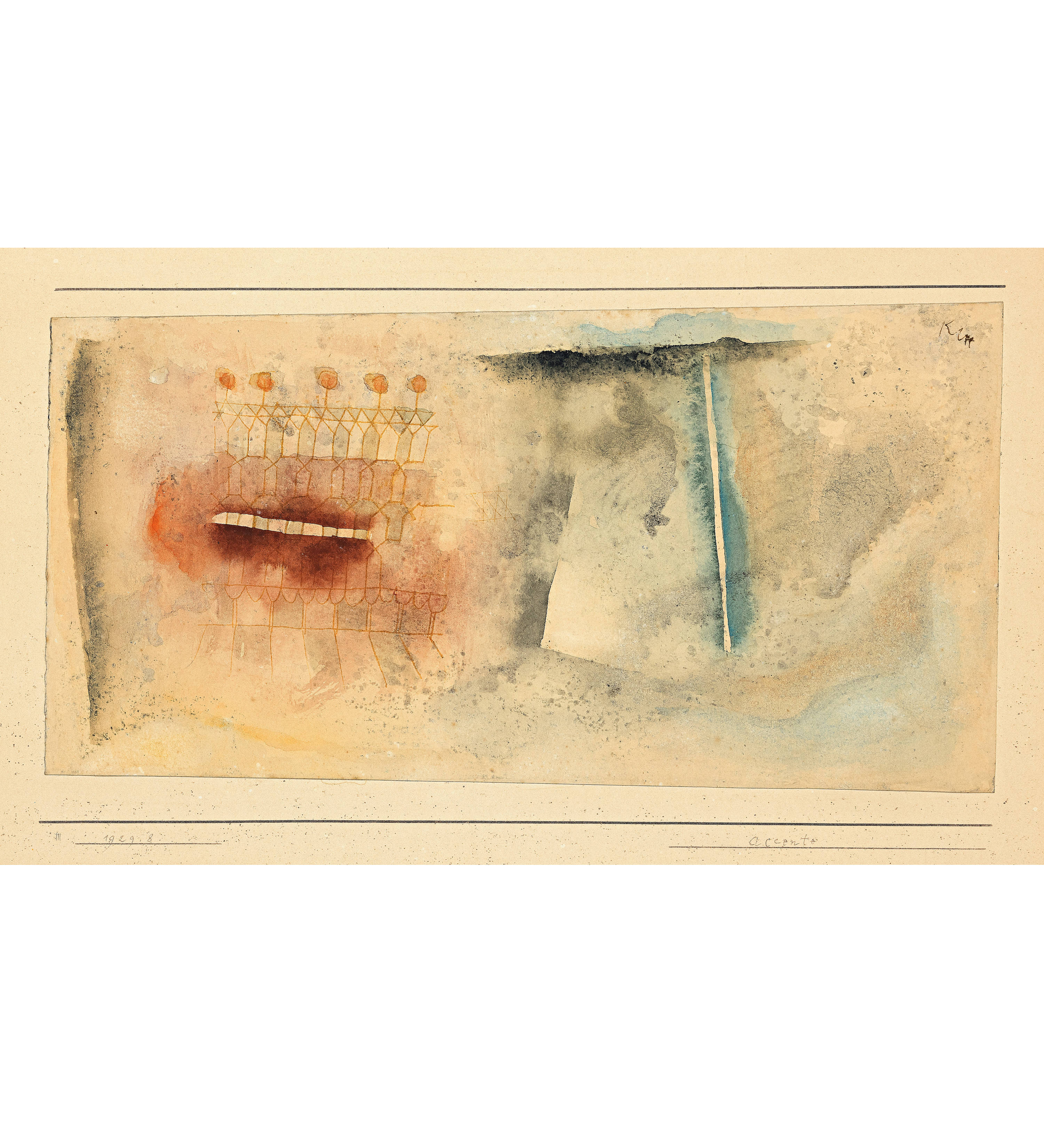
1929 - work number 1929.8
Watercolour, partly sprayed, and pen and ink on paper on cardboard
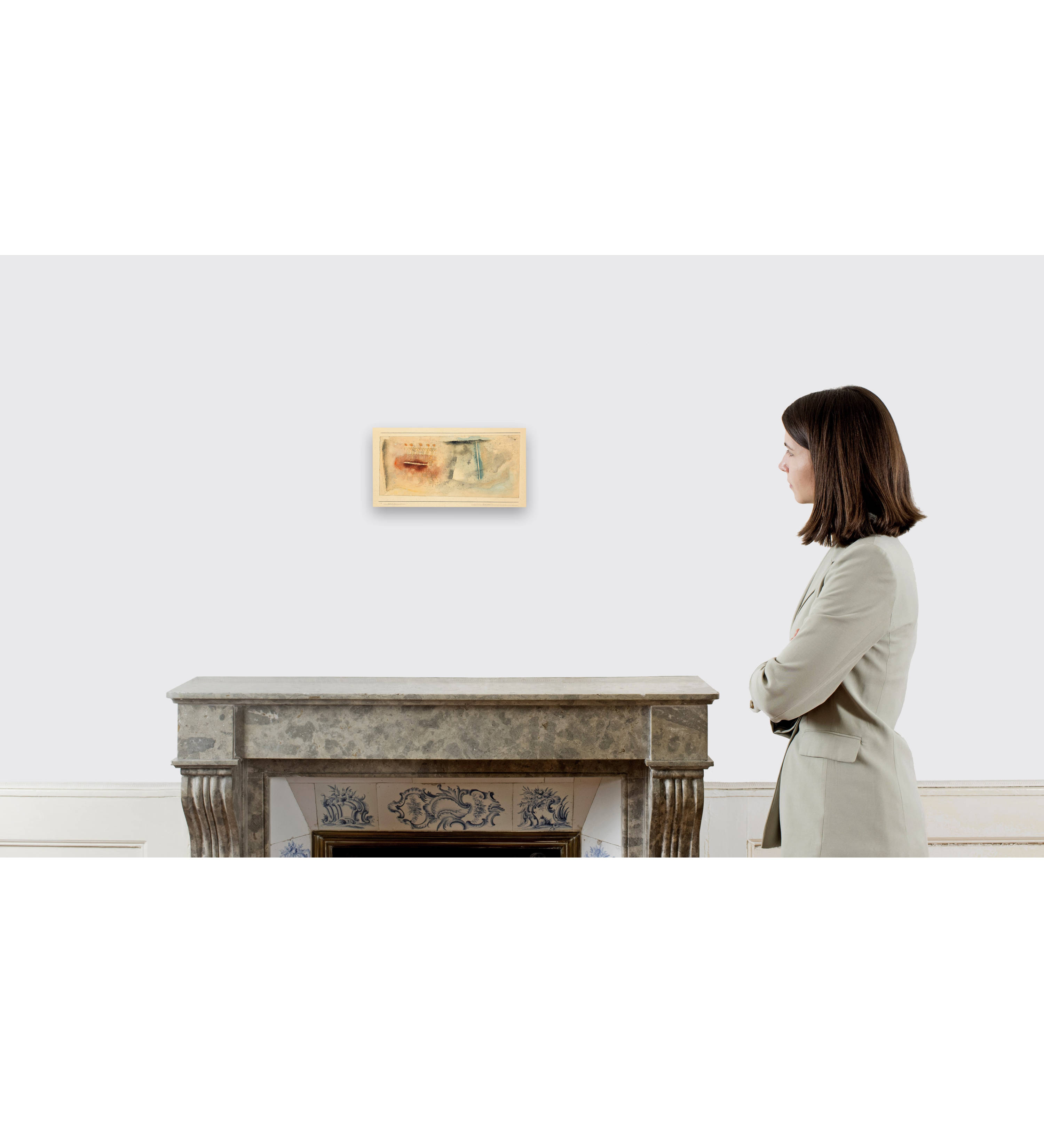
19x36.8 cm, image; 37.1x48 cm, backing board
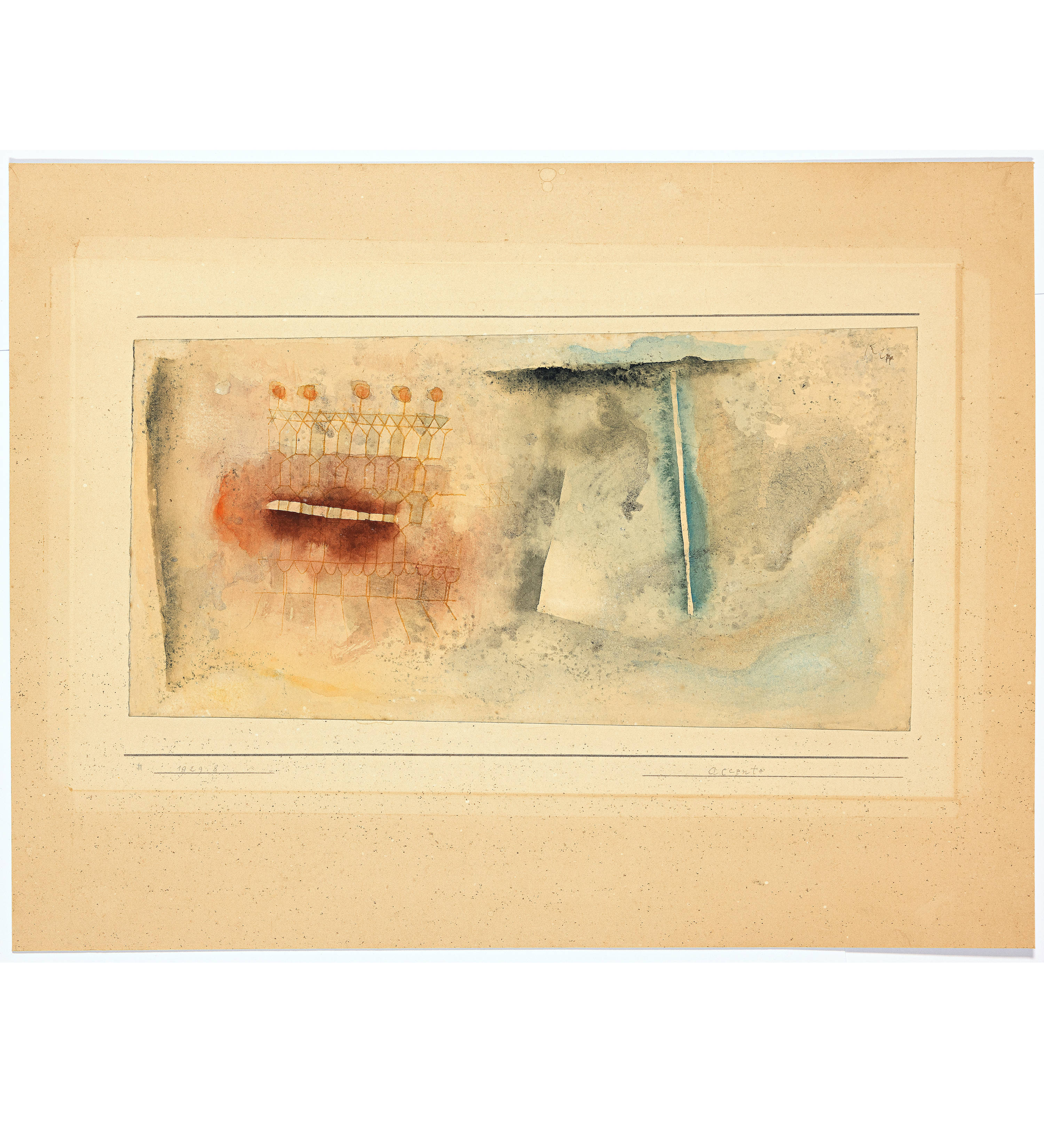
Signed on the upper right by the artist "Klee". Inscribed on the cardboard with marginal borders lower left "1929.8." and lower right "Accente", next to the date in pencil "III"
Catalogue raisonné, Paul Klee, vol. 5, Werke 1923-1926, Bern 2001, no. 4764
Rudolf Probst (Galerie Neue Kunst Fides; Das Kunsthaus), Dresden/Mannheim (1929)
Hermann Baumgarten, Stuttgart (from 1929)
Alfred Flechtheim, Düsseldorf/Berlin/Paris/London (from 1930)
Daniel-Henry Kahnweiler, Paris (until 1935)
The Mayor Gallery, London (from 1935)
M. Kauffer Collection
The Mayor Gallery, London
Leicester Galleries, London
Auction Christie's, London, 7 July 1961, lot 39
Auction Lempertz, Cologne, 1 December 1961, lot 341
Auction Karl & Faber, Munich, 12 December 1968, lot 958
Beyeler Gallery, Basel (1968-1969)
Collection Erwin Rehmann, Laufenburg
Private collection Switzerland
Saarbrücken 1930, Staatliches Museum Saarbrücken, Paul Klee. Aquarelle aus 25 Jahren, cat. no. 99
Düsseldorf 1931, Kunstverein für Rheinland und Westfalen in association with the Alfred Flechtheim Gallery, Paul Klee, cat. no. 209
London 1935, The Mayor Gallery, Paul Klee, cat. no. 22
London 1941, Leicester Galleries, Paul Klee, cat. no.32
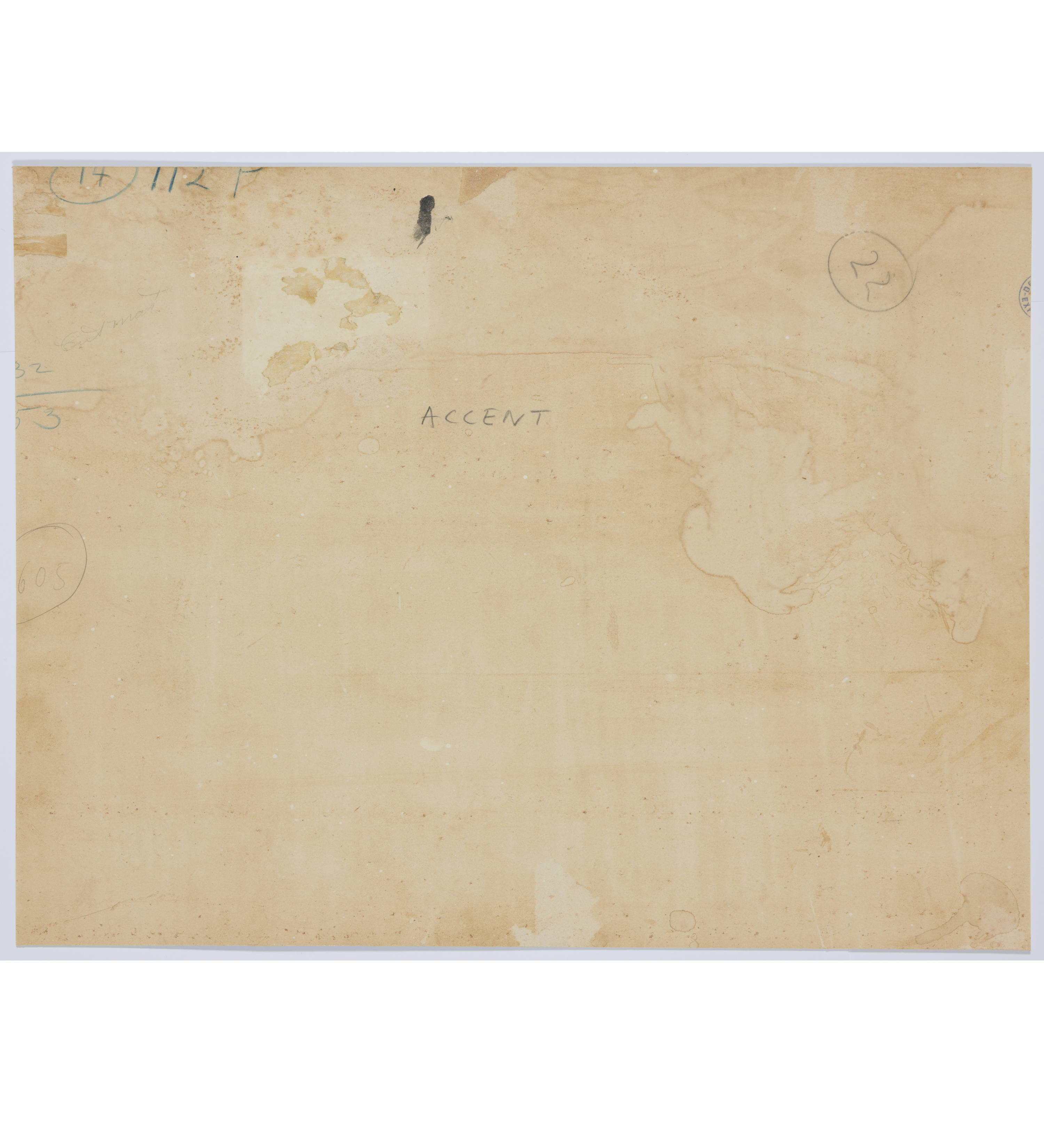
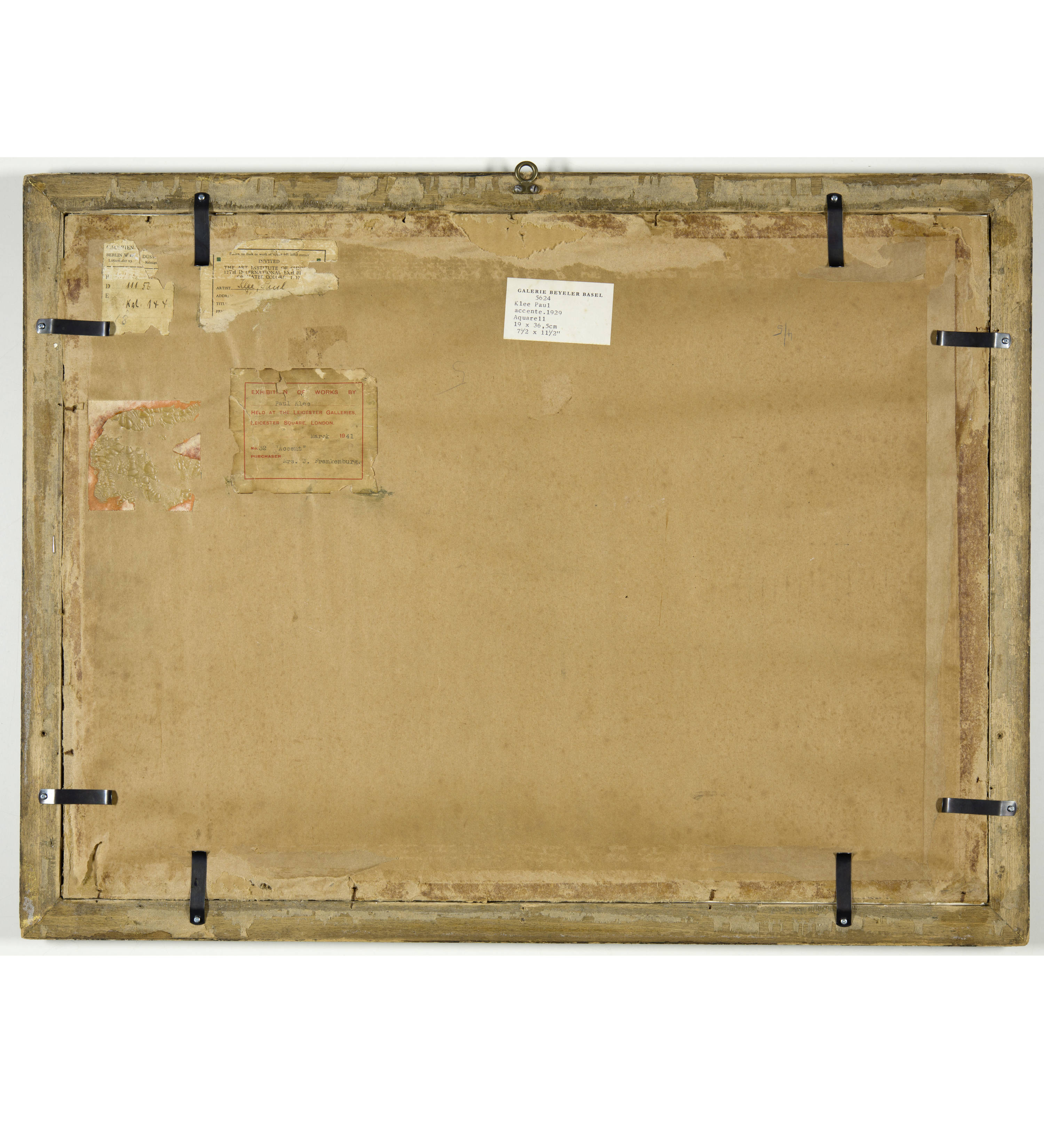
The Art Institute of Chicago, with label on back board
The cardboard browned, with lightstruck and waterstains in the margin. Stains in the backing
Since the legendary trip to Tunis with Macke and Moilliet in 1914, Klee had not undertaken any more major journeys. His longing for the south led him to Egypt at the turn of the year 1928/1929; this time he travelled alone and without much luggage. The journey takes him from Alexandria via Cairo and Luxor to Aswan. In addition to visiting ancient Egyptian monuments and tombs, he was particularly fascinated by the fertile landscape along the Nile with its colourfulness. He produced almost no works in Egypt itself, but his impressions clearly flowed into his works after his return
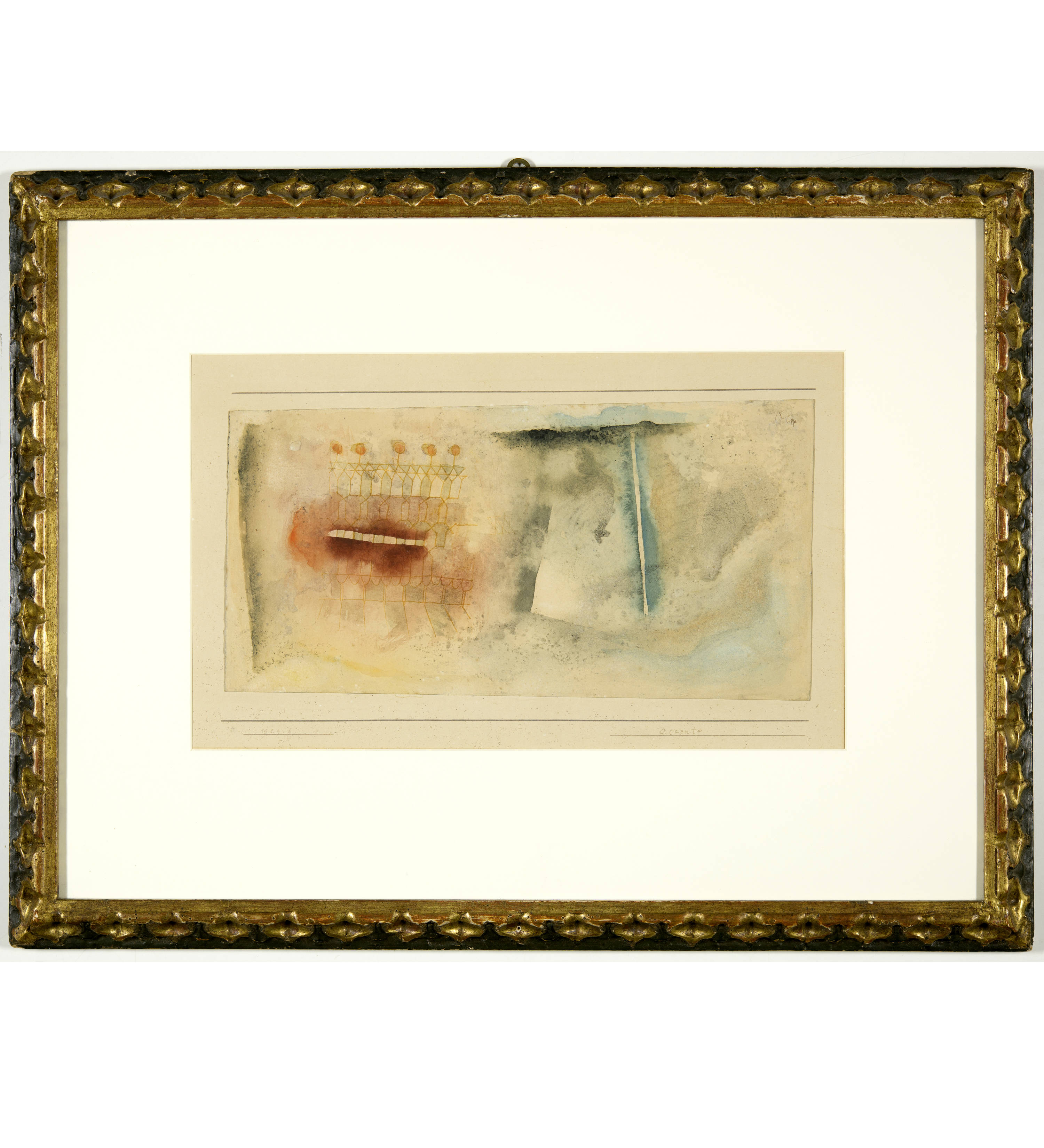
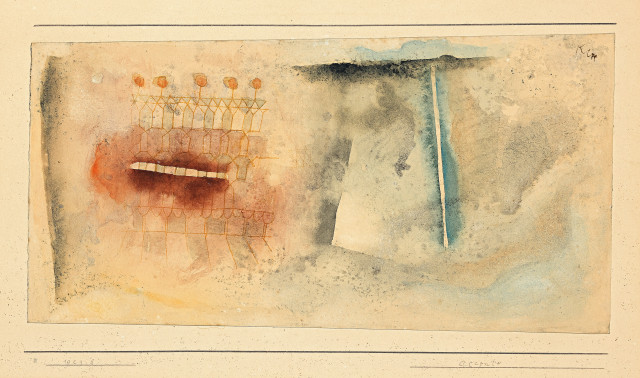
The present sheet is one of his first works in 1929. Several of these works are characterised by a glazed, fine application of colour, Klee also using the "splash technique". "Accente" is a mysterious work full of contrasts. Do the red and architectural elements on the left stand for the desert and cities and the blue on the right for fertile landscape and the Nile? Or can the horizontal opening in the red be understood as a simplified transposition of the temple of Hatshepsut in Thebes and the vertical opening in the blue as a symbol of the temple of Abu Simbel, both of which Klee visited on his journey? The riddle remains unsolved. What is undisputed is that the influence of the trip to Egypt had a particularly strong impact on the late work with the hieroglyphic-like signs
1929 - Werknummer 1929.8
Aquarell, teilweise gespritzt, und Feder auf Papier auf Karton
19x36,8 cm, Darstellung; 37,1x48 cm, Unterlagekarton
Oben rechts vom Künstler signiert "Klee". Bezeichnet auf dem Karton mit Randleisten unten links "1929.8." und unten rechts "Accente", neben dem Datum in Bleistift "III"
Catalogue raisonné, Paul Klee, Band 5, Werke 1927-1930, Bern 2001,
Rudolf Probst (Galerie Neue Kunst Fides; Das Kunsthaus), Dresden/Mannheim (1929)
Hermann Baumgarten, Stuttgart (ab 1929)
Alfred Flechtheim, Düsseldorf/Berlin/Paris/London (ab 1930)
Daniel-Henry Kahnweiler, Paris (bis 1935)
The Mayor Gallery, London (ab 1935)
Slg. M. Kauffer
The Mayor Gallery, London
Leicester Galleries, London
Auktion Christie's, London, 7. Juli 1961, Los 39
Auktion Lempertz, Köln, 1. Dezember 1961, Los 341
Auktion Karl & Faber, München, 12. Dezember 1968, Los 958
Galerie Beyeler, Basel (1968-1969)
Slg. Erwin Rehmann, Laufenburg
Privatsammlung Schweiz
Saarbrücken 1930, Staatliches Museum Saarbrücken, Paul Klee. Aquarelle aus 25 Jahren,
Düsseldorf 1931, Kunstverein für Rheinland und Westfalen in Verbindung mit der Galerie Alfred Flechtheim, Paul Klee,
London 1935, The Mayor Gallery, Paul Klee,
London 1941, Leicester Galleries, Paul Klee, Kat. Nr.32
The Art Institute of Chicago, mit Etikett auf Rückenkarton
Der Karton gebräunt, mit Lichtrand und im Rand mit Wasserflecken. Fleckchen in der Unterlage
Seit der legendären Tunisreise mit Macke und Moilliet im Jahr 1914 hat Klee keine grossen Reisen mehr unternommen. Die Sehnsucht nach dem Süden führt ihn an der Jahreswende 1928/1929 nach Ägypten; dieses Mal reist er alleine und ohne grosses Gepäck. Die Reise geht von Alexandria über Kairo und Luxor bis nach Assuan. Neben dem Besuch altägyptischer Monumente und Grabanlagen begeistert ihn vor allem die fruchtbare Landschaft am Nil mit ihrer Farbigkeit. In Ägypten selber entstehen fast keine Arbeiten, doch fliessen die Eindrücke nach seiner Rückkehr eindeutig in seine Werke ein
Zu den ersten Werken im Jahr 1929 gehört das vorliegende Blatt. Mehrere dieser Arbeiten sind durch einen lasierenden, feinen Farbauftrag geprägt, Klee verwendet dabei auch die «Spritztechnik». «Accente» ist ein geheimnisvolles Werk voller Gegensätze. Stehen das Rot und die Architekturelemente links für die Wüste und die Städte und das Blau rechts für fruchtbare Landschaft und den Nil? Oder kann man die horizontale Öffnung im Rot als vereinfachte Umsetzung des Hatschepsut-Tempels in Theben und die vertikale Öffnung im Blau als Symbol des Tempels von Abu Simbel verstehen, die Klee beide auf seiner Reise besucht hat? Das Rätsel bleibt ungelöst. Unumstritten ist, dass der Einfluss der Ägyptenreise besonders das Spätwerk mit den hieroglyphenartigen Zeichen stark geprägt hat