- EN


 Log in
-
- Live Auctions
- Past auctions
- More
- Kornfeld today
- The Story of Kornfeld
- Information




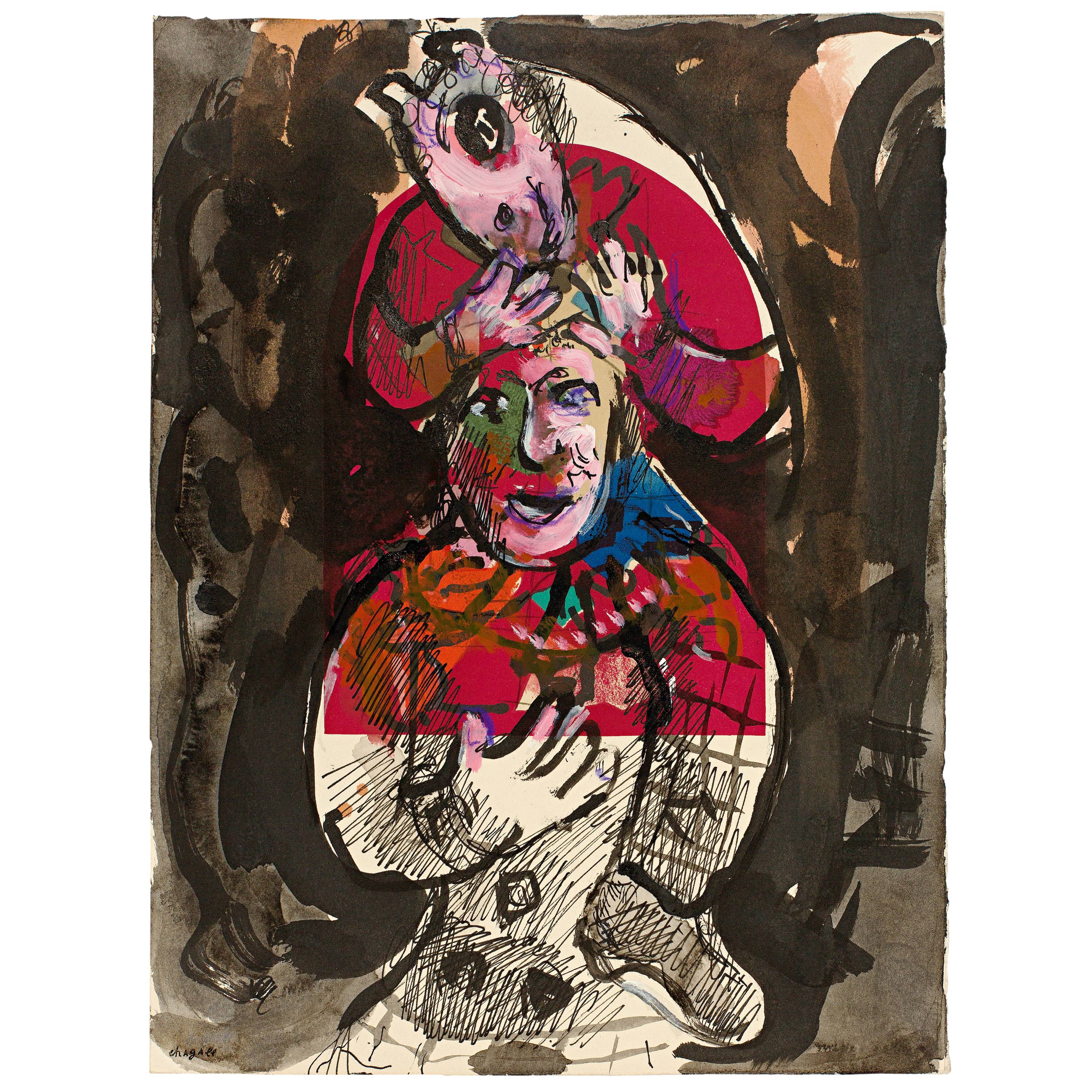
Witebsk 1887 - 1985 Saint-Paul-de-Vence


1971
Indian ink, gouache, coloured pencil, pastel and pencil
36,5×27,2 cm
Signature stamp of the estate "Chagall", lower left
Confirmation of authenticity (no. 2021065) from the Comité Marc Chagall, Paris, dated 7 July 2021
Estate of the artist
On firm wove paper, worked on a painted reproduction from 1962 of the fourth preparatory maquette for La Tribu de Juda, 1960–1962, reproduced in the book Marc Chagall, Vitraux pour Jérusalem, Paris, André Sauret, 1962, p. 70. With small wrinkle on the left, fresh in colours and in immaculate overall condition
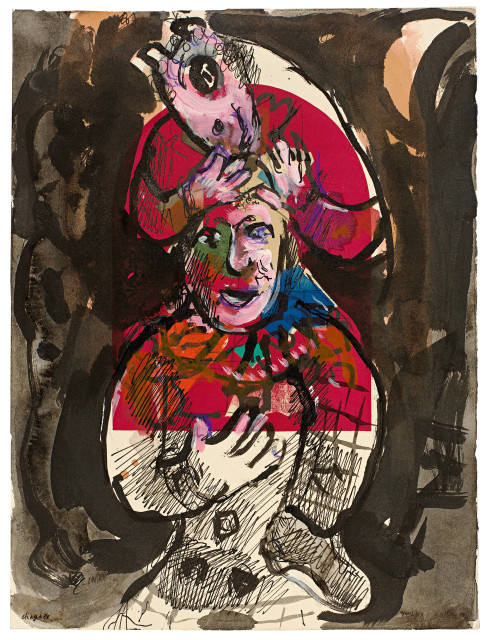
Chagall shows two clowns, one sitting on the shoulders of the other. The upper one wears the mask of the anthropomorphic, mystical animal, which Chagall sees as a metaphor for inspiration and creativity. In the facial features of the lower clown, one recognises those of the artist himself; he also points to himself with his right hand. It is a joy to see how Chagall uses brush and pen side by side, for example in the space of the moon at upper right, or in the apparently coloured clothes, which are actually sections of the blank background. The composition is based on Chagall’s colour reproduction of a preliminary study for a stained-glass window in Jerusalem. The artist creates fascinating transitions between the foreground and background areas of the image
1971
Tusche, Gouache, Farbstift, Pastell und Bleistift
36,5x27,2 cm
Unten links mit dem Signaturstempel des Nachlasses "Chagall"
Echtheitsbestätigung (Nr. 2021065) des Comité Marc Chagall, Paris, datiert vom 7. Juli 2021, liegt vor
Nachlass des Künstlers
Auf festem Velin, gearbeitet auf farbiger Reproduktion von 1962 der vierten vorbereitenden Maquette für "La Tribu de Juda", 1960-1962, reprod. im Buch "Marc Chagall, Vitraux pour Jérusalem", Paris, André Sauret, 1962, pag. 70. Mit minimer Quetschfalte links, farbfrisch und in tadelloser Gesamterhaltung
Zwei Clowns, einer sitzt auf den Schultern des anderen. Der obere trägt die Maske des anthropomorphen, mystischen Tiers, das Chagall als Metapher für die Inspiration und Kreativität versteht. Man kann in den Gesichtszügen des unteren Clowns durchaus den Künstler selber erkennen; er deutet mit der rechten Hand auch auf sich selbst. Schön, wie Chagall Pinsel und Feder nebeneinander einsetzt, etwa in der Aussparung des Mondes oben rechts, oder bei den vermeintlich eingefärbten Kleidern, die sich jedoch als Teile des ausgesparten Untergrunds entpuppen. Die Komposition ist nämlich auf eine farbige Reproduktion einer Vorstudie mit Collagetechnik für ein Glasfenster in Jerusalem gearbeitet; mit den Aussparungen erreicht der Künstler eine spannende Verbindung und Verwandlung zwischen Vorder- und Hintergrund