- EN


 Log in
-
- Live Auctions
- Past auctions
- More
- Kornfeld today
- The Story of Kornfeld
- Information


Note: The image cannot be displayed for legal reasons. For more information, see the PDF of the catalogue: Link to PDF






Ardning 1938 - lebt und arbeitet in Graz und auf den Kanaren


1980
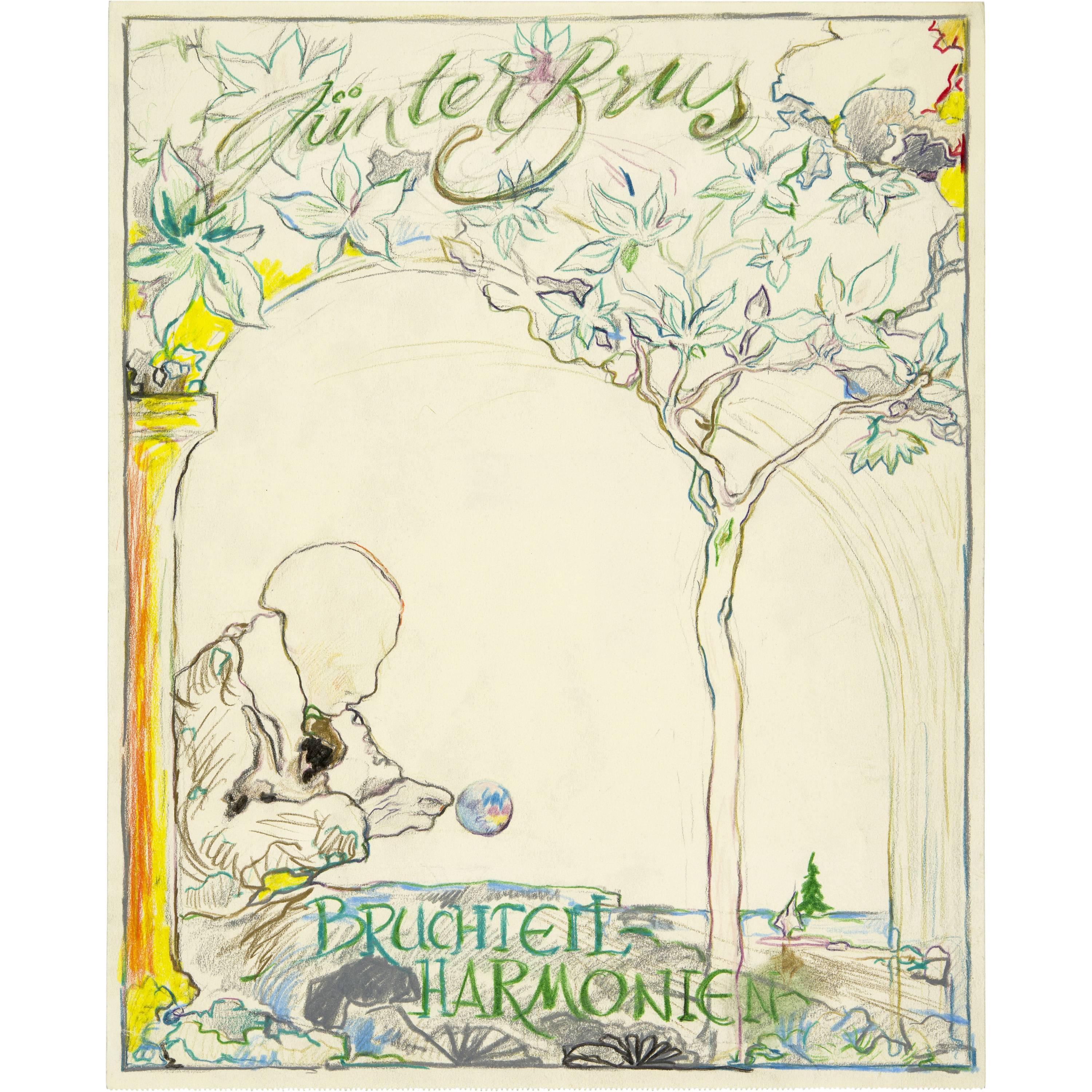
9 drawings in chalk, coloured pencil and carpenter's pencil
Each ca. 40x32 cm
The first sheet inscribed "Günter Brus" in coloured pencil at the top, titled "BRUCHTEIL-HARMONIEN" at the bottom, dated "20.IV.80" in pencil on the reverse and inscribed with the number "1"
Gallery Maeght Lelong, Zurich, 1984 purchased there for private collection Switzerland
All sheets on drawing paper, each perforated at one edge, 7 sheets mounted in passepartout, 2 loose
Günter Brus is one of the most important representatives of Viennese Actionism, who attracted attention with extremely radical actions, even to the point of self-mutilation. The year 1970, however, marks a turning point in his work; his graphic novel "Irrwisch" is the beginning of a series of works in which he becomes a "picture poet" by combining literature and the visual arts. In doing so, he enters into a dialogue with artists of other decades and centuries, for example with William Blake, or with Alfred Kubin. In 1979 he wrote and drew "Des Knaben Wunderhorn". The work presented here is an exciting example of this late creative phase, which is extremely rare as a cycle
Group lot
Together 9 sheets
1980
9 Zeichnungen in Kreide, Farb- und Zimmermannsbleistift
Je ca. 40x32 cm
Das erste Blatt oben in Farbstift bezeichnet "Günter Brus", unten betitelt "BRUCHTEIL-HARMONIEN", rückseitig in Bleistift datiert "20.IV.80" und mit der Nummer "1" bezeichnet
Galerie Maeght Lelong, Zürich, 1984 dort angekauft für Privatsammlung Schweiz
Alle Blätter auf Zeichenpapier, je an einer Kante perforiert, 7 Blätter in Passepartout montiert, 2 lose
Günter Brus gehört zu den bedeutendsten Vertretern des Wiener Aktionismus, der mit äusserst radikalen Aktionen bis hin zur Selbstverstümmelung aufgefallen ist. Das Jahr 1970 bildet jedoch einen Wendepunkt in seinem Schaffen, sein Bildroman "Irrwisch" ist der Beginn einer Reihe von Arbeiten, in denen er zum "Bild-Dichter" wird, indem er Literatur und Bildende Kunst miteinander verbindet. Er tritt dabei in einen Dialog mit Künstlern anderer Jahrzehnte und Jahrhunderte, etwa mit William Blake, oder mit Alfred Kubin. 1979 schreibt und zeichnet er „Des Knaben Wunderhorn“. Die hier vorliegende Arbeit ist ein spannendes Beispiel dieser späten Schaffensphase, als Zyklus äusserst selten
Konvolut
Zus. 9 Blatt
| Switzerland | CHF | 150 |
| Europe | CHF | 250 |
| USA | CHF | 320 |
| Overseas | CHF | 325 |
Note: The image cannot be displayed for legal reasons. For more information, see the PDF of the catalogue: Link to PDF