- EN


 Log in
-
- Live Auctions
- Past auctions
- More
- Kornfeld today
- The Story of Kornfeld
- Information


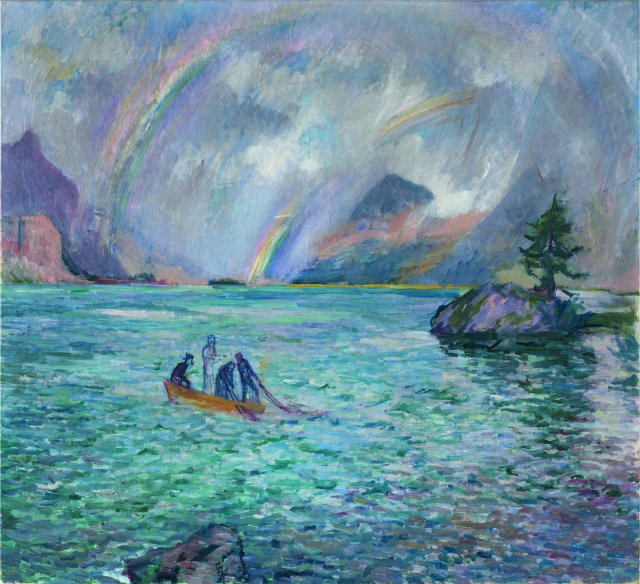


Stampa 1868 - 1933 Glion


1926
Oil on canvas
110x120 cm
Monogrammed by the artist in oil paint at lower left "GG". Signed on the reverse of the canvas by the artist in brush in black oil paint "Giovni Giacometti", inscribed "Maloja" and dated "1926"
Paul Müller/Viola Radlach, Giovanni Giacometti, Werkkatalog der Gemälde, Band II/2, Zurich 1997, no. 1926.13
Registro dei quadri, Heft 2, pag. 54, no. 479 (handwritten catalogue raisonné by the artist)
Collection H. Rippmann, Binningen
Private collection Switzerland
The houses and stables of the hamlet of Capolago near Maloja were the alpine houses of the farmers of Stampa, who had their alpine pastures for summering their cattle above Capolago. In 1905, the Giovanni Giacometti family inherited a large house in Capolago and converted the adjoining stable, as they had done in Stampa, into a studio, where their son Alberto also worked after Giovanni's death in 1934. From 1905 onwards, the Giacometti family spent several weeks at a time in Capolago, where a large part of Giovanni's painterly work was created
The view goes over the Silsersee towards Corvatsch, which is overcast with thunderclouds, with the striking reddish rocky outcrop "Crap di Chüern" (old spelling) on the left of the picture. Giacometti captures a stormy atmosphere with a rainbow, a fishing boat in the foreground. Obviously rain and thunderstorms have led to a very good catch of fish
1926
Öl auf Leinwand
110x120 cm
Unten links vom Künstler in Ölfarbe monogrammiert "GG". Rückseitig auf der Leinwand vom Künstler in Pinsel in schwarzer Ölfarbe signiert "Giovni Giacometti", bezeichnet "Maloja" und datiert "1926"
Paul Müller/Viola Radlach, Giovanni Giacometti, Werkkatalog der Gemälde, Band II/2, Zürich 1997, Nr. 1926.13
Registro dei quadri, Heft 2, pag. 54,
Slg. H. Rippmann, Binningen
Privatsammlung Schweiz
Die Häuser und Ställe des Weilers Capolago bei Maloja waren die Alphäuser der Bauern von Stampa, die ihre Alpweiden zum Sömmern ihres Viehs oberhalb von Capolago hatten. Die Familie Giovanni Giacometti hat im Jahr 1905 ein grosses Haus in Capolago geerbt und den dazugehörigen Stall, wie schon in Stampa, zu einem Atelier umgebaut, in dem nach dem Tode von Giovanni 1934 auch Sohn Alberto arbeitete. Von 1905 an verbrachte die Familie Giacometti jeweils mehrere Wochen in Capolago, wo ein grosser Teil des malerischen Werkes von Giovanni entstand
Der Blick geht über den Silsersee gegen den mit Gewitterwolken verhangenen Corvatsch, links im Bild mit der markanten, rötlichen Felsnase "Crap di Chüern" (alte Schreibweise). Giacometti hält eine Gewitterstimmung mit Regenbogen fest, im Vordergrund ein Fischerboot. Offensichtlich haben Regen und Gewitter zu einem sehr guten Fischfang geführt