- EN


 Log in
-
- Live Auctions
- Past auctions
- More
- Kornfeld today
- The Story of Kornfeld
- Information


Note: The image cannot be displayed for legal reasons. For more information, see the PDF of the catalogue: Link to PDF






Saint-Quentin 1886 - 1966 Cannes


1927
Oil on canvas
60x57 cm
Signed and dated "Ozenfant 1927" in white oil paint by the artist at lower right
Margaret Guénégan/Pierre Guénégan, Amédée Ozenfant, Catalogue raisonné, St. Albans 2012, no. 1927/006
Col. Raoul La Roche, Paris, by inheritance to
Private Collection Switzerland
Exhibition catalogue Kunstmuseum Basel, Ein Haus für den Kubismus - Die Sammlung Raoul La Roche, Ostfildern-Ruit, Hatje, 1998, cat. no. 140, ill.
Susan Ball, Ozenfant and Purism: the evolution of a style, 1915-1930, Ann Arbor, UMI Research Press, 1981
Saint Quentin/Mulhouse/Besançon/Mâcon 1985/1986, Musée Antoine Lécuyer/Musée des Beaux Arts/Musée des Beaux Arts/Musée des Ursuline, Amédée Ozenfant, cat. no. 74, ill.
On the original chassis, in the original nailing. With thin frame strip. With occasional craquelures in the pasty colour. Freshly coloured and in very good overall condition
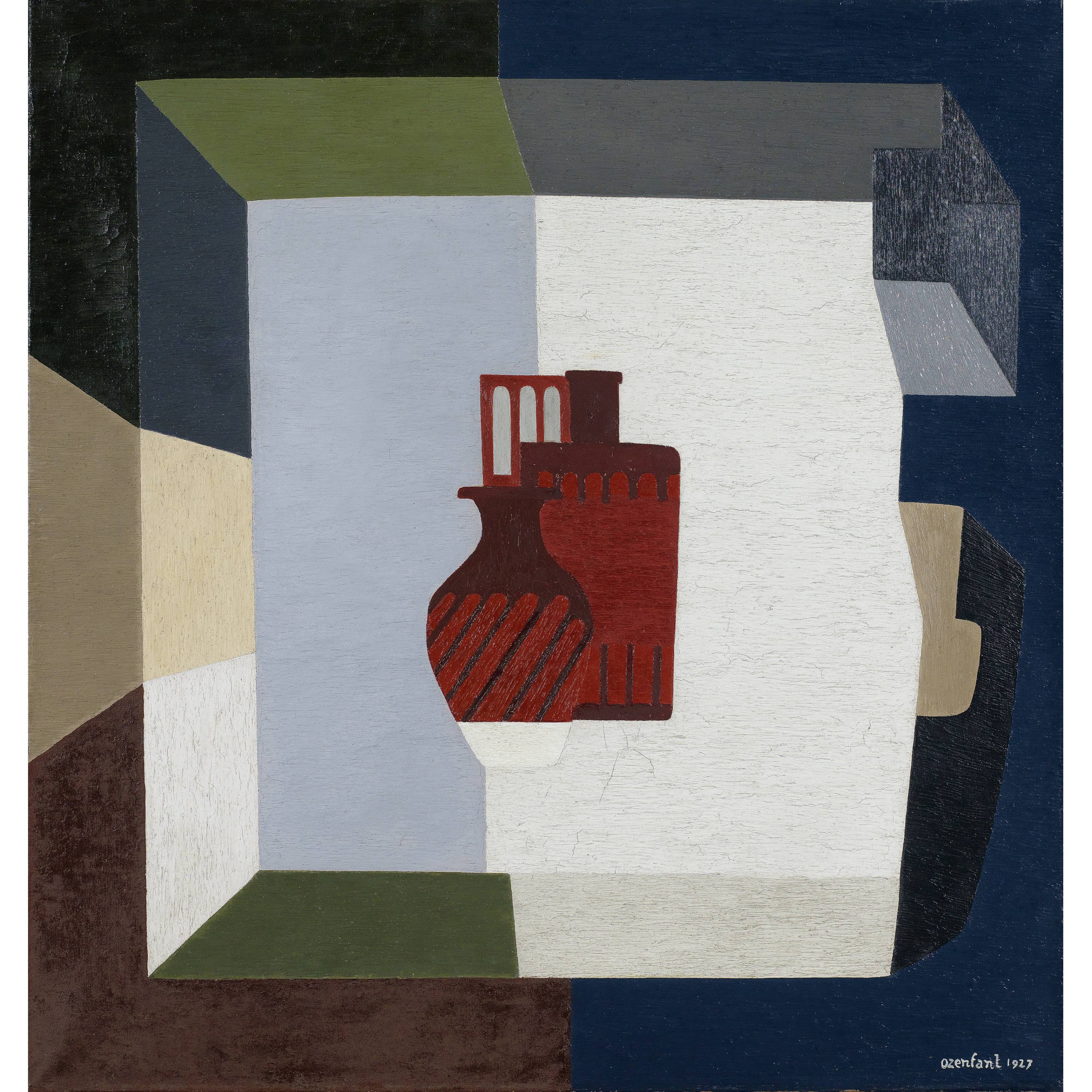
Together with Charles-Edouard Jeanneret (Le Corbusier), Amédée Ozenfant founded "purism" as a new style of modern art. They laid down the criteria in the manifesto "Après le cubisme" of 1918. Purism is characterized by the fact that a limited repertoire of simple everyday objects such as bottles, glasses or guitars were used as central motifs in the paintings. In strict, clear forms and a colour palette reduced to earth colours, the works were mostly realised as still lifes. In 1927 Ozenfant wrote an article in "Les Cahiers d'Art" in which he once again formulated his vision of "Le Purisme". From 1928 he softened his clear ideas and found a freer way of painting. "Vases" is a masterpiece of purist composition: centrally the arrangement of three vases, which Ozenfant used in exactly this form in several works from 1925 onwards, framed by several painted, structured frames. The vases, in other paintings the "Doric style" is mentioned, lack any perspective and are painted completely frontally. However, the double framing and the pastose application of paint create an unbelievably astonishing effect of depth in the painting. The main work of the group, "Grande nature morte" (Guénégan 1926/010) is in the Musée d'Art Moderne de la ville de Paris. The painting offered here, with its compactness, is without doubt one of the most beautiful works of the artist. It was acquired by the great patron and collector Raoul La Roche; his collection included 25 paintings by Ozenfant
1927
Öl auf Leinwand
60x57 cm
Unten rechts vom Künstler in weisser Ölfarbe signiert und datiert "Ozenfant 1927"
Margaret Guénégan/Pierre Guénégan, Amédée Ozenfant, Catalogue raisonné, St. Albans 2012,
Slg. Raoul La Roche, Paris, durch Erbschaft an
Privatsammlung Schweiz
Ausstellungskatalog Kunstmuseum Basel, Ein Haus für den Kubismus - Die Sammlung Raoul La Roche, Ostfildern-Ruit, Hatje, 1998,
Susan Ball, Ozenfant and Purism: the evolution of a style, 1915-1930, Ann Arbor, UMI Research Press, 1981
Saint Quentin/Mulhouse/Besançon/Mâcon 1985/1986, Musée Antoine Lécuyer/Musée des Beaux Arts/Musée des Beaux Arts/Musée des Ursuline, Amédée Ozenfant,
Auf dem originalen Chassis, in der originalen Nagelung. Mit dünner Rahmenleiste. Mit vereinzelten Craquelüren in der pastosen Farbe. Farbfrisch und in sehr guter Gesamterhaltung
Amédée Ozenfant begründete zusammen mit Charles-Edouard Jeanneret (Le Corbusier) den "Purismus" als neue Stilrichtung der modernen Kunst. Sie legten die Kriterien im Manifest "Après le cubisme" von 1918 fest. Der Purismus zeichnet sich dadurch aus, dass ein beschränktes Repertoire simpler Alltagsgegenstände wie Flaschen, Gläser oder Gitarren als zentrale Bildmotive verwendet wurde. In strengen, klaren Formen und einer auf Erdfarben reduzierten Farbpalette wurden die Werke meistens als Stillleben umgesetzt. Ozenfant schrieb 1927 einen Artikel in "Les Cahiers d’Art", in welchem er seine Vision über "Le Purisme" noch einmal formulierte. Ab 1928 weichte er seine klaren Vorstellungen auf und fand zu einer freieren Malart
"Vases" ist ein Meisterwerk puristischer Komposition: Zentral das Arrangement von drei Vasen, das Ozenfant in genau dieser Form ab 1925 in mehreren Werken verwendet hat, eingefasst von mehreren gemalten, strukturierten Rahmen. Die Vasen, bei anderen Gemälden ist vom "dorischen Stil" die Rede, entbehren jeglicher Perspektive und sind völlig frontal gemalt. Die doppelt gemalte Rahmung und die pastos aufgetragene Farbe erzeugt im Gemälde jedoch eine unglaublich verblüffende Tiefenwirkung. Das Hauptwerk der Gruppe, "Grande nature morte" (Guénégan 1926/010) befindet sich im Musée d'Art Moderne de la ville de Paris. Das hier angebotene Gemälde gehört mit seiner Kompaktheit zweifellos zu den schönsten Arbeiten des Künstlers. Es wurde vom grossen Förderer und Sammler Raoul La Roche erworben; seine Sammlung umfasste 25 Gemälde von Ozenfant
Note: The image cannot be displayed for legal reasons. For more information, see the PDF of the catalogue: Link to PDF