- EN


 Log in
-
- Live Auctions
- Past auctions
- More
- Kornfeld today
- The Story of Kornfeld
- Information









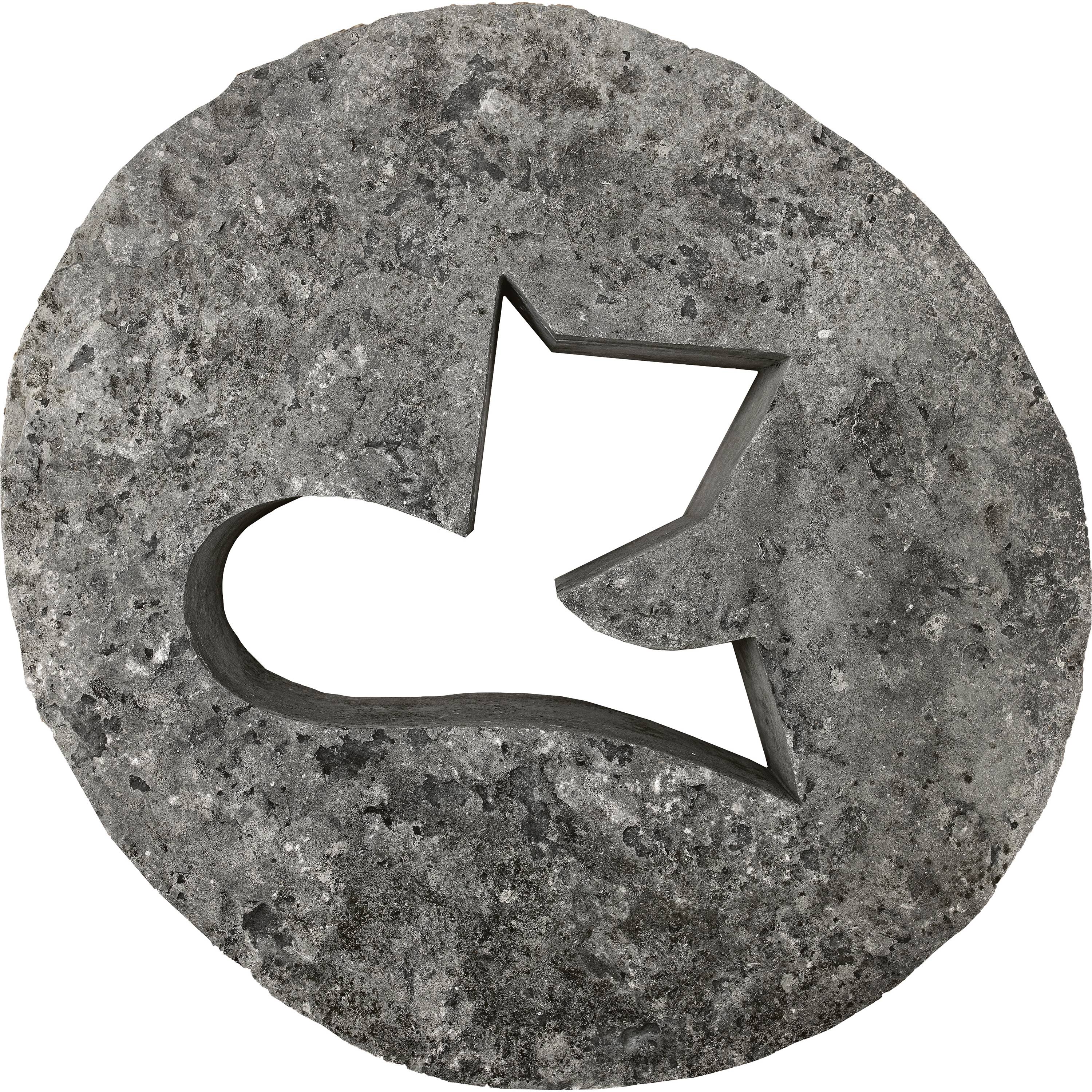
Strassburg 1886 - 1966 Basel


1962
Limestone, one side sculpted, one side cut from stone
78x84x24 cm
Hartog/Fischer 2012, cat. no. 286, p. 188, ill.
Gift from the artist to the Witzig family, by descent to Private collection, Switzerland
Eduard Trier, Hans Arp, Skulpturen 1957-1966, Stuttgart, Hatje, 1968, cat. no. 286, ill. p. 121
Ionel Jianou, Jean Arp, Paris 1973, Arted, cat. no. 286, entry Col. Witzig
Rudolf Suter, Hans Arp. Weltbild und Kunstauffassung im Spätwerk, Bern 2007, Peter Lang, pp. 433
Minimally cleaned, in very good original condition
From 1961 to 1967 7 pieces of hewn stone were created, which are titled "Waldrad I-VII". The "Waldrad" offered here is number V of the series. When the Witzig family, related to Hans Arp, had a new house built near a forest in the early 1960s, the artist felt that a "Waldrad" (forest wheel) had to be set up in the garden. Carola Giedion-Welcker wrote in her important work on the artist in 1961: "Today he places massive" forest wheels "as stone circles" from primeval times ", such as early historical sun wheels or rustic millstones in the large space of nature." There are several reasons why Arp's interest in the subject came from. Perhaps he was simply looking for a "reduced", geometric balance in addition to the organic sculptures that were being created in parallel. Rudolf Suter suspects in "Hans Arp. Weltbild und Kunstaufstellung im Spätwerk" that Hans Arp dealt with archaic, Aztec sculpture on his 1958 Mexico trip. The Chinese "Bi-Discs", which Arp had to know from articles in "Cahier d’Art", could also have been a source of inspiration. Or even an old millstone set up in the garden of the artist house in Locarno could have animated him to create the "forest wheels". All the deductions would fit very well with the cosmic worldview, which can be seen again and again in Arp's works. The installation on the floor is reminiscent of his postulate that art should "get lost in nature". The material, especially the carved side, looks natural, but at the same time also archaic, an effect that cannot be achieved to the same extent with classic materials like marble or bronze back and forth between material and empty forms, she perceives both as positive and equivalent. Suter writes: "Material and empty, positive and negative forms keep each other in balance. [...] The empty center [has] become a world center towards which all things are ideally oriented." $ NThe theme "forest wheels" are a completed important group of works within the artist's oeuvre, they "formally" also take up the idea of the "relief", now expanded into space. Sculptures of this importance are extremely rare
1962
Kalkstein, eine Seite behauen, eine Seite aus dem Stein geschnitten
78x84x24 cm
Arie Hartog/Kai Fischer, Hans Arp, Skulpturen – eine Bestandsaufnahme, Ostfildern 2012,
Geschenk des Künstlers an die Familie Witzig Hagenbach, durch Erbschaft an Privatsammlung Schweiz
Eduard Trier, Hans Arp, Skulpturen 1957-1966, Stuttgart, Hatje, 1968,
Ionel Jianou, Jean Arp, Paris, Arted, 1973,
Rudolf Suter, Hans Arp, Weltbild und Kunstauffassung im Spätwerk, Bern, Peter Lang, 2007, pag. 433 ff.
Minimal gereinigt, in sehr gutem Originalzustand
Von 1961 bis 1967 entstanden 7 Arbeiten aus gehauenem Stein, die mit "Waldrad I-VII" betitelt sind. Beim hier angebotenen "Waldrad" handelt es sich um die Nummer V der Serie. Als die verwandtschaftlich mit Hans Arp verbundene Familie Witzig Anfang der 1960er Jahre ein neues Haus in der Nähe eines Waldes errichten liess, fand der Künstler, dass unbedingt ein "Waldrad" im Garten aufgestellt werden müsse. Carola Giedion-Welcker schrieb in ihrem wichtigen Werk zum Künstler 1961: "Heute stellt er wuchtige "Waldräder" als Steinkreise "aus urdenklichen Zeiten", wie frühgeschichtliche Sonnenräder oder rustikale Mühlsteine in den grossen Raum der Natur." Woher Arps Interesse an der Materie kam, kann verschiedene Gründe haben. Vielleicht suchte er schlicht einen "reduzierten", geometrischen Ausgleich neben den parallel entstehenden, organischen Skulpturen. Rudolf Suter vermutet in "Hans Arp. Weltbild und Kunstauffassung im Spätwerk", dass sich Hans Arp auf seiner Mexikoreise von 1958 mit archaischer, aztekischer Plastik auseinandersetzte. Auch die chinesischen "Bi-Scheiben", die Arp aus Artikeln im "Cahier d’Art" kennen musste, könnten eine Inspirationsquelle gewesen sein. Oder sogar ein im Garten des Künstlerhauses in Locarno aufgestellter, alter Mühlstein könnte ihn zur Schaffung der "Waldräder" animiert haben. Alle Herleitungen würden sehr gut zur kosmischen Weltanschauung passen, die sich immer wieder in den Werken Arps ablesen lässt
Die Aufstellung am Boden erinnert an sein Postulat, dass die Kunst "sich in der Natur verlieren" soll. Das Material, insbesondere die behauene Seite, wirkt naturhaft, gleichzeitig aber auch archaisch, eine Wirkung, die mit klassischen Materialien wie Marmor oder Bronze nicht im gleichen Mass erzielt werden kann
Beim Betrachten wird die Aufmerksamkeit immer wieder von der Leerform angezogen, der Blick wandert hin und her zwischen materiellen und leeren Formen, nimmt sie beide als positiv und gleichwertig wahr. Suter schreibt: "Materielle und leere, positive und negative Formen halten sich das Gleichgewicht. […] Das leere Zentrum [ist] zu einer Weltmitte geworden, auf die alle Dinge ideell ausgerichtet sind."
Die "Waldräder" sind als abgeschlossene, sehr wichtige Werkgruppe im Œuvre des Künstlers zu lesen, nehmen sie doch "förmlich" auch die Idee des "Reliefs" auf, nun erweitert in den Raum. So kapitale Skulpturen sind von grosser Seltenheit