- FR


 S’inscrire
-
- Ventes Classiques
- Ventes passées
- Plus
- Acheter
- Vendre
- Plus
- Galerie
- Commerce d'art
- Maison d'Édition
- Kornfeld aujourd’hui
- L'histoire de la Maison
- Informations


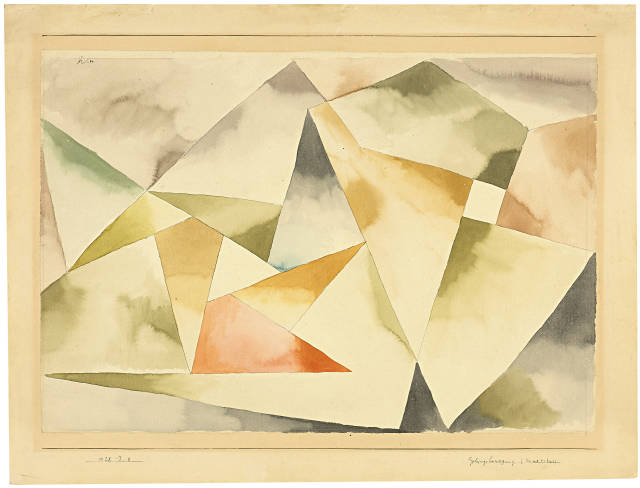


Münchenbuchsee bei Bern 1879 - 1940 Muralto


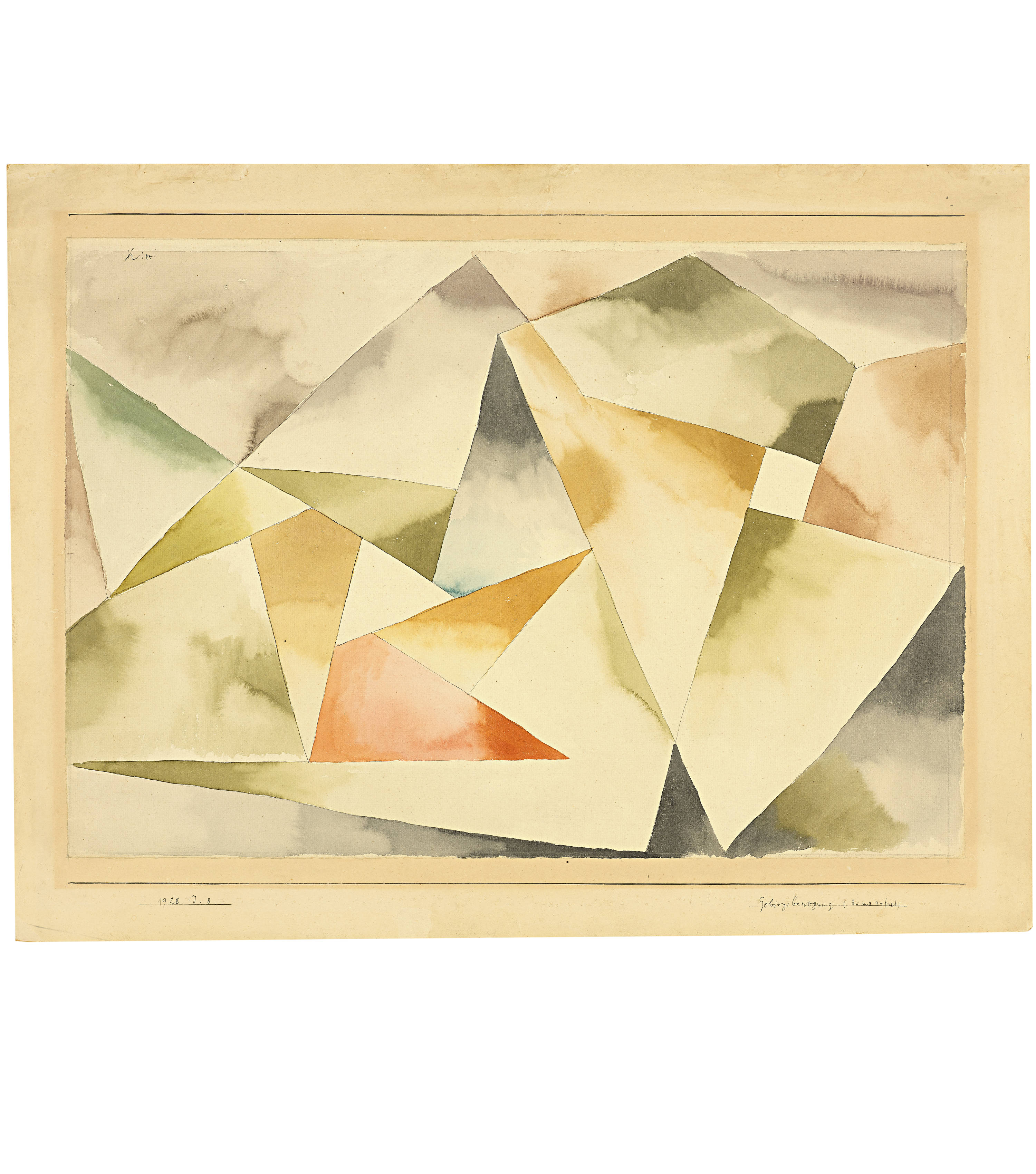
1928 – Work number 1928.188 (J 8)
Watercolour on Ingres on cardboard
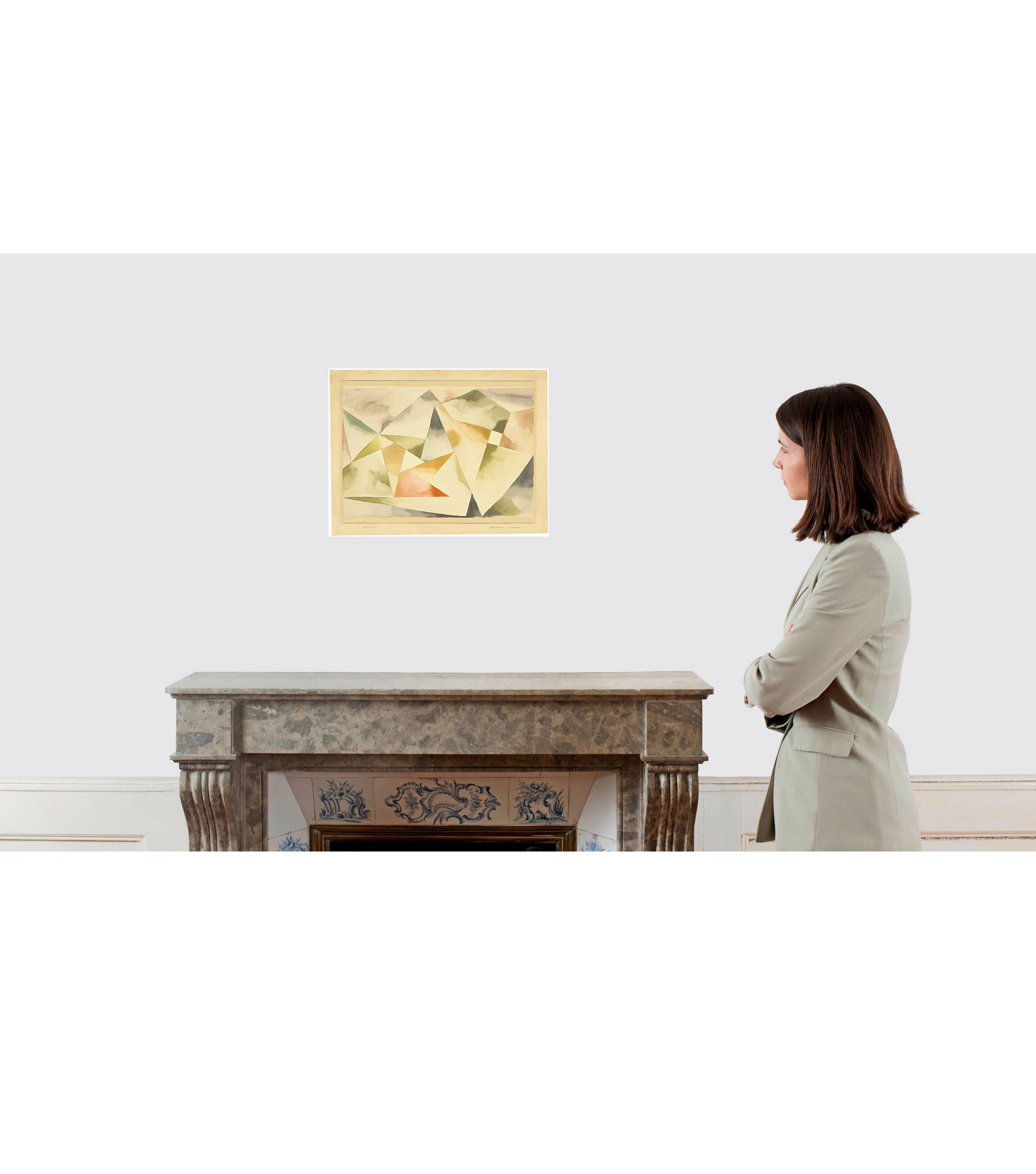
35.5x47.5 cm, incl. end line; 41x54.1 cm, support
Upper left signed by the artist in pen and ink "Klee", below the end line with the work number and the title "1928 J.8. Gebirgsbewegung (3= und 4=takt)"
Paul Klee Stiftung, Catalogue raisonné, vol. 5, Werke 1927-1930, Bern 2001, no. 4730
From 1929 on consignment with Alfred Flechtheim, Berlin, Alex Vömel, Düsseldorf, The Mayor Gallery, London, Galerie Simon (Daniel-Henry Kahnweiler), Paris, Nierendorf Gallery, New York, Galka Scheyer, Hollywood
Estate of the artist
Collection Lily Klee, Bern (1940-1946)
Nierendorf Gallery, New York, probably there acquired in 1944 by
Private collection USA (until 1977)
James Goodman Gallery, New York, there acquired in 1977 by
Paul Kantor Gallery, Beverly Hills
Private collection Los Angeles
Auction Sotheby's, London, 7 December 1977, lot 123, there acquired by
Herbert Palmer Gallery, Los Angeles, probably there acquired by
Collection J. Bruce Jacobs, Santa Monica
Acquavella Galleries, New York, there acquired in 1988 by
Michael & Judy Steinhardt, New York, auctioned at
Auction Christie's, New York, 9 November 2000, lot 430, there acquired by
International private collection
Auction Sotheby's, London, 13-19 April 2023, lot 26, there acquired by
Private collection USA
Berlin 1929, Galerie Alfred Flechtheim, Paul Klee, cat. no. 109
Düsseldorf 1930, Galerie Alfred Flechtheim, Paul Klee. Aquarelle, Zeichnungen u. Graphik aus 25 Jahren, cat. no. 125
Saarbrücken 1930, Staatliches Museum, Paul Klee. Aquarelle aus 25 Jahren, 1905 bis 1930, cat. no. 60
Düsseldorf 1931, Kunstverein für die Rheinlande und Westfalen in Verbindung mit der Galerie Alfred Flechtheim, Paul Klee, cat. no. 195
Colorado Springs 1938, Colorado Springs Fine Arts Center at Colorado College, Abstractions by Paul Klee, without catalogue
San Francisco 1939, San Francisco Museum of Art, Paul Klee, without catalogue
New York 1942, Nierendorf Gallery, Fifth Selection of Works by Paul Klee, cat. no. 8
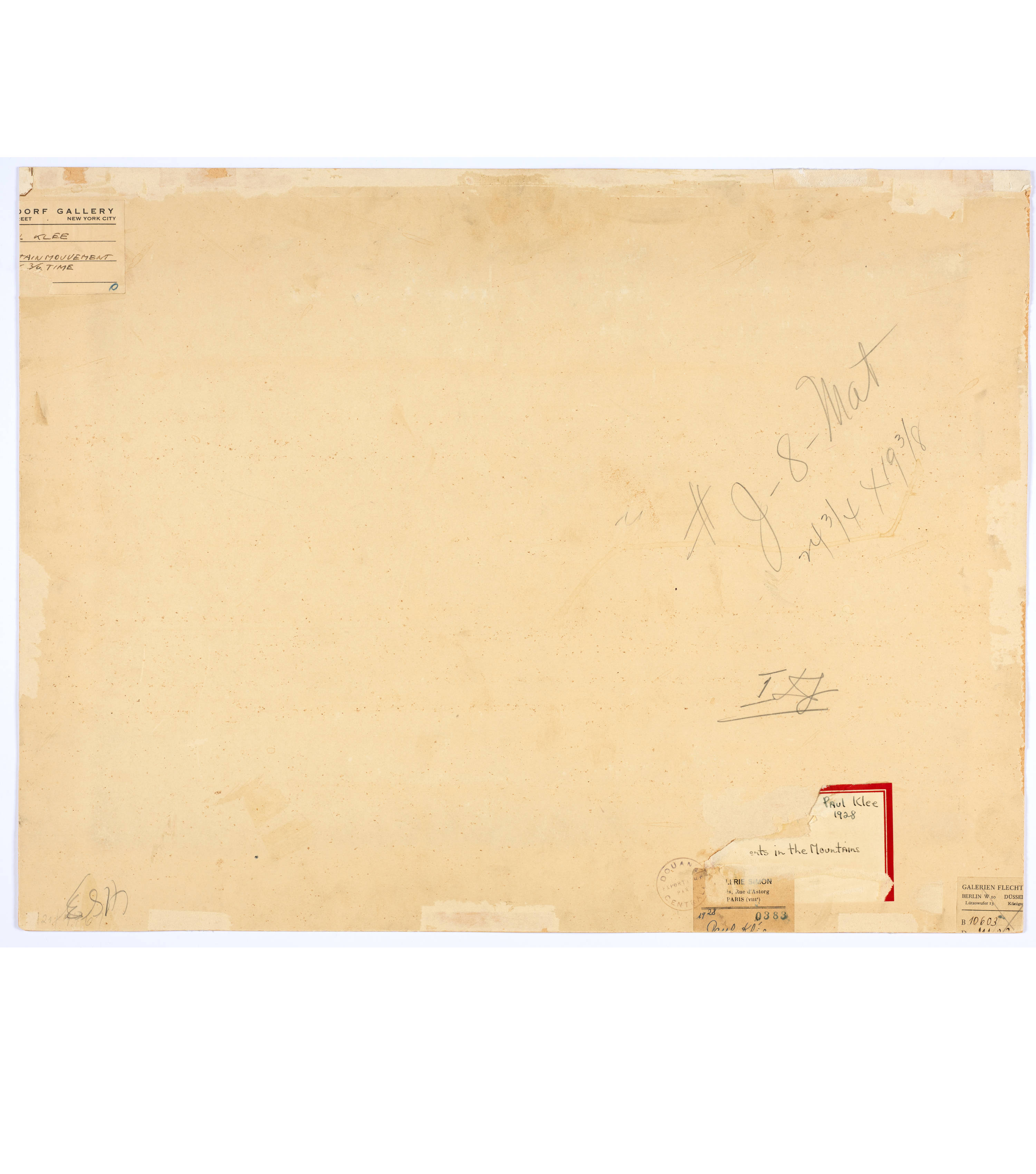
The paper minimally browned, with a faint light margin. On the reverse various labels and traces of old mounting. In very fine colours and condition
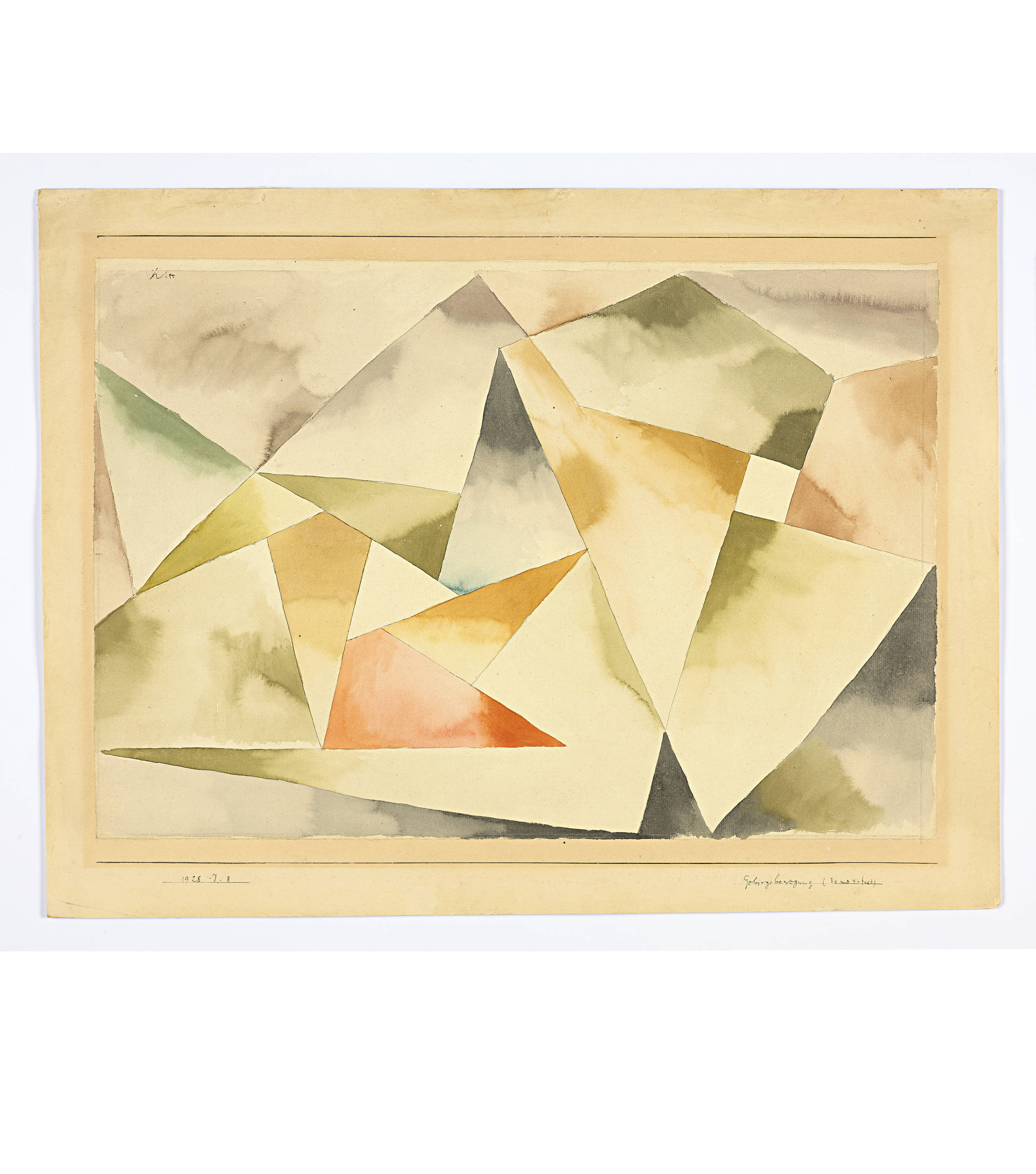
With "Gebirgsbewegung (3= und 4=takt)", Paul Klee combines two thematic spheres that shaped his work throughout his life: landscape as an expression of inner processes of growth, and music as the ordering principle of the image. Created at the height of his Bauhaus period in Dessau, the work belongs to that phase in which Klee tested his theoretical considerations on rhythm, movement, and pictorial construction in a multitude of paintings and watercolours. Here, landscape is not understood as a static natural phenomenon, but as an organism defined by forces and tensions.
The unusual title already points to the close connection between seeing and hearing. The indication "3= und 4=takt" comes from musical terminology and refers to different time signatures, whose rhythmic order Klee transfers to the image. As a trained violinist and passionate connoisseur of music, he understood musical structures not merely as models, but as a fundamental paradigm for pictorial design. Like voices in a composition, lines, colour fields, and signs stand in a balanced relationship to one another and only unfold their meaning in the harmony of the whole.
Accordingly, the mountains do not appear as a topographically tangible landscape, but as a rhythmically structured configuration. The mountains seem to rise and fall in time; geological structure and musical rhythm merge into a pictorial unity. The characteristic connection in Klee’s work between constructive order and poetic imagination achieves a particular clarity here.
1928 - Werknummer 1928.188 (J 8)
Aquarell auf Ingres auf Karton
35,5x47,5 cm, inkl. Abschlussstrich; 41x54,1 cm, Unterlage
Oben links vom Künstler in Feder in Tusche signiert "Klee", unter dem Abschlussstrich mit der Werknummer und dem Titel "1928 J.8. Gebirgsbewegung (3= und 4=takt)"
Paul Klee Stiftung, Catalogue raisonné, Band 5, Werke 1927-1930, Bern 2001,
Ab 1929 in Kommission bei Alfred Flechtheim, Berlin, Alex Vömel, Düsseldorf, The Mayor Gallery, London, Galerie Simon (Daniel-Henry Kahnweiler), Paris, Nierendorf Gallery, New York, Galka Scheyer, Hollywood
Nachlass des Künstlers
Slg. Lily Klee, Bern (1940-1946)
Nierendorf Gallery, New York, dort vermutlich 1944 erworben von
Privatsammlung USA (bis 1977)
James Goodman Gallery, New York, dort 1977 erworben von
Paul Kantor Gallery, Beverly Hills
Privatsammlung Los Angeles
Auktion Sotheby's, London, 7. Dezember 1977, Los 123, dort erworben von
Herbert Palmer Gallery, Los Angeles, dort vermutlich erworben von
Slg. J. Bruce Jacobs, Santa Monica
Acquavella Galleries, New York, dort 1988 erworben von
Michael & Judy Steinhardt, New York, versteigert bei
Auktion Christie's, New York, 9. November 2000, Los 430, dort erworben von
Internationaler Privatsammlung
Auktion Sotheby's, London, 13.-19. April 2023, Los 26, dort erworben von
Privatsammlung USA
Berlin 1929, Galerie Alfred Flechtheim, Paul Klee,
Düsseldorf 1930, Galerie Alfred Flechtheim, Paul Klee. Aquarelle, Zeichnungen u. Graphik aus 25 Jahren,
Saarbrücken 1930, Staatliches Museum, Paul Klee. Aquarelle aus 25 Jahren, 1905 bis 1930,
Düsseldorf 1931, Kunstverein für die Rheinlande und Westfalen in Verbindung mit der Galerie Alfred Flechtheim, Paul Klee,
Colorado Springs 1938, Colorado Springs Fine Arts Center at Colorado College, Abstractions by Paul Klee, ohne Katalog
San Francisco 1939, San Francisco Museum of Art, Paul Klee, ohne Katalog
New York 1942, Nierendorf Gallery, Fifth Selection of Works by Paul Klee,
Das Papier minim gebräunt, mit leichtem Lichtrand. Rückseitig verschiedene Etiketten und Spuren alter Montierungen. In sehr schöner Farbigkeit und Erhaltung
Mit "Gebirgsbewegung (3= und 4=takt)" verbindet Paul Klee zwei Themenkreise, die sein Schaffen sein Leben lang prägten: die Landschaft als Ausdruck innerer Wachstumsprozesse und die Musik als Ordnungsprinzip des Bildes. Entstanden auf dem Höhepunkt seiner Bauhauszeit in Dessau, gehört das Werk in jene Phase, in der Klee seine theoretischen Überlegungen zu Rhythmus, Bewegung und bildnerischer Konstruktion in einer Vielzahl von Gemälden und Aquarellen erprobte. Landschaft wird dabei nicht als statische Naturerscheinung verstanden, sondern als ein von Kräften und Spannungen bestimmter Organismus.
Bereits der ungewöhnliche Titel verweist auf die enge Verbindung von Sehen und Hören. Die Angabe "3= und 4=takt" entstammt der musikalischen Terminologie und bezeichnet unterschiedliche Taktarten, deren rhythmische Ordnung Klee auf das Bild überträgt. Als ausgebildeter Geiger und leidenschaftlicher Musikkenner verstand er musikalische Strukturen nicht als blosses Vorbild, sondern als grundlegendes Modell bildnerischer Gestaltung. Wie Stimmen in einer Komposition stehen Linien, Farbflächen und Zeichen in einem ausgewogenen Verhältnis zueinander und entfalten ihren Sinn erst im Zusammenklang des Ganzen.
Das Gebirge erscheint entsprechend nicht als topografisch fassbare Landschaft, sondern als rhythmisch gegliedertes Gefüge. Die Berge scheinen sich gleichsam im Takt zu heben und zu senken; geologische Struktur und musikalischer Rhythmus verschmelzen zu einer bildnerischen Einheit. Die für Klee charakteristische Verbindung von konstruktiver Ordnung und poetischer Imagination erreicht hier eine besondere Prägnanz.
| Suisse | CHF | 170 |
| Europe | CHF | 270 |
| USA | CHF | 360 |
| Outre-mer | CHF | 380 |