- FR


 S’inscrire
-
- Ventes Classiques
- Online Only
- Ventes passées
- Acheter
- Vendre
- Plus
- Galerie
- Commerce d'art
- Maison d'Édition
- Kornfeld aujourd’hui
- L'histoire de la Maison
- Informations










Bottrop 1888 - 1976 New Haven

Mise en vente le 11/09/2026,
vers 15:00 h (CET)
(+/- 30 min)

1962
Oil on hardboard
61x61 cm
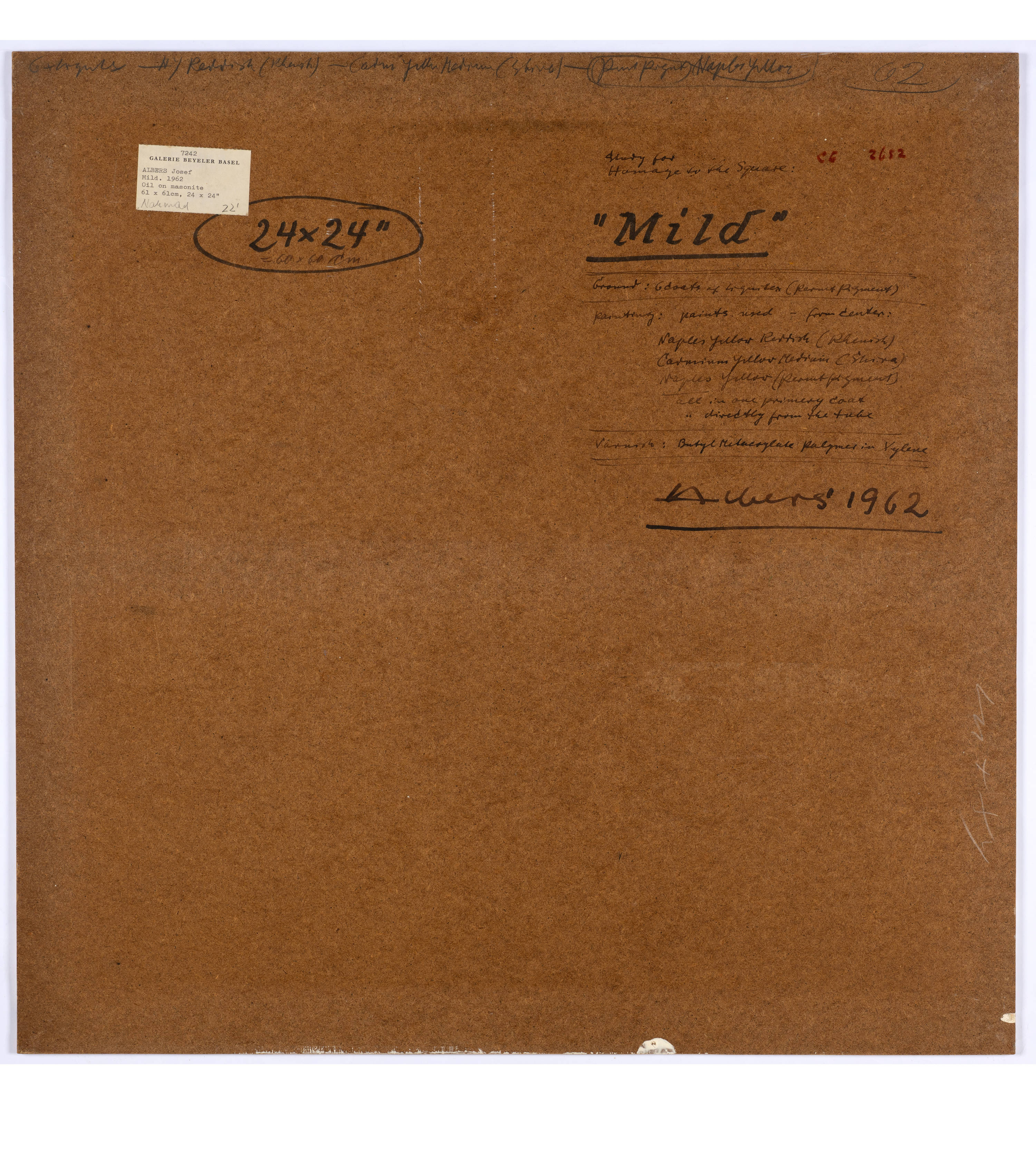
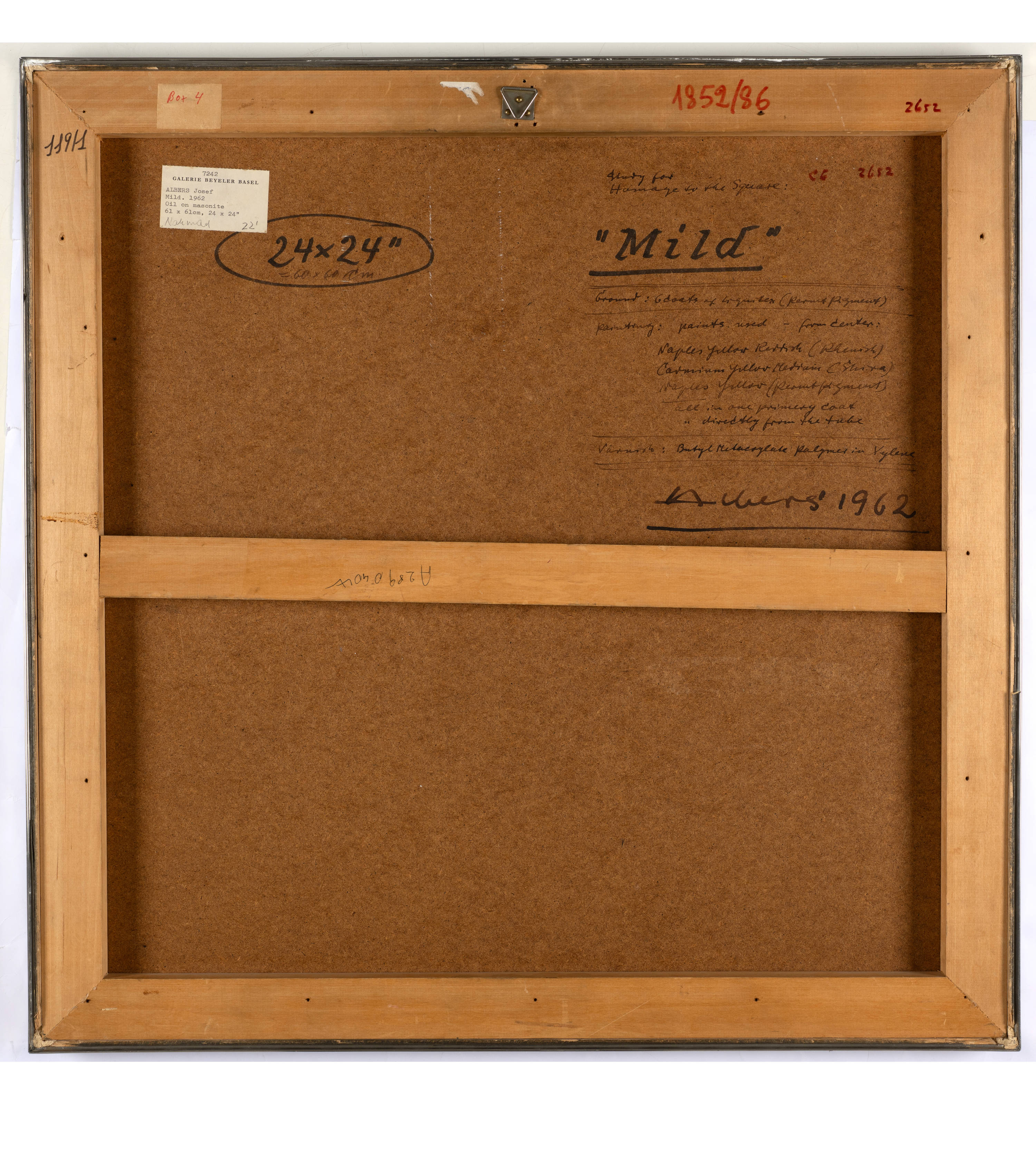
Lower right monogrammed and dated by the artist "JA 62", signed and dated by the artist on the reverse "Albers 1962", titled above "Mild"
The work will be included in the catalogue raisonné of paintings by Josef Albers and is registered in the Josef and Anni Albers Foundation under the number JAAF 1962.1.89
Artist's studio, there acquired on 21 March 1972 by
Galerie Beyeler, Basel, inv. no. 7242, there acquired on 3 April 1973 by
Galerie Nahmad, Milan
Collection Guido Nati, Rome, until December 1992
Galleria Anna D'Ascanio, Rome, sold at Art Basel on 15 June 1995 to
Private collection Germany, by inheritance to
Private collection Switzerland
Pasadena 1968, Pasadena Art Museum, Serial Imagery, cat. no. 57
Düsseldorf 1970, Städtische Kunsthalle Düsseldorf, Josef Albers, cat. no. 49
New York 1971, Metropolitan Museum of Art, Josef Albers at the Metropolitan Museum of Art, cat. no. 43
Basel 1973, Galerie Beyeler, Albers, cat. no. 25
Milan 1973, Galleria d'arte Medea, 3 interventi nello Spazio Astratto
With typical abrasions beneath the aluminium frame and a few small retouchings in the lower left as well as in the upper central area of the middle and outer colour fields. In very good condition
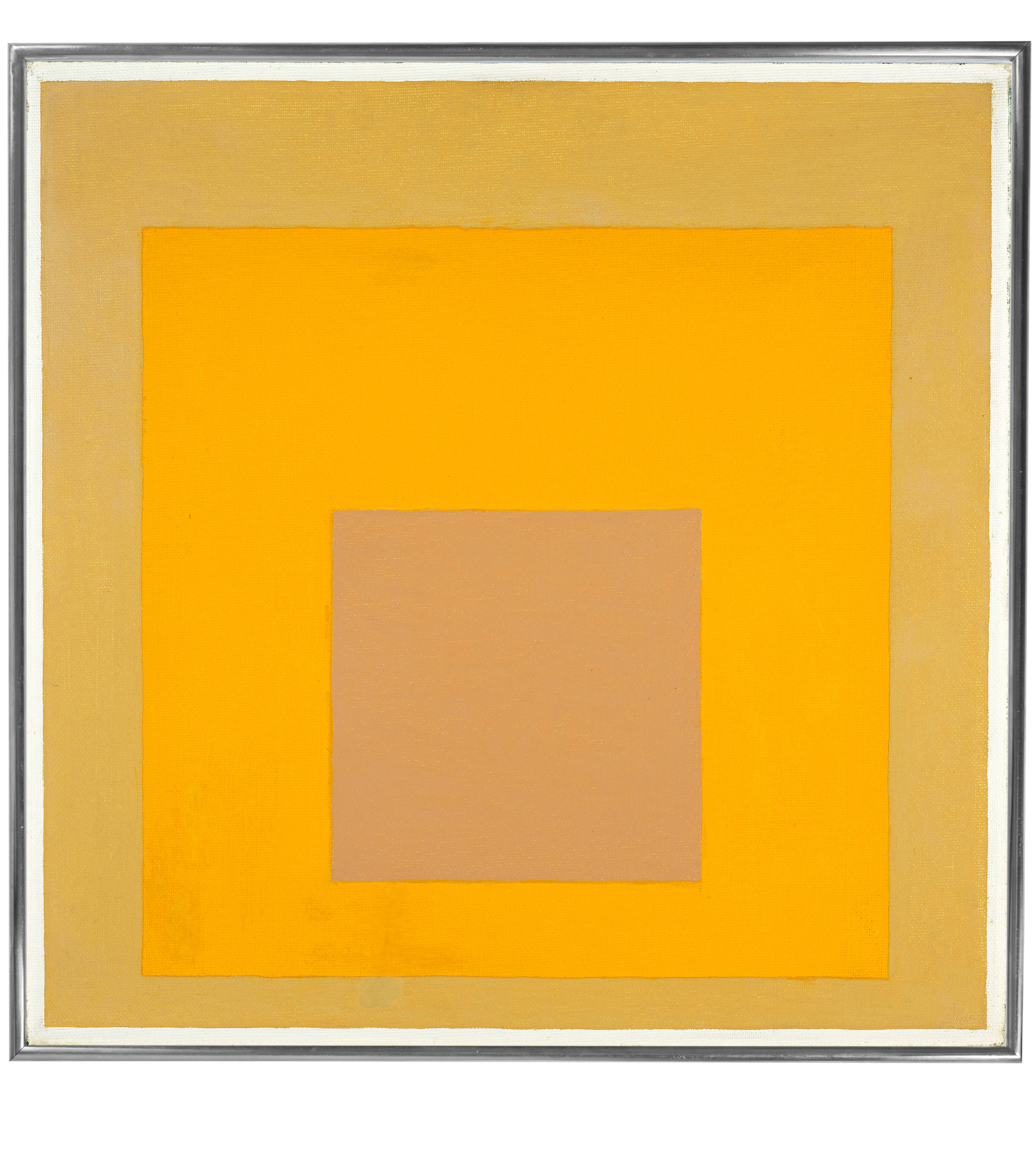
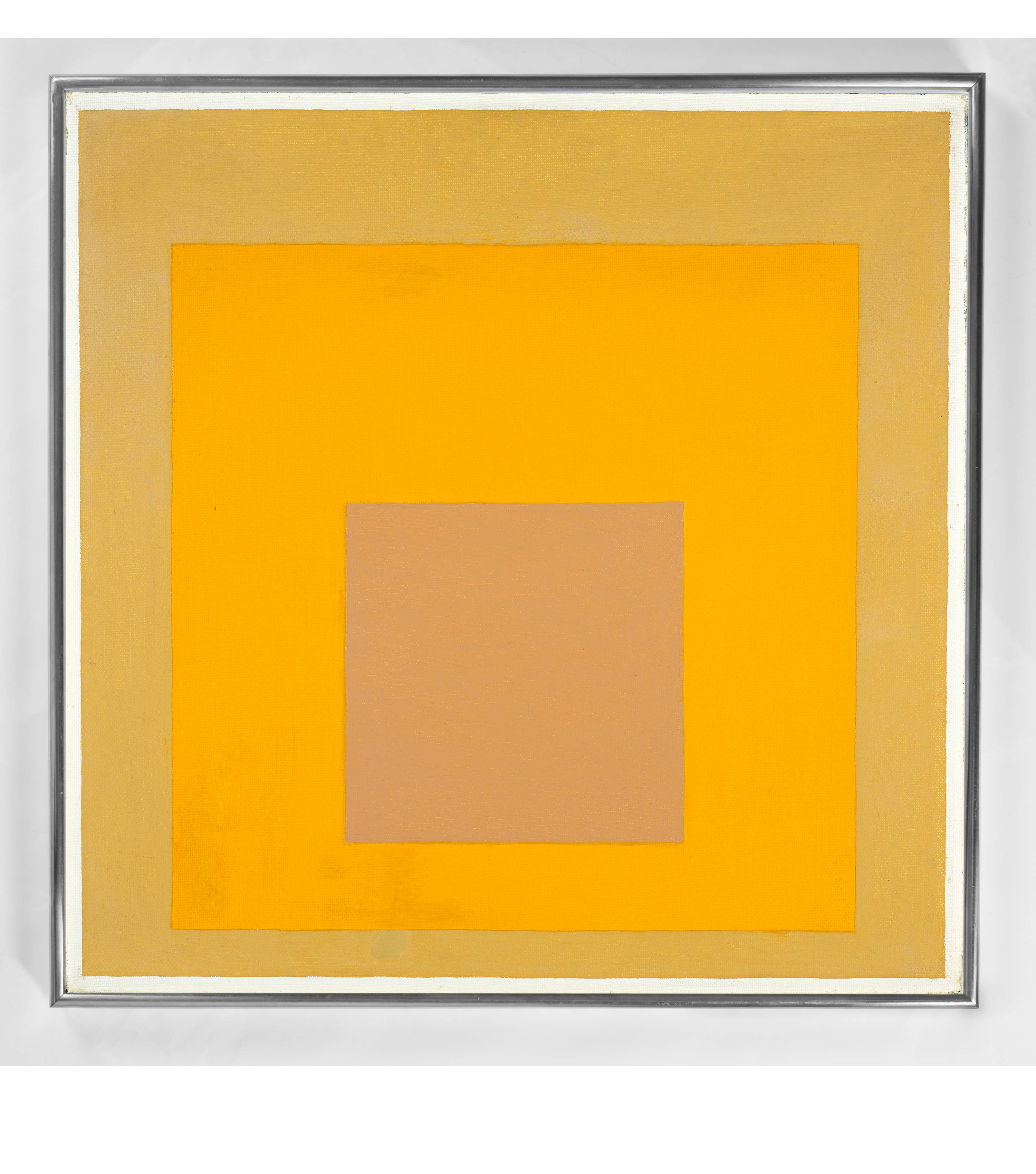
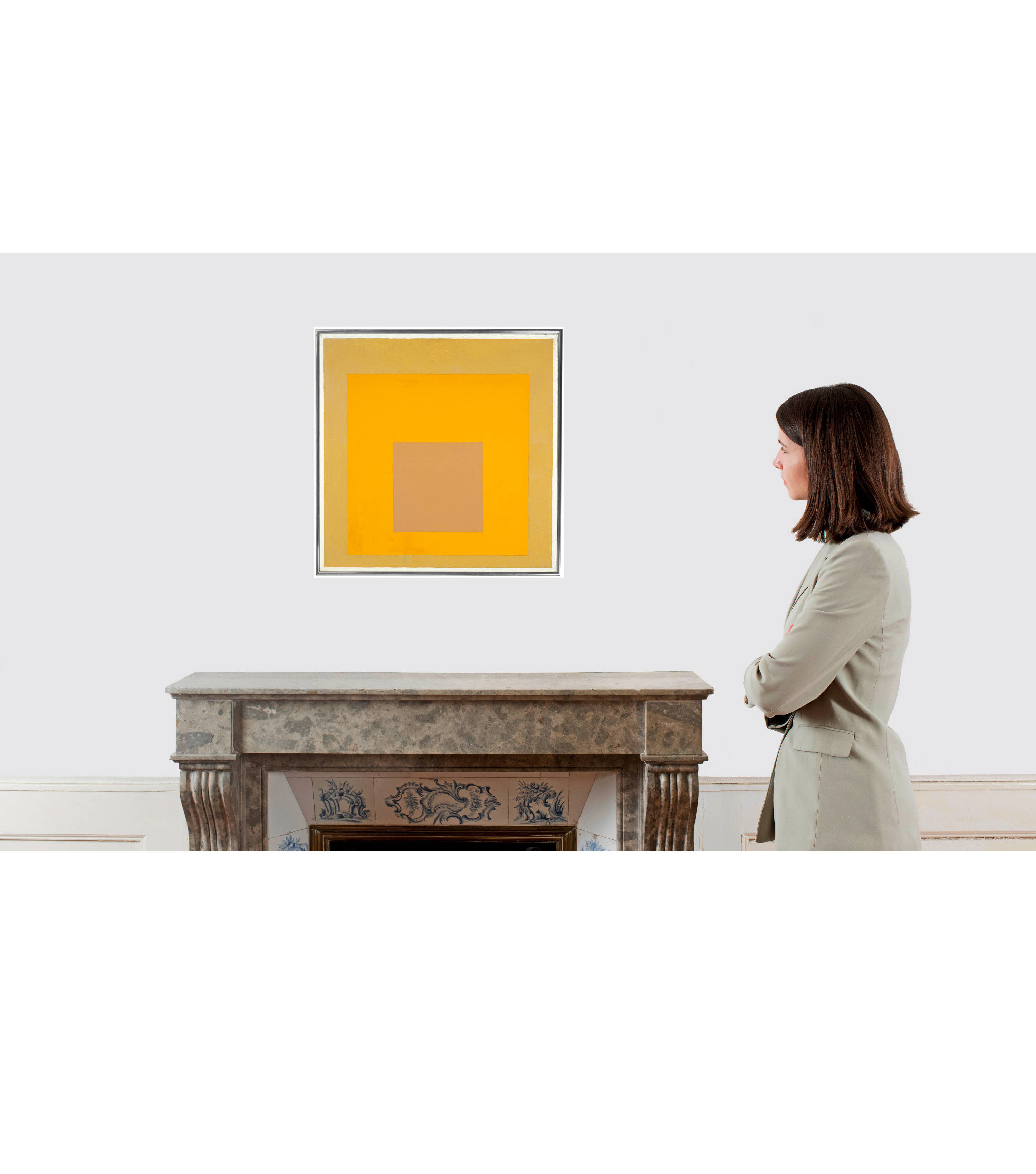
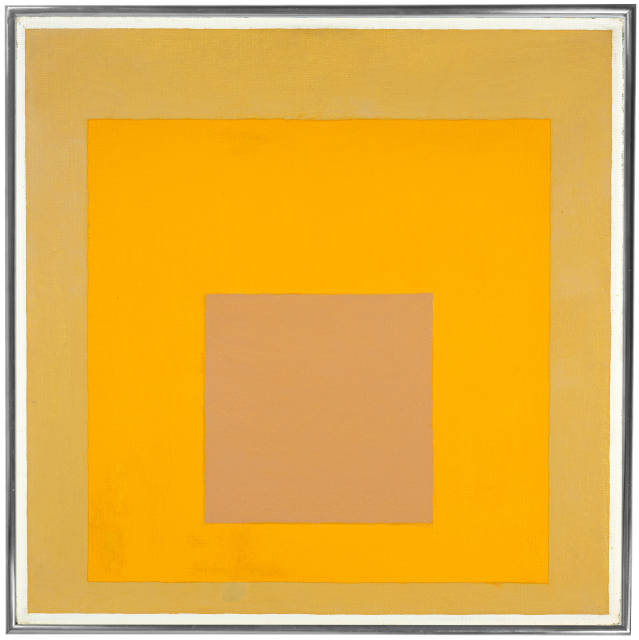
"Homage to the Square: Mild" is part of Albers' iconic series "Homage to the Square", which was created over a period of 25 years. It represents the artist's long-standing and multifaceted engagement with the interplay of colors. "Mild" consists of three concentric, interlocking squares in different shades of yellow, whose color mixture Albers documented by hand on the reverse of the work: they range from the warm ochre "Naples Yellow Reddish" in the center, through a medium "Cadmium Yellow" to an ochre-yellow "Naples Yellow, medium". Each color square shifts in relation to its neighbor. With three diagonals following their corners, the squares create an illusion of spatiality that expands either inward or outward. Their asymmetrical construction—the distances outside the central square are twice as large on the left and right, three times as large above—also gives them a subtle upward movement.
After his first professorship at the Bauhaus, Albers moved to Black Mountain College in 1933, where he further developed his ideas on color theory. He had his students layer various combinations of colored paper and observed that colors were not isolated units, but "sich in ständigem Wandel präsentieren, stets in Beziehung zu wechselnden Nachbarn und sich ändernden Bedingungen". When Albers took up a teaching position at Yale University in 1950, he began his "Homages", which he continued to create until his death in 1976. Each individual work is a lesson in color theory and follows the same format: concentric squares in different shades.
Albers used paint straight from the tube and applied it with a spatula onto a primed hardboard panel. After determining the color scheme through precise experimentation, he executed the paintings with absolute control. He worked by hand, without mechanical aids such as masking tape, allowing the imperfect edges between the colors to vibrate. Despite the static structure, his paintings, as Albers emphasized, possess not only a spatial dimension but also suggest a tendency toward movement: "Meine Quadrate bewegen sich vor und zurück, sie scheinen einzudringen und sich zu entfernen, zu wachsen und sich zu verkleinern".
The work is among the central positions of Color Field painting and demonstrates how Albers achieved maximum optical complexity with minimal means.
1962
Öl auf Hartfasertafel
61x61 cm
Unten rechts vom Künstler monogrammiert und datiert "JA 62", rückseitig vom Künstler signiert und datiert "Albers 1962", darüber betitelt "Mild"
Das Werk wird in das Werkverzeichnis der Gemälde von Josef Albers aufgenommen und ist in der Josef and Anni Albers Foundation unter der Nummer JAAF 1962.1.89 registriert
Atelier des Künstlers, dort am 21. März 1972 erworben von
Galerie Beyeler, Basel, Inv.
Galerie Nahmad, Mailand
Slg. Guido Nati, Rom, bis Dezember 1992
Galleria Anna D'Ascanio, Rom, am 15. Juni 1995 verkauft an der Art Basel an
Privatsammlung Deutschland, durch Erbschaft an
Privatsammlung Schweiz
Pasadena 1968, Pasadena Art Museum, Serial Imagery,
Düsseldorf 1970, Städtische Kunsthalle Düsseldorf, Josef Albers,
New York 1971, Metropolitan Museum of Art, Josef Albers at the Metropolitan Museum of Art,
Basel 1973, Galerie Beyeler, Albers,
Mailand 1973, Galleria d'arte Medea, 3 interventi nello Spazio Astratto
Mit typischen Abreibungen unter dem Alurahmen und einzelnen kleinen Retuschen im unteren linken sowie im oberen mittigen Bereich des mittleren sowie des äusseren Farbfeldes. In sehr guter Erhaltung
"Homage to the Square: Mild" gehört zu Albers ikonischer Serie "Homage to the Square", welche über einen Zeitraum von 25 Jahren entstanden ist. Sie bildet eine langjährige und vielfältige Auseinandersetzung des Künstlers mit dem Zusammenspiel von Farben. "Mild" besteht aus drei konzentrischen, ineinander verschachtelten Quadraten in unterschiedlichen Gelbnuancen, deren Farbmischung Albers eigenhändig auf der Rückseite des Werkes dokumentiert: sie reichen vom warmem ockerfarbenen "Naples Yellow Reddish" im Zentrum, über ein mittleres "Cadmium Yellow" zu einem ocker-gelben "Naples Yellow, medium". Jedes Farbton-Quadrat verschiebt sich dabei im Verhältnis zu seinem Nachbarn. Mit drei Diagonalen, die ihren Ecken folgen, erzeugen die Quadrate eine Illusion von Räumlichkeit, die sich entweder nach innen oder nach aussen ausdehnt. Ihre asymmetrische Konstruktion - die Abstände ausserhalb des zentralen Quadrats sind links und rechts doppelt so gross, oberhalb dreimal so gross - verleiht ihnen zudem eine subtile Aufwärtsbewegung.
Nach seiner ersten Professur am Bauhaus wechselte Albers 1933 an das Black Mountain College, wo er seine Ideen zur Farbtheorie weiterentwickelte. Er liess seine Studierenden verschiedene Kombinationen aus farbigem Papier übereinanderlegen und beobachtete, dass Farben keine isolierten Einheiten waren, sondern "sich in ständigem Wandel präsentieren, stets in Beziehung zu wechselnden Nachbarn und sich ändernden Bedingungen". Als Albers 1950 eine Lehrtätigkeit an der Yale University aufnahm, begann er mit seinen "Homages", die er bis zu seinem Tod im Jahr 1976 schuf. Jedes einzelne Werk ist dabei eine eigene Lektion in Farbtheorie und weist das gleiche Format auf: konzentrische Quadrate in unterschiedlichen Farbtönen.
Albers verwendete die Farbe direkt aus der Tube und trug sie mit einem Spachtel auf eine grundierte Hartfaserplatte auf. Nachdem er das Farbschema zuvor durch präzise Experimente festgelegt hatte, führte er die Gemälde mit absoluter Kontrolle aus. Er arbeitete von Hand, ohne mechanische Hilfsmittel wie Abdeckband, um die unvollkommenen Ränder zwischen den Farben vibrieren zu lassen. Trotz des statischen Aufbaus haben seine Bilder, wie Albers betont, nicht nur eine räumliche Dimension, sie suggerieren auch eine Bewegungstendenz: "Meine Quadrate bewegen sich vor und zurück, sie scheinen einzudringen und sich zu entfernen, zu wachsen und sich zu verkleinern".
Das Werk gehört zu den zentralen Positionen der Farbfeldmalerei und demonstriert, wie Albers durch minimale Mittel maximale optische Komplexität erreichte.
| Suisse | CHF | Offre individuelle |
| Europe | CHF | Offre individuelle |
| USA | CHF | Offre individuelle |
| Outre-mer | CHF | Offre individuelle |