- FR


 S’inscrire
-
- Ventes Classiques
- Ventes passées
- Plus
- Acheter
- Vendre
- Plus
- Galerie
- Commerce d'art
- Maison d'Édition
- Kornfeld aujourd’hui
- L'histoire de la Maison
- Informations


Note : L'image ne peut pas être affichée pour des raisons légales. Pour plus d'informations, voir le PDF du catalogue : Lien vers le PDF






Aldeanueva del Camino 1930 - 2007 Siders


Circa 1965
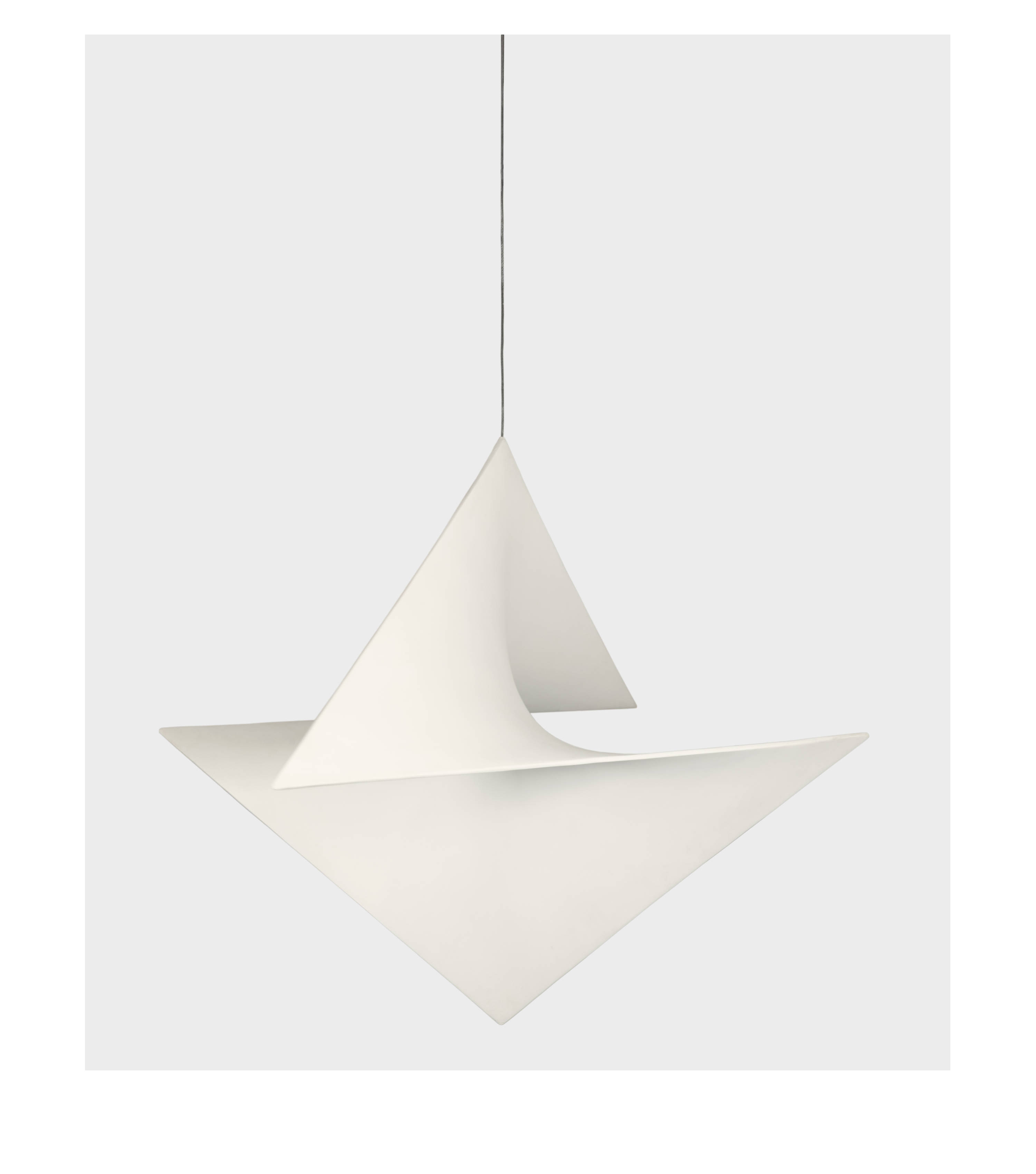
Iron and polyester, white painted
Ca. 110x140x80 cm
An authentication by the artist on the reverse of a photograph of the exhibition at the Kunsthaus Zurich, dated 1968, is available
Acquired at the Zurich exhibition by
Private collection Switzerland, by inheritance to
Private collection Germany
Zurich 1968, Kunsthaus, Wege und Experimente, possibly cat. no. 35 or no. 36, both with different measurements there
Hanging sculpture with signs of age, in good condition
Duarte created numerous modules from so-called hyperbolic paraboloids, to which the present work also belongs. These sculptures are often a kind of prototype with which he could test his theory. Duarte, a member of the artist group "Equipo 57", began working with paraboloids in 1958. His goal was to find a measurable geometric form that could spatially implement the principles of interactivity theory and suggest the spatial continuum: "We take into account […] a single space and a surface that distributes the action of this space. This surface is continuous in itself. Through its double concave-convex curvature, it directs the space in all directions. The active continuity of the space requires the elimination of flat surfaces or surfaces curved in only one direction, as these cannot interact with the space." (Text by Equipo 57; published in the catalogue for the exhibition at Club Urbis in Madrid, April 1959).
The hyperbolic paraboloids appear in Duarte's sculptures as surfaces with double opposing curvature. These are modules defined by simple, square or mostly triangular polygons. Due to the double curvature, they have a strong dynamic tension. They mark transitions between different spaces: full and empty, outside and inside (from: Anne Gaillard, Musées cantonaux Valais, Angel Duarte, sculpteur, plasticien et mathématicien, 2007).
Um 1965
Eisen und Polyester, weiss gefasst
Ca. 110x140x80 cm
Eine Authentifikation des Künstlers auf der Rückseite einer Photographie der Ausstellung im Kunsthaus Zürich, datiert 1968, liegt vor
In der Zürcher Ausstellung erworben von
Privatsammlung Schweiz, durch Erbschaft an
Privatsammlung Deutschland
Zürich 1968, Kunsthaus, Wege und Experimente, ev.
Hängeskulptur mit Altersspuren, in guter Erhaltung
Duarte realisierte zahlreiche Module aus sogenannten hyperbolischen Paraboloiden, zu denen auch das hier vorliegende Werk gehört. Bei diesen Plastiken handelt es sich oft um eine Art Prototypen, mit denen er seine Theorie testen konnte. Duarte, Mitglied der Künstlergruppe "Equipo 57", begann im Jahr 1958 mit Arbeiten im Bereich Paraboloide. Sein Ziel war es, eine messbare geometrische Form zu finden, die die Grundsätze der Interaktivitätstheorie räumlich umzusetzen und das räumliche Kontinuum anzudeuten vermochte: "Wir tragen […] einem einzigen Raum Rechnung und einer Fläche, welche die Aktion dieses Raums verteilt. Diese Fläche ist an sich kontinuierlich. Durch ihre doppelte, konkav-konvexe Krümmung lenkt sie den Raum in alle Richtungen. Die aktive Kontinuität des Raums setzt die Aufhebung der flachen oder nur in einer Richtung gekrümmten Fläche voraus, da diese nicht mit dem Raum interagieren können" (Text von Equipo 57; veröffentlicht im Katalog zur Ausstellung im Club Urbis in Madrid, April 1959).
Die hyperbolischen Paraboloide erscheinen in Duartes Plastiken als Flächen mit doppelter gegensinniger Krümmung. Es handelt sich um Module, die durch einfache, quadratische oder meist dreieckige Polygone definiert sind. Aufgrund der doppelten Krümmung weisen sie eine starke dynamische Spannung auf. Sie kennzeichnen Übergänge zwischen unterschiedlichen Räumen: voll und leer, aussen und innen (aus: Anne Gaillard, Musées cantonaux Valais, Angel Duarte, sculpteur, plasticien et mathématicien, 2007).
| Suisse | CHF | Offre individuelle |
| Europe | CHF | Offre individuelle |
| USA | CHF | Offre individuelle |
| Outre-mer | CHF | Offre individuelle |
Note : L'image ne peut pas être affichée pour des raisons légales. Pour plus d'informations, voir le PDF du catalogue : Lien vers le PDF