- FR


 S’inscrire
-
- Ventes Classiques
- Ventes passées
- Plus
- Acheter
- Vendre
- Plus
- Galerie
- Commerce d'art
- Maison d'Édition
- Kornfeld aujourd’hui
- L'histoire de la Maison
- Informations


Note : L'image ne peut pas être affichée pour des raisons légales. Pour plus d'informations, voir le PDF du catalogue : Lien vers le PDF


1893 Berlin 1959



1919
Watercolour over pen and ink drawing, on heavy wove paper
43.7x30.4 cm
Lower right signed and dated by the artist in ink 'Grosz 19', verso inscribed in pencil in the artist's hand 'Aquarell / Deutsches Lied und deutscher Wein / Grosz'
Confirmation of authenticity from Ralph Jentsch, dated 15 May 2025, is available. The work will be included in the catalogue raisonné currently in preparation
Artist's studio, Berlin, 1919
International Private Collection
The Eberhard W. Kornfeld Collection, Bern, with the collector's stamp on the back, Lugt 913b
Sabine Rewald, George Grosz in Berlin, The Relentless Eye, New York 2022, cat. no. 29
Bern 1989, Kunstmuseum, Von Goya bis Tinguely, Aquarelle und Zeichnungen aus einer Privatsammlung [The Eberhard W. Kornfeld Collection], cat. no. 151
London 1997, Royal Academy of Arts, The Berlin of George Grosz, cat. no. 76
Madrid 2003, Fundación Juan March, Espíritu de modernidad: de Goya a Giacometti, Obra sobre papel de la colección Kornfeld, cat. no. 56
Madrid 2005/2006, Fundación Colección Thyssen-Bornemisza, Mimesis, Modern Realism, cat. no. 65
Vienna 2008/2009, Albertina, Wege der Moderne, Aus der Sammlung Eberhard W. Kornfeld, cat. no. 87
Stuttgart 2022, Staatsgalerie, Glitzer und Gift der Zwanzigerjahre, George Grosz in Berlin
Sheet slightly foxed and with a slight light-struck area. On the reverse with remnants of an old museum mounting
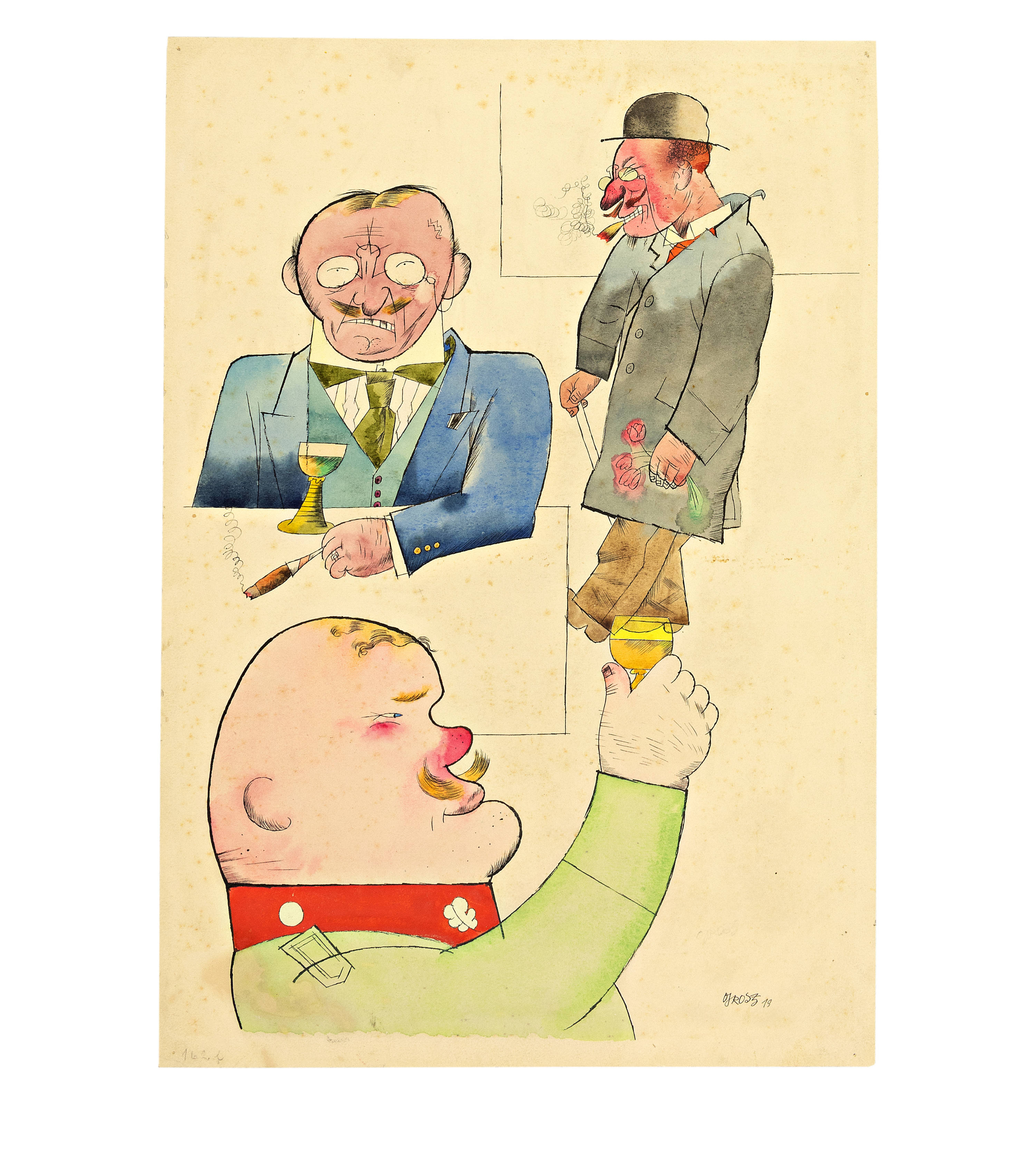
As the text on the reverse by the artist suggests, the title refers to the 'Deutschlandlied', which is also known as the 'Lied der Deutschen'. August Heinrich Hoffmann von Fallersleben composed it as early as 1841 on what was then the British Crown Colony of Helgoland. Based on Joseph Haydn's melody of the imperial anthem 'Gott erhalte Franz, den Kaiser', the song was for a long time just one of many songs of the national movement. It was only in the Weimar Republic that it was declared the official national anthem of Germany, although it had already gained greater significance during the First World War. For example, a battle report from November 1914, according to which soldiers had spontaneously sung the song during a trench skirmish, was exploited for propaganda purposes by the Supreme Army Command in the press. The second verse begins with the words 'Deutsche Frauen, deutsche Treue, deutscher Wein und deutscher Sang'. George Grosz takes this theme as an opportunity to draw a caricatured pub scene with three figures: in the foreground, one sees a uniformed bald man who appears to be toasting two men in civilian clothes in the background. As is well known, Grosz hated everything German. Is the officer toasting to the supposedly certain victory? Or to defeat? Sabine Rewald suspects that with the title, Grosz wanted to create 'a stark contrast between patriotic feelings and the three [...] repulsive figures depicted'.
1919
Aquarell über Federzeichnung in Tusche, auf festem Velin
43,7x30,4 cm
Unten rechts vom Künstler in Tusche signiert und datiert "Grosz 19", rückseitig in Bleistift eigenhändig bezeichnet "Aquarell / Deutsches Lied und deutscher Wein / Grosz"
Echtheitsbestätigung von Ralph Jentsch, datiert vom 15. Mai 2025, liegt vor. Die Arbeit wird in das in Vorbereitung befindliche Werkverzeichnis aufgenommen
Künstleratelier, Berlin, 1919
Internationaler Privatbesitz
Slg. Eberhard W. Kornfeld, Bern, rückseitig mit dem Sammlerstempel, Lugt 913b
Sabine Rewald, George Grosz in Berlin, The Relentless Eye, New York 2022,
Bern 1989, Kunstmuseum, Von Goya bis Tinguely, Aquarelle und Zeichnungen aus einer Privatsammlung [Slg. Eberhard W. Kornfeld],
London 1997, Royal Academy of Arts, The Berlin of George Grosz,
Madrid 2003, Fundación Juan March, Espíritu de modernidad: de Goya a Giacometti, Obra sobre papel de la colección Kornfeld,
Madrid 2005/2006, Fundación Colección Thyssen-Bornemisza, Mimesis, Modern Realism,
Wien 2008/2009, Albertina, Wege der Moderne, Aus der Sammlung Eberhard W. Kornfeld,
Stuttgart 2022, Staatsgalerie, Glitzer und Gift der Zwanzigerjahre, George Grosz in Berlin
Blatt leicht stockfleckig und mit leichtem Lichtrand. Rückseitig mit Resten einer alten Museumsmontierung
Wie der rückseitige Text des Künstlers bereits erahnen lässt, bezieht sich der Titel auf das "Deutschlandlied", das auch als "Lied der Deutschen" bekannt ist. August Heinrich Hoffmann von Fallersleben komponierte es bereits 1841 auf der damaligen britischen Kronkolonie Helgoland. Basierend auf Joseph Haydns Melodie der Kaiserhymne "Gott erhalte Franz, den Kaiser" war das Lied lange Zeit nur eines von zahlreichen Liedern der Nationalbewegung. Erst in der Weimarer Republik wurde es zur offiziellen Nationalhymne Deutschlands ernannt, doch bereits im Ersten Weltkrieg hatte es grössere Bedeutung erlangt. So wurde eine Gefechtsmeldung vom November 1914, laut der Soldaten das Lied bei einem Stellungsscharmützel spontan angestimmt hätten, von der Obersten Heeresleitung in der Presse propagandistisch ausgeschlachtet. Die zweite Strophe beginnt mit den Worten "Deutsche Frauen, deutsche Treue, deutscher Wein und deutscher Sang". George Grosz nimmt dieses Thema zum Anlass karikaturhaft eine Kneipenszene mit drei Gestalten zu zeichnen: Im Vordergrund sieht man einen uniformierten Glatzkopf, der zwei Männern in Zivil im Hintergrund zuzuprosten scheint. Bekanntlich hasste Grosz alles Deutsche. Prostet der Offizier auf den vermeintlich sicher geglaubten Sieg? Oder auf die Niederlage? Sabine Rewald vermutet, dass Grosz mit dem Titel "einen starken Kontrast zwischen patriotischen Gefühlen und den drei (...) dargestellten abstossenden Figuren" schaffen wollte.
| Suisse | CHF | 170 |
| Europe | CHF | 270 |
| USA | CHF | 360 |
| Outre-mer | CHF | 380 |
Note : L'image ne peut pas être affichée pour des raisons légales. Pour plus d'informations, voir le PDF du catalogue : Lien vers le PDF