- FR


 S’inscrire
-
- Ventes Classiques
- Ventes passées
- Plus
- Acheter
- Vendre
- Plus
- Galerie
- Commerce d'art
- Maison d'Édition
- Kornfeld aujourd’hui
- L'histoire de la Maison
- Informations


Note : L'image ne peut pas être affichée pour des raisons légales. Pour plus d'informations, voir le PDF du catalogue : Lien vers le PDF






Rosario de Santa Fé 1899 - 1968 Comabbio


1956
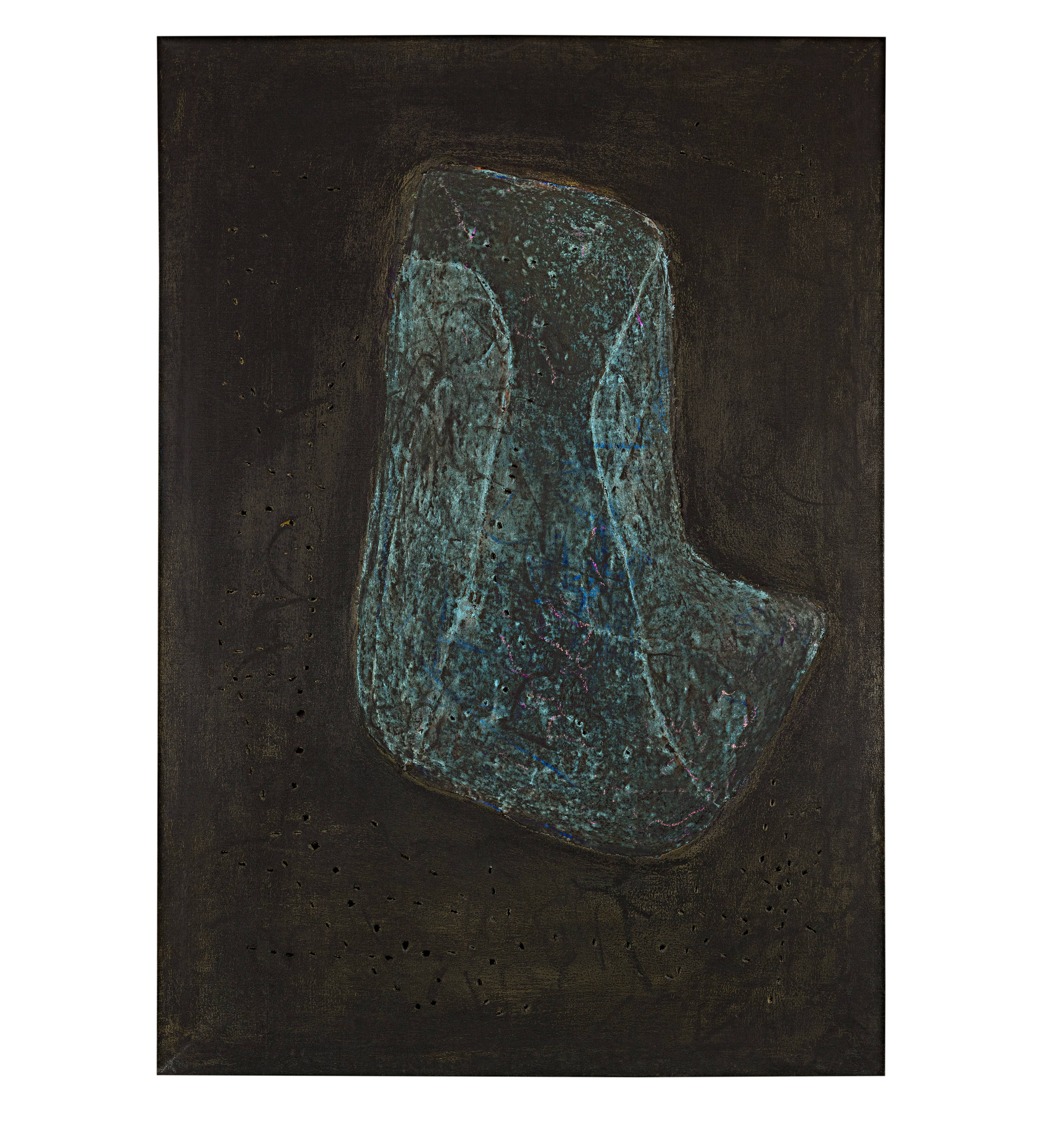
Oil, chalk, plaster, pastel and canvas collage on canvas
99.7x70 cm
Signed, titled and dated on the reverse by the artist "L. Fontana / Concetto spaziale / 1956"
Enrico Crispolti, Lucio Fontana, Catalogo ragionato di sculture, dipinti, ambientazioni, vol. II, Milan 1986, no. 56 G 14
Private collection, Perugia
Christie's auction, London, 30 June 1994, lot 23, acquired there by
International Private Collection
Enrico Crispolti, Lucio Fontana, Catalogue raisonné des peintures, sculptures et environnments spatiaux rédigés, vol. II, Brussels 1974, no. 56 G 14
Germano Celant, Lucio Fontana. Ambienti Spaziali, Milano 2012, pag. 228, no. 245
New York 2015, Helly Nahmad Gallery, The Wounded Canvas: Burri Fontana Manzoni Tàpies
Zurich 2002, de Pury & Luxembourg, Lucio Fontana, cat. no. 68
On the original stretcher, in the original nailing. Fresh in colour and in very good overall condition
With his "Manifesto bianco" published in 1946 and the manifestos of "Spazialismo" published in 1947, Fontana called for a departure from conventional materials in art. Art should no longer be static, but become dynamic. While at first it was picture supports perforated with holes that constituted his newly defined, spatial concept of art, from 1958 onwards a new dimension was added with the "tagli", the cuts in geometrically painted, later purely monochrome canvases.
In the 1950s, the artist took part in art exhibitions of international importance and constantly advanced his research in the field of painting. He constantly developed his language and in the middle of the decade created new pictorial concepts such as the series "Barocchi" (1954-1957) or "Gessi" (1954-1958), to the latter of which the painting offered here also belongs. It dates from the peak phase of his creative new creations. For the "Gessi" (plasters) he used chalk, plaster and pastels arranged in free forms on the almost monochrome surface of the canvas. Most of the time the canvases are perforated, often the irregular, free silhouettes are further clarified by collages of canvas on canvas, in the present case even on two levels. The works are characterised by a particularly "dramatic" colourfulness, they are rather sombre and heavy, whereby the amorphous forms are delicately yet clearly contrasted by chalk or pastel heightening. In this way they appear like floating structures; bodies that sound out the space. With the deliberately placed holes/violations in the canvas, a three-dimensional quality is achieved in addition to the canvas collage.
In the work offered here, the floating impression of the figure is particularly accentuated by the light-dark contrast. The painting can undoubtedly be counted among the most important and impressive works of the entire group
1956
Öl, Kreide, Gips, Pastell und Leinwandcollage auf Leinwand
99,7x70 cm
Auf der Rückseite vom Künstler signiert, betitelt und datiert "L. Fontana / Concetto spaziale / 1956"
Enrico Crispolti, Lucio Fontana, Catalogo ragionato di sculture, dipinti, ambientazioni, Bd. II, Mailand 1986,
Privatsammlung, Perugia
Auktion Christie's, London, 30. Juni 1994, Los 23, dort erworben von
Internationale Privatsammlung
Enrico Crispolti, Lucio Fontana, Catalogue raisonné des peintures, sculptures et environnments spatiaux rédigés, Bd. II, Brüssel 1974,
Germano Celant, Lucio Fontana. Ambienti Spaziali, Milano 2012, pag. 228,
New York 2015, Helly Nahmad Gallery, The Wounded Canvas: Burri Fontana Manzoni Tàpies
Zürich 2002, de Pury & Luxembourg, Lucio Fontana,
Auf dem originalen Chassis, in der originalen Nagelung. Farbfrisch und in sehr guter Gesamterhaltung
Mit seinem 1946 publizierten "Manifesto bianco" und den 1947 publizierten Manifesten des "Spazialismo" forderte Fontana die Abkehr von herkömmlichen Materialien in der Kunst. Die Kunst sollte nicht mehr statisch sein, sondern dynamisch werden. Waren es zuerst mit Löchern perforierte Bildträger, die sein neu definiertes, räumliches Kunstkonzept ausmachten, kam mit den "Tagli", den Schnitten in geometrisch bemalte, später rein monochrome Leinwände ab 1958 eine neue Dimension dazu
In den 1950er Jahren nimmt der Künstler an Kunstausstellungen von internationaler Bedeutung teil und treibt seine Forschungen auf dem Gebiet der Malerei stetig voran. Ständig entwickelt er seine Sprache weiter und schafft in der Mitte des Jahrzehnts neue Bildkonzepte wie die Serien "Barocchi" (1954-1957) oder "Gessi" (1954-1958), zu letzterer auch das hier angebotene Gemälde zählt. Es stammt aus der Hochphase seiner kreativen Neuschöpfungen. Für die "Gessi" (Gipse) verwendete er Kreide, Gips und Pastelle, die in freien Formen auf der fast monochromen Oberfläche der Leinwand angeordnet sind. Meistens sind die Leinwände mit Löchern versehen, oft werden die unregelmässigen, freien Silhouetten auch noch durch Collagen von Leinwand auf Leinwand verdeutlicht, im vorliegenden Fall sogar in zwei Ebenen. Die Werke zeichnen sich durch eine besonders "dramatische" Farbigkeit aus, sie sind eher düster und schwer gehalten, wobei sich die amorphen Formen durch Kreide- oder Pastellhöhungen fein und doch klar absetzen. Sie wirken so wie schwebende Gebilde; Körper, die den Raum ausloten. Mit den bewusst gesetzten Löchern/Verletzungen in der Leinwand wird zusätzlich zur Leiwandcollage eine dreidimensionale Qualität erreicht
Bei der hier angebotenen Arbeit wird der schwebende Eindruck der Figur durch den Hell-Dunkel-Kontrast noch ganz besonders akzentuiert. Das Gemälde darf zweifelsfrei zu den bedeutendsten und eindrücklichsten Werken der ganzen Gruppe gezählt werden
Note : L'image ne peut pas être affichée pour des raisons légales. Pour plus d'informations, voir le PDF du catalogue : Lien vers le PDF