- FR


 S’inscrire
-
- Ventes Classiques
- Ventes passées
- Plus
- Acheter
- Vendre
- Plus
- Galerie
- Commerce d'art
- Maison d'Édition
- Kornfeld aujourd’hui
- L'histoire de la Maison
- Informations


Note : L'image ne peut pas être affichée pour des raisons légales. Pour plus d'informations, voir le PDF du catalogue : Lien vers le PDF






Castleford 1898 - 1986 Much Hadham


1942/1946
Pencil, grease crayons, coloured crayons, watercolour, ballpoint and pen and ink
17,5x25,4 cm, image and sheet size
Signed by the artist in pen and ink "Moore / 42" at the bottom left, with the number "17" at the top right
Ann Garrould, Henry Moore, Complete Drawings 1940-49, Volume 3, London/Much Hadham 2001, AG 46.40, reversed ill.
The Henry Moore Foundation, Online Catalogue raisonné 2372, reversed ill.
Leicester Galleries, London, verso with label and no. 54
Howard Bliss, London
The Mayor Gallery, London, verso with label and no. 3335
Lefevre Gallery, London, verso with label
Thomas Gibson Fine Art, London, verso with label
Saidenberg Gallery, New York, verso with label, bought there by
Privatsammlung USA
London 1946, Leicester Galleries, Exhibition of Living Irish Art, New Sculpture and Drawings by Henry Moore, cat. no. 54
On strong watercolour paper, on the reverse side minimal traces of an old mounting. Freshly coloured and in impeccable condition
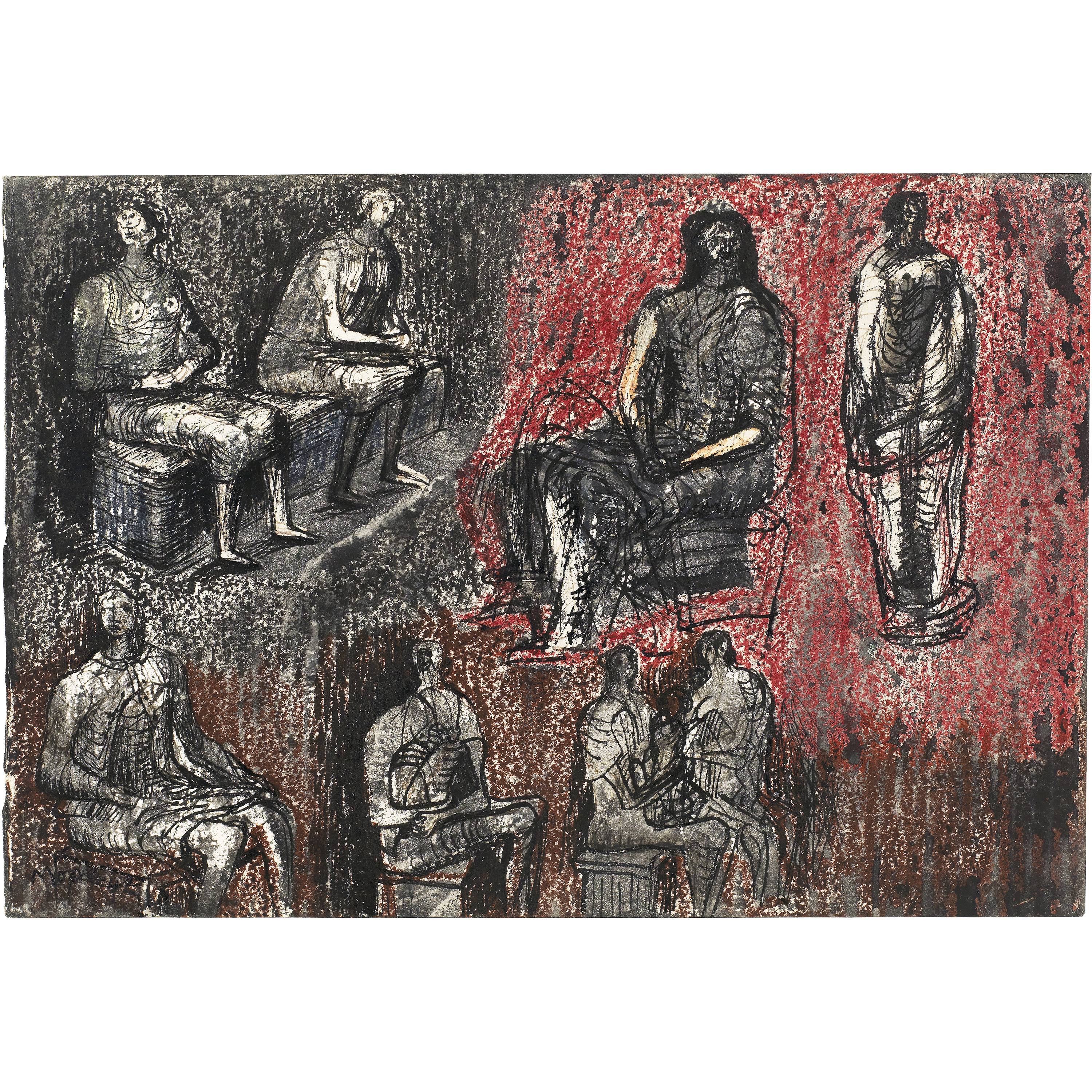
With the outbreak of the Second World War Moore gave up his position as head of the sculpture department at the Chelsea School of Art. He received commissions as a "War Artist" and mainly created powerful drawings of people seeking shelter in the underground stations during the bombing of London. These "Shelter Drawings" made Moore internationally known, especially in the USA, as they are considered metaphors for the stoic resistance of the British during the war. After his apartment in the London district of Hampstead was hit by a bomb, Moore and his wife Irina moved into a farmhouse called "Hoglands" in the small village of Perry Green, Hertfordshire. There their daughter Mary was born on 7 March 1946, which prompted the artist to take up the theme of "Mother and Child" again. The present sheet was first exhibited in the Leicester Galleries in London in 1946 - probably dated 1942 at the time. In Ann Garrould's catalogue raisonné, it is pointed out that it is page 17 of an unidentified sketchbook. No horizontally bound sketchbook is known before 1946, so that the dating 1942 is questioned. Nevertheless, the sheet exudes all the power of the earlier "Shelter Drawings", the anxiety of isolation and uncertain expectation. Moore masterfully immerses the drawing in an obscure light, accentuated with shades of red and ochre
1942/1946
Bleistift, Fettkreiden, farbige Kreiden, Aquarell, Kugelschreiber und Tusche
17,5x25,4 cm, Darstellung und Blattgrösse
Unten links vom Künstler in Tusche signiert "Moore / 42", oben rechts mit der Zahl "17"
Ann Garrould, Henry Moore, Complete Drawings 1940-49, Volume 3, London/Much Hadham 2001, AG 46.40, seitenverkehrt reprod.
The Henry Moore Foundation, Online Catalogue raisonné 2372, seitenverkehrt reprod.
Leicester Galleries, London, rückseitig mit Etikett und der Nummer 54
Howard Bliss, London
The Mayor Gallery, London, rückseitig mit Etikett und der Nummer 3335
Lefevre Gallery, London, rückseitig mit Etikett
Thomas Gibson Fine Art, London, rückseitig mit Etikett
Saidenberg Gallery, New York, rückseitig mit Etikett, von dort an
Privatsammlung USA
London 1946, Leicester Galleries, Exhibition of Living Irish Art, New Sculpture and Drawings by Henry Moore,
Auf festem Aquarellpapier, rückseitig minime Spuren einer alten Montage. Farbfrisch und in tadelloser Erhaltung
Mit dem Ausbruch des Zweiten Weltkriegs gab Moore seine Tätigkeit als Leiter des Bildhauerei-Bereichs an der Chelsea School of Art auf. Er erhielt Aufträge als "War Artist" und schuf vor allem kraftvolle Zeichnungen von Menschen, die während der Bombenangriffe auf London in den U-Bahn-Stationen Schutz suchten. Diese "Shelter-Drawings" machten Moore international bekannt, vor allem in den USA, gelten sie doch als Metaphern für den stoischen Widerstand der Engländer während des Krieges
Nachdem seine Wohnung im Londoner Stadtteil Hampstead von einer Bombe getroffen worden war, zogen Moore und seine Frau Irina in ein Bauernhaus namens "Hoglands" im kleinen Dorf Perry Green, Hertfordshire. Dort kam am 7. März 1946 ihre Tochter Mary zur Welt, was den Künstler bewog, wiederum das Thema "Mutter und Kind" aufzunehmen. Das vorliegende Blatt wurde 1946 ein erstes Mal in den Leicester Galleries in London ausgestellt - wohl damals vordatiert auf 1942. Im Werkverzeichnis von Ann Garrould wird darauf hingewiesen, dass es sich um Seite 17 eines nicht näher identifizierbaren Skizzenbuches handelt. Vor 1946 sei kein horizontal gebundenes Skizzenbuch bekannt, so dass die Datierung 1942 in Frage gestellt wird. Nichtsdestotrotz strahlt das Blatt die ganze Kraft der früheren "Shelter-Drawings" aus, die Beklemmung der Isolation und der ungewissen Erwartung. Meisterhaft taucht Moore die Zeichnung in ein obskures Licht, akzentuiert mit Rot- und Ockertönen
Note : L'image ne peut pas être affichée pour des raisons légales. Pour plus d'informations, voir le PDF du catalogue : Lien vers le PDF